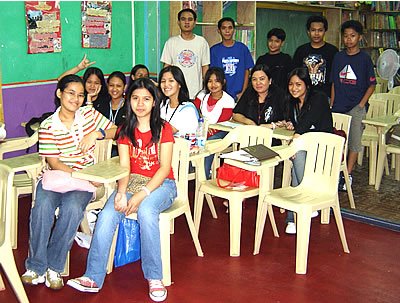
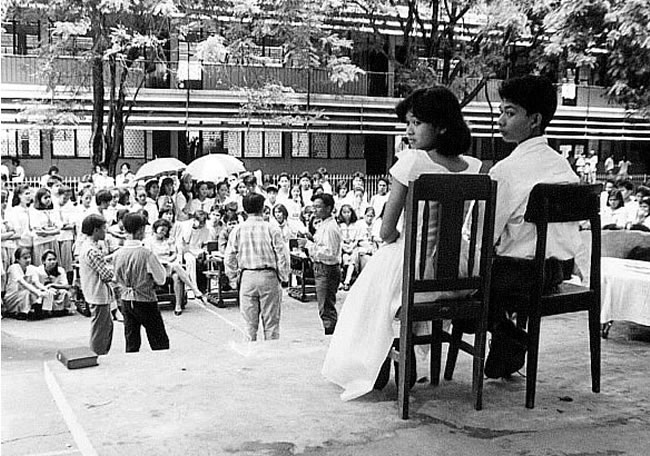
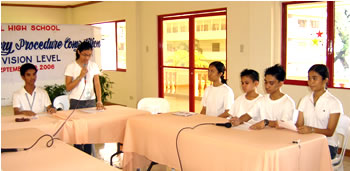
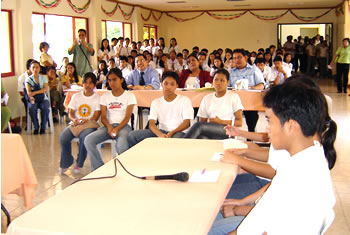
Parliamentary Procedures competition among Rizal High School Main, Sagad High School and Santolan High School
The competition judges were Atty. Cyrus Victor Tiamson, Dina Jacosalem (Administrative Officer, RHS Main), Elmer Martin (Head, Political Science Department, Rizal Technological University), and me (as usual, taking pictures of others!)
Order, waiter!
And the winner is ... RHS Main!
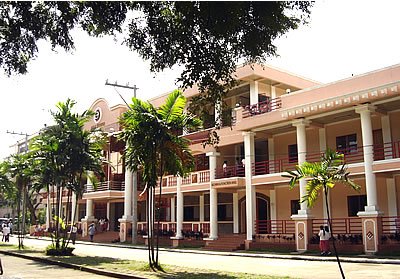
The former RTC building occupied by Rizal High School since the middle 1990s.
Some 6,344 law graduates (a record number) are taking the bar examinations on the four Sundays of September at the De La Salle University campus in Taft Avenue, Manila. Administered by the Supreme Court, the bar exam is the final hurdle for these graduates from some 100 law schools in the Philippines after some eight years of hard work and rigorous studies.
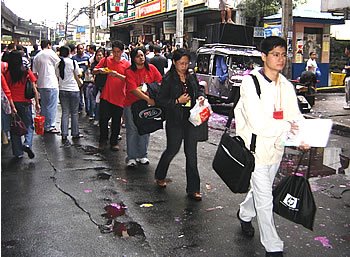
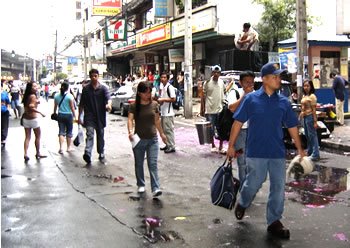
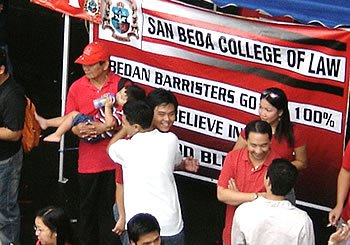
The annual bar exams are considered to be the most celebrated licensure exam in the Philippines. (Six or seven of our country’s presidents were lawyers, while a lot of our senators and congressmen, past and present, are lawyers.) The various law schools, academic organizations, fraternities and sororities conduct their “bar operations” in support of their graduates or members. They provide food, transportation, review materials and encouragement, in the midst of a fiesta atmosphere in front of DLSU. As early as 2 or 3 in the morning, these groups stake out their places setting up tents, tables and chairs, sound equipment, etc. As the examinees start coming in at around 5 AM, there’s also fireworks, street dancing, cheers and words of encouragement from anxious relatives, schoolmates and friends. The grandest celebration takes place at the end of the exams, which falls this year on September 24.
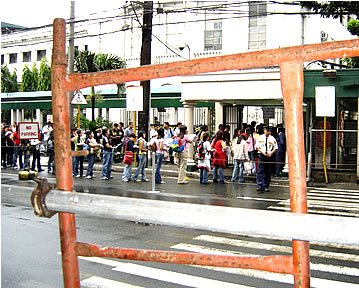
The area in front of DLSU, from Quirino Avenue to Vito Cruz, is closed to traffic from 4 AM up to 6 PM. Some 1,398 court personnel are overseeing the exams, with bomb disposal experts, police officers and medical teams providing assistance to the examinees and the crowd waiting outside DLSU.
Previously, a bar examinee who failed for three straight times was required to take a one-year refresher course in law schools. After the refresher course, he or she was allowed to take the bar exams again. Should he fail to pass the bar, he/she was again required to take the refresher course. Each retake, the examinee was required to pay higher fees. Since last year, however, the Supreme Court has implemented the “five strike rule” which means that a bar examinee is only allowed to take the bar exams a total of five times. Based on studies, most of the bar passers are first-timers, and the Supreme Court has decided that if a person doesn’t pass the bar even after five takes, he/she most probably won’t ever pass the bar. The fewer number of bar takers would then lighten the load on the bar examiners (lawyers selected by the Supreme Court to draft the questions and check the papers).
Anyone who wants to become a lawyer is required to first take a preparatory 4-year college course. This may be any course - Education, Engineering, Accounting, science courses, etc - as long as the required subjects are completed. My preparatory course was AB English (I am a Philippine Christian University graduate in the late 70’s), and I would advise any high school graduate thinking about becoming a lawyer to consider as a good preparatory course the following: Journalism, Economics, Accounting, and Legal Management.
Then the college graduate takes the 4-year Bachelor of Laws in any recognized school (the “LlB” stands for “Lleyes Baccalaureate”). In most law schools, except for the premier schools like UP, Ateneo and San Beda, majority of the students are working students and classes are usually scheduled on evenings. I’m a proud graduate of Jose Rizal College (now known as Jose Rizal University) and I also experienced the hardships and travails of working in the daytime and going to law school at night.
After graduating from law school, he/she now takes the six-month review course.
To this year’s bar examinees, I will say just one thing about the bar exams:
Some 100 students from Caniogan Elementary School, Maybunga Elementary School, De Castro Elementary School and San Miguel Elementary School attended the two-day conference featuring resource talks and competitions in various aspects of journalism. I gave the OHP lecture on photojournalism and then selected the winning entries. Congratulations to all the winners and the participants!
Some 15 students from the grade and high school departments attended the three-hour seminar I gave last Saturday. The lecture-seminar, coordinated by Ms. Imelda Ferrer, is part of the school's preparation for the Division Press Conference. Thanks to the students for their interest and enthusiasm and for bearing with my corny jokes and stories!
The essence of portraiture is to capture or express an individual’s personality, to show something about the person’s life or work. As such, portrait photography need not be confined within the studio; it encompasses all kinds of ways of portraying people (like the so-called “environmental portrait” which we’ll discuss below).
Furthermore, portraits can be close-ups, full shots (from head to foot) or long shots (the individual shown in relation to his or her environment).To do portrait photography on a limited, shoestring budget, we have to consider three things: the lens to use, the light source, and the physical setting.
Free articles and cheat sheets from Tech Radar (Digital Camera World):
You can use your standard 50 mm lens for portraits; maintain a distance of about 5 feet or more for a head and shoulders shot.
If you’re using a zoom or telephoto lens, take note of your minimum focusing distance.
The so-called “portrait lens” has a focal length of 85 or 90 mm.
Avoid using a wide angle lens for close-up portraits. Why? The lens will cause distortions and exaggerations of the nose, the forehead, etc. For environmental portraits however, you can use a wide angle lens.
What about digital cameras? Point and shoot digital camera models oftentimes have zoom lenses with a wide angle to telephoto range. Use the camera's wide angle setting for environmental portraits and the telephoto setting for head and shoulders portraits.
Light sources for portraits
Your light source can be your camera flash, ordinary room lights, or sunlight through windows or doors.
On-camera flash (that is, flash placed in what is known as your SLR camera’s hot shoe), however, gives a frontally lit portrait with harsh shadows in the background. Solution? Shoot from a high angle so that the shadows would be hidden behind your subject (we will be taking up flash photography later on).
Be careful if you’re using flash as your light source for portraits. Some people, react instinctively to flash by closing their eyes. Solution? Shoot a lot of pictures, so you’ll have a lot of pictures of your subject with eyes closed ... just kidding! What usually happens after the second or third burst of your flash is that the subject becomes used to the flash.
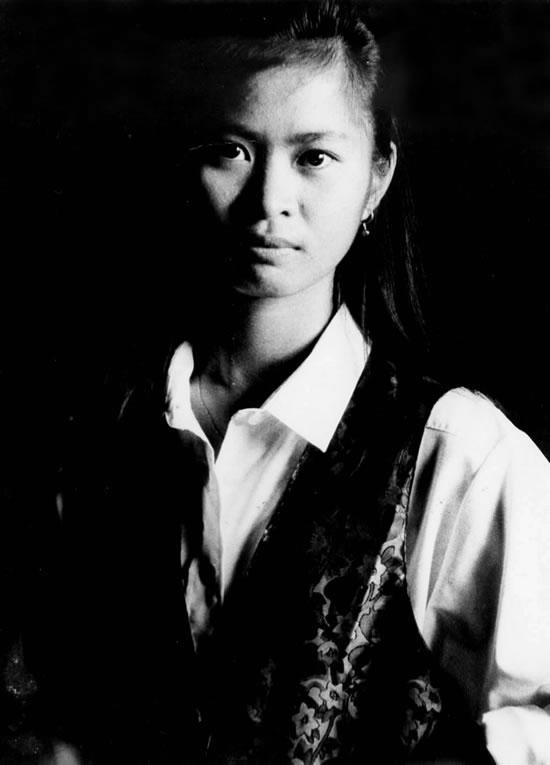
Since we’re doing portraits on a shoestring budget, the light source need not be expensive, elaborate studio lights with umbrellas, reflectors, etc. In the picture above, my yearbook staffers and I had covered up all the windows of an abandoned room with newspapers, thus plunging the whole room into darkness, except for the light coming from the slightly open door.
The physical setting for portraits
In “environmental portraits,” we use the person’s natural, normal surroundings as the setting, instead of a studio. These could be any place where the setting could possibly say something about the person’s character.
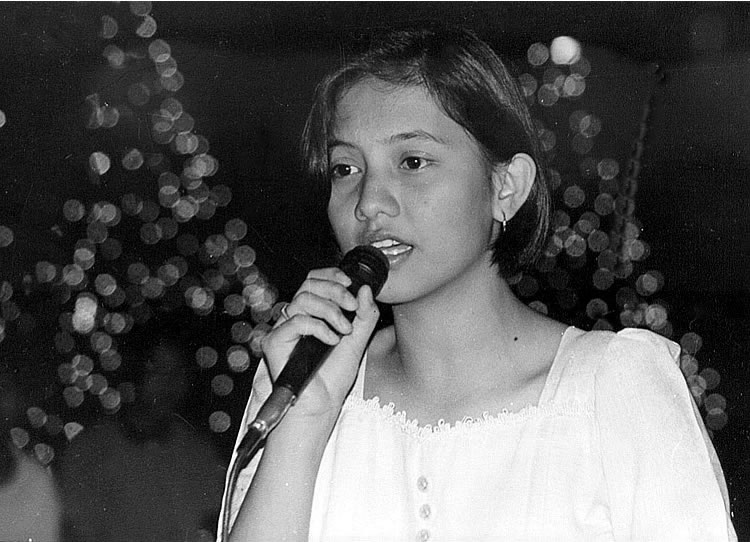
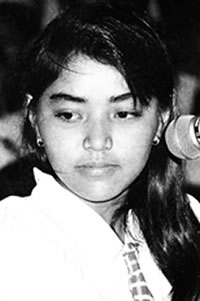
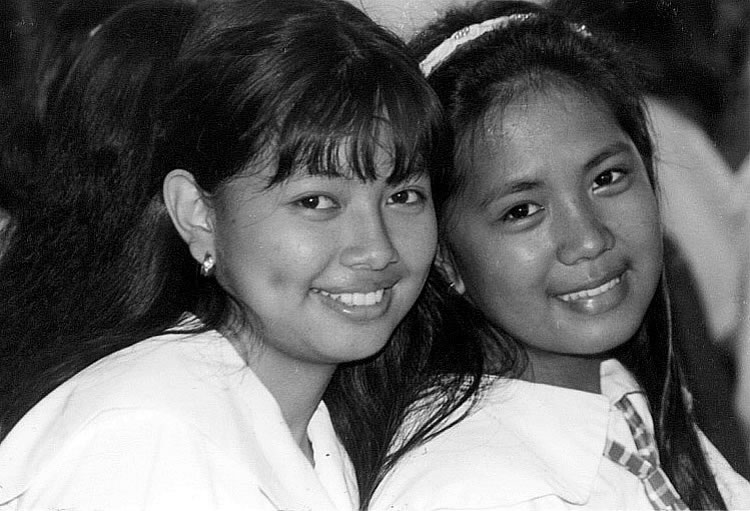
The girl in the very first picture of this post was a very talented singer in our school a decade ago. Naturally, I wanted to show that aspect of her personality. I wanted a head and shoulders portrait, but decided that a horizontal format would be better than the usual vertical format for portraits. I also framed her between the Christmas trees. Since I had used my Vivitar 28-210 mm zoom lens set at its telephoto end and had shot her at about ten feet away, the lights became gorgeous looking, out of focus highlights. Looking back now, I really wish I had used color film to take this picture!
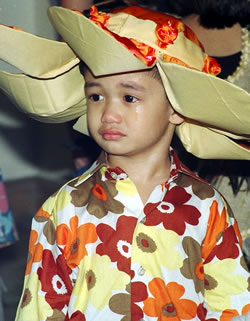
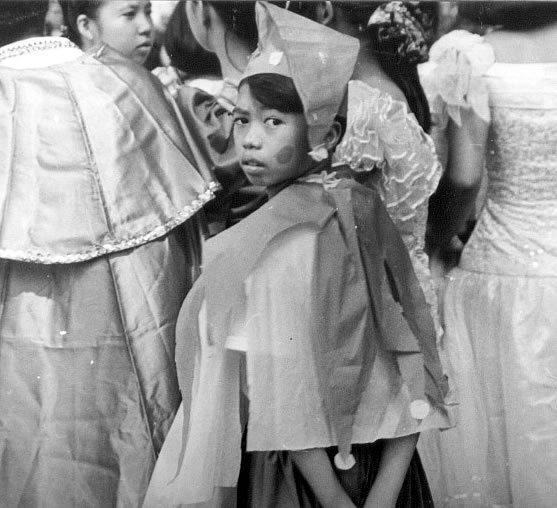
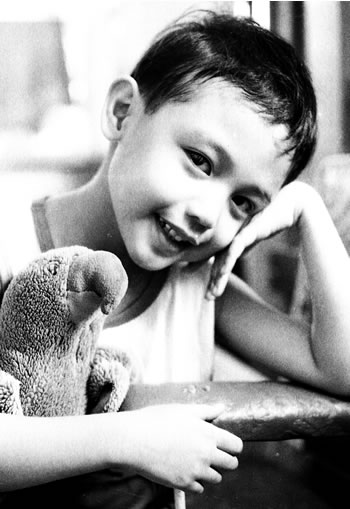
The pictures above (in full color!) are another example of environmental portraits. It’s a portrait of my nephew Gino in his natural environment – with his dolls and toys, and with a flower hat during a school presentation in Greenhills Christian Fellowship. Gino is cute because he looks like me. Hey, what can I say? Cuteness is in our genes!
Horizontal or vertical formats for portraits
Remember our lesson on formats? We usually shoot vertically when doing portraits. If you can’t decide however whether a vertical or horizontal format would be better, shoot your subject in both formats. Or, you can shoot a horizontal portrait like that of Rachelle in the first picture below. Later on, you can crop the image to come up with a vertical format portrait as in the next picture below.
What if you want to shoot somebody’s portrait but you’re in the wrong location, you don’t have the right viewpoint as when your subject’s back is turned towards you as in the two pictures below? What do you do? Call out your subject’s name to get his or her attention. When your subject turns towards you, take the picture. For example, you can say, “Hey, Angel! Kahit isang sulyap lang, Darna!”
Practical suggestions in shooting portraits
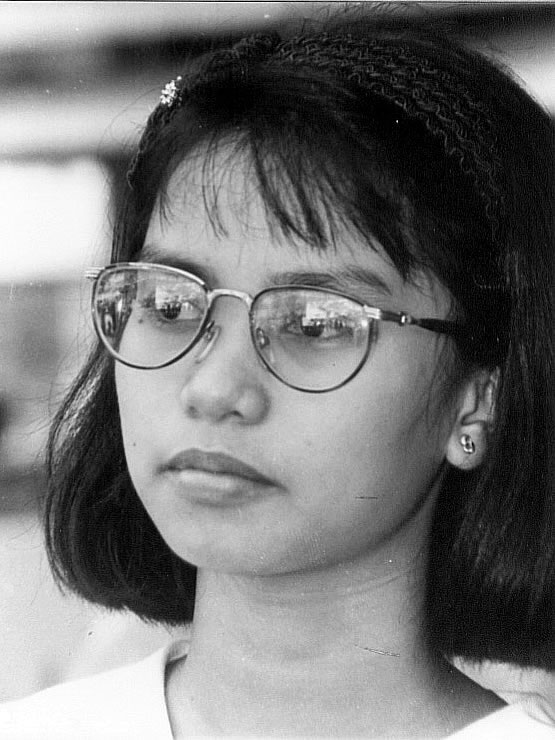
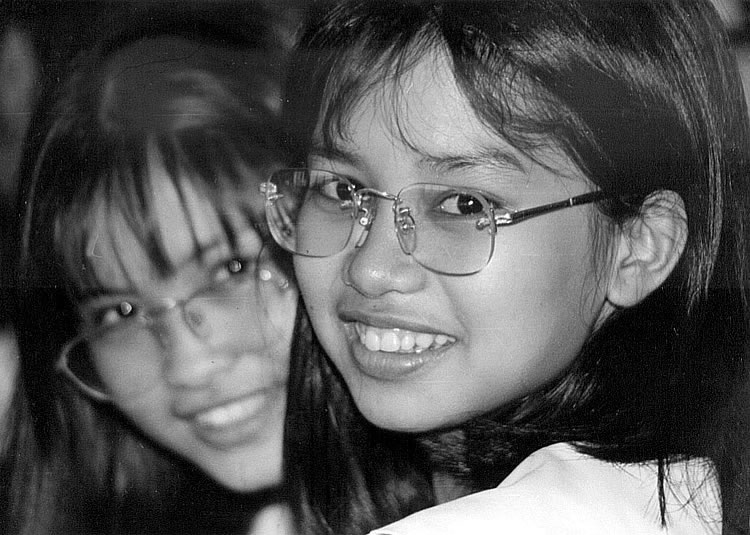
(1) When you’re shooting pictures of someone wearing glasses, focus on the eyes, not on the eyeglasses. Also, ask your subject to pull his/her chin a little bit downward so that the eyeglasses won’t have unwanted reflections, as in the picture above.
(2) Always play up your subject’s best features. The girl on the left in the picture below has very cute, very pronounced dimples, and so I took her picture from the side.
(3) Remember the picture below of my nephew JR? He’s cute, right? That’s because he looks like me! If you draw a diagonal line from the lower left hand corner up to the upper right hand corner, you’ll notice that the stuffed toy, JR’s eyes, nose and forehead all lie along that line. This line is known as the “picture diagonal,” and you should always strive to place the important elements of your photograph along this line. The picture diagonal, of course. may also extend from the lower right hand corner up to the upper left hand corner. (Please review the discussion on composition, specifically the topic on dynamic symmetry.)
Portraits need not be of a single person only; there’s such a thing as group portrait, okay? You can liven up a portrait through the appropriate props.
(4) Use foreground and background blur
A blurred background or foreground is ideal for portraits since you would be “erasing” any distracting element, as in the two pictures below. Please review our lesson in foreground and background, ok?) If you are using however a point and shoot camera (whether film-based or digital) with a fixed focus lens, you cannot achieve this effect. You've got to use an SLR camera (whether film-based or digital) with a manual focus lens or with an autofocus lens that can be locked at a certain point or area of your image.
9 Photo Composition Tips (featuring Steve McCurry, 2002 Photographer of the Year, American Photo Magazine); Tip No. 7: Place the dominant eye in the center of the photo
Band-Maid is an all-female Japanese band (formed in 2013) that’s considered as one of the best rock bands in the world today. The band combines genres such as rock (hard, progressive, punk), metal, pop, blues, and jazz. Examples of their rock-jazz-blues songs are “Manners,”“Wonderland,” and “Bubble.” For the band’s softer side, listen to “About Us” and to acoustic songs “Puzzle,”“Anemone,”“Smile,” and “Catharsis.”
“Dice” and “Hate?” at Lollapalooza 2023
“Don’t You Tell Me” fan cam video (lead guitar vs. bass from 2:21 to 3:41); watch official MV.
Band-Maid’s B-sides are also excellent; for example, “Hide and Seek” (fan cam video; listen to the bass and lead guitar).
Do you love great basslines? Listen to “Yuragu” where the great bassline leads to an explosive lead guitar solo (2:19 and 3:06 marks in the fan cam video below; 3:03 and 5:27 in the reaction video, with the lead guitar solo at 5:39 mark).
Free seminars on photojournalism, journalism, science/technology writing, and English proficiency
For Metro Manila and Rizal Province schools only; for more information, contact me at gtgalacio@yahoo.com or 0927-798-3138.
Photojournalism (23): Composition: Decide first what theme, emotion, idea or concept you want to convey; Think about the best way to shoot your subjects before actually doing so; Every good picture has a hidden geometric pattern; Other ways of composing your shots: Visual balance; Place vertical elements against horizontal elements, or vice-versa; Contrast one object in sharp focus with another object that is out of focus; Using linear perspective; Balance by tone; Using the picture diagonal; Breaking the rules to get better photographs; Each subject presents unique possibilities; Ways to improve your composition skills
Have regular hours for work and play; make each day both useful and pleasant, and prove that you understand the worth of time by employing it well. Then youth will be delightful, old age will bring few regrets, and life will become a beautiful success.
Louisa May Alcott (1832-1888)
Marital infidelity: causes, consequences and conclusions; Mediation not allowed in domestic violence cases (with apologies to Pia Guanio); Why Marriages Fail: He said, She said; Transformers: Why do persistent suitors become passive husbands? How to save your marriage alone; All about women; Why do men think the things they think, say the things they say, and do the things they do? Surviving marital infidelity; Legal lessong from Willie Revillame and Liz Amoro; Marriage: The Ultimate Fighting Championship; Boundaries in marriage; and other articles
Amy Perez case: psychological incapacity in declaring a marriage null and void; Adultery, concubinage and psychological violence; Can a mother be deprived of custody of her child? Can an unwed mother avail of the benefits of the Solo Parents Welfare Act? Divorce obtained abroad by a Filipino not recognized here; How to disinherit your spouse; Support for abandoned woman and family; The "Battered Woman Syndrome" as defense; The right of a divorced Filipino spouse to remarry under Article 26 of the Family Code; What happens in an annulment case if the respondent fails to file an Answer? RA 9262 Anti-Violence Against Women and their Children Act of 2004; and other articles


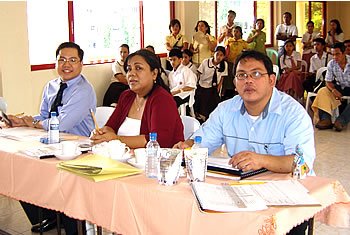 The competition judges were Atty. Cyrus Victor Tiamson, Dina Jacosalem (Administrative Officer, RHS Main), Elmer Martin (Head, Political Science Department, Rizal Technological University), and me (as usual, taking pictures of others!)

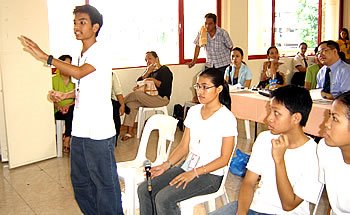 Order, waiter!
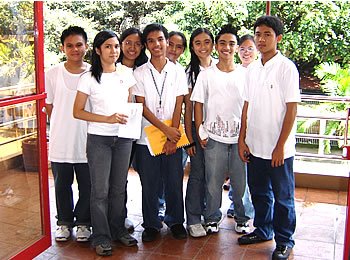
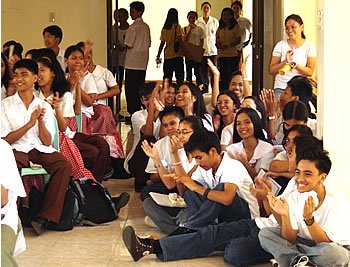 And the winner is ... RHS Main!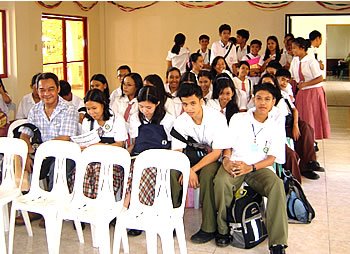
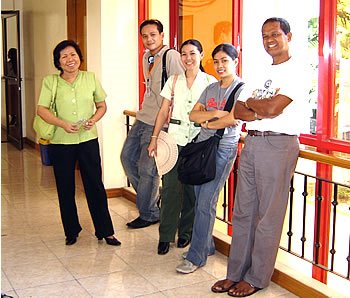

 The former RTC building occupied by Rizal High School since the middle 1990s.
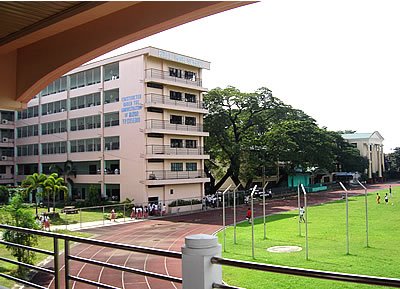 The new RHS Main Building