Thursday, October 25, 2007

Photojournalism (33): Photo essays using the chronological approach

Update as of September 18, 2023:

If you’re a high school or grade school student in the Philippines who’s joining the photojournalism contest in the division, regional, or national press conference, I’m offering two free resources to you :

A. 900-plus interactive exercises on English grammar, vocabulary, reading comprehension, verbal analogy, etc (with around 200 megabytes total file size). The exercises have time limit and automatic scoring, with an average of 10 items per exercise.

Examples of these interactive exercises are: Common English grammar errors: Exercise 01 (nouns - confusions of number); Phrasal Verbs: Expressions with Go; English Placement Test (45 items).

B. 200-plus resources (JPG, PDF, MP4, etc.) on photography and photojournalism, with 600-plus megabytes total file size. For some examples of these resources, surf to the “Free photography e-books, cheat sheets” page.

For the download links and more information about how to use the interactive exercises, please surf to my “Better English resources and exercises” blog. Please inform your journalism teacher/schoolpaper adviser or your parents about these resources before downloading them.

If you have any question about downloading or using these free resources, please email me (after informing your journalism teacher/schoolpaper adviser or your parents). I’ll be able to reply to you within two to three days; if you don’t see my reply in your Inbox, check your Spam folder. Or, you can text me.

Also, if you win in the photojournalism contest at whatever level (district, division, regional, or national), you can send me your prizewinning pictures, and I will feature them in a blog post.

Atty. Gerry T. Galacio
gtgalacio@yahoo.com
0927-798-3138


Examples of photo essays:

Trouble Shared (Brenda Ann Kennelly/ New York Times/Lens); A Country Doctor (W. Eugene Smith/Magnum for Life); A Young Father’s Balancing Act (Benjamin Norman/The New York Times); New York City Coffeehouse (Dima Gavrysh/Lens); Where Beauty Softens Your Grief (Gianni Cipriano/ICP); Gun Nation (Zed Nelson); What the World Eats (Time); Last Supper (2004; Celia A. Shapiro/Mother Jones); The Bitter Sweet Pill – GMB Akash; Happy Horsemeat (Alex Soth)

Unusual photo essays:

February Assignment: Photographing Pictures in Reflection; Magic in the Nearly Forgotten Mailbox; Andrew Moore Detroit; Superheroes – Dulce Pinzon; A Photo Fright Most Viral; Jump Book – Phillippe Halsman

Relevant article: “Week Five_The Photo Essay” from CUNY Graduate School of Journalism (topics include kinds of shots like signature shot, process, interaction, clincher, etc., and how to structure your narrative)

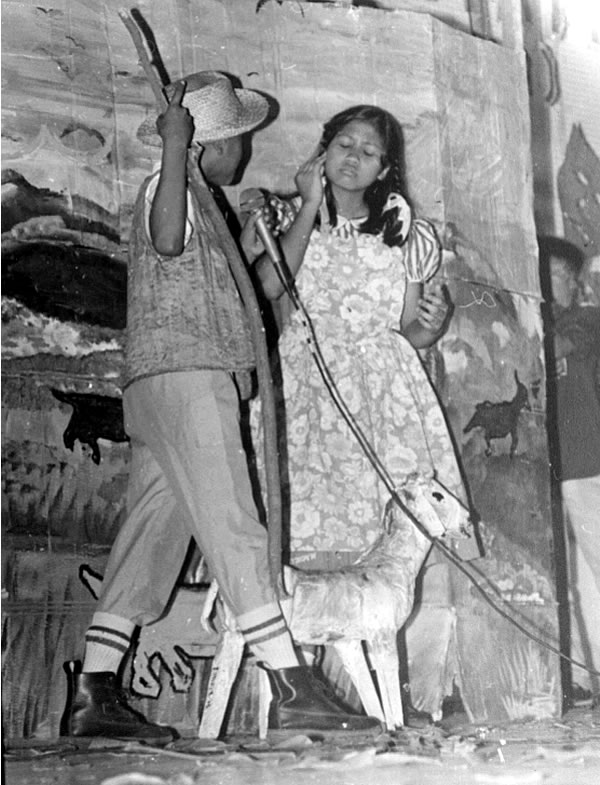
In using the chronological approach, you follow as events unfold before you, and you shoot your subject over a period of time. A simple example of a photo essay is that of the two pictures below where a little lamb makes friends with the freshmen and then finally gets the limelight as it performs on stage. Baa! Baa!

In the photo essay below, I shot a high school student writing the names of his friends on the hollow blocks. (Please take note of the bust of Dr. Jose Rizal on the background of the first picture.) He was only using a piece of chalk, and so I didn’t scold him. He didn’t see me shooting him while he was writing on the hollow blocks. Later on, after he left, I got a medium shot of the letters he wrote on the blocks. As a final shot, using the vertical format, I shot the letters on the blocks, with a group of students walking away on the background.
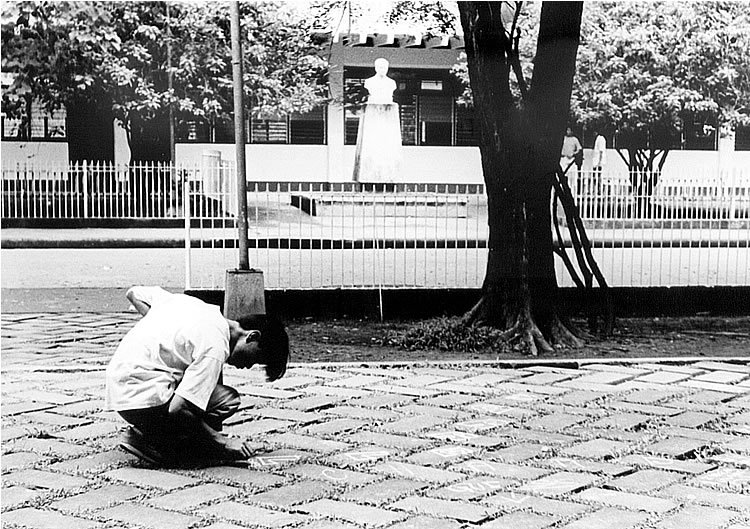

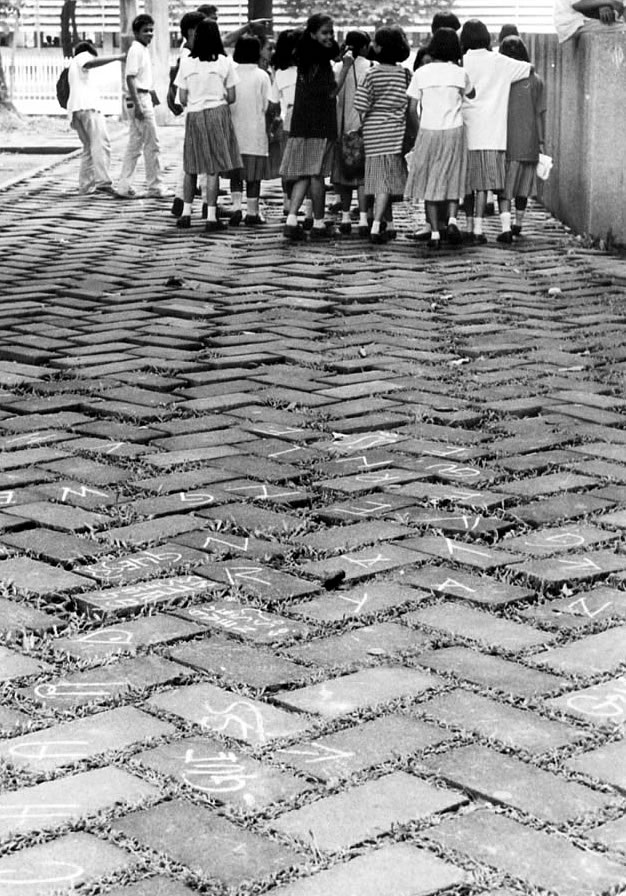

Sequence shots can be a chronological photo essay

In the pictures below, I asked my Class 1990 yearbook staffer Eric to pose by the dike at the back of Rizal High School in Pasig. I was on the 3rd floor of a building with my beloved Canon AE-1 Program camera fitted with a Vivitar Series 1 70-210 mm lens. (Believe it or not, I bought this 2nd hand zoom lens in a barbershop in Blumentritt, Manila.)  

I wanted to express the contemplative mood and loneliness a senior normally goes through as graduation time comes near. I just wanted two elements in my picture - Eric and the still waters of the Marikina River flowing behind the Rizal High School campus in Pasig. The first two pictures of the scene below were the ones I needed to express what I wanted.

But then, I saw the tugboat coming from the left. I switched on the power winder of my camera. I shot about 20 frames all in all as the tugboat passed Eric and created ripples on the water. Serendipity! I had a photo essay which could be used to illustrate life cycles, transient moments, peace and serenity, consequences and change!
 
(If you mouse over the pictures, the captions will appear for about five seconds. If you continue to move your mouse over the picture, the caption will stay visible.)

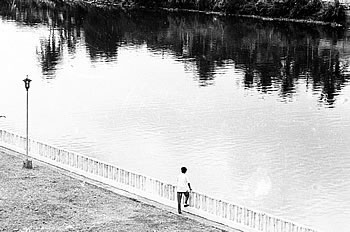
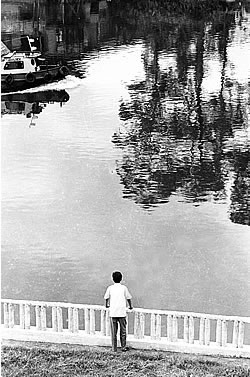
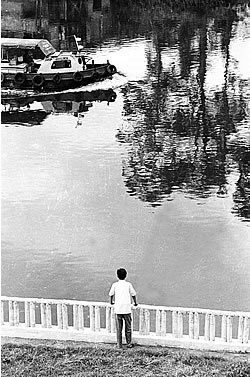
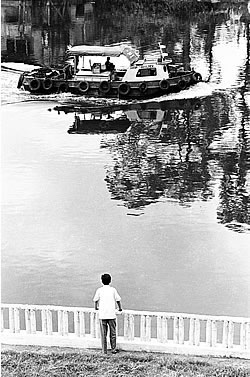

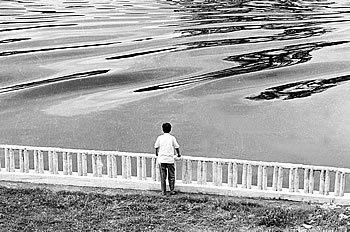


Pssst, Eric! It has been sixteen years since 1990 when I asked you to pose by the dike. You can move away from the dike now, and go on with your life, okay?

Thursday, October 18, 2007

Apollo Moon Documentary Bears Witness
for a Creator


By Mark Ellis, Senior Correspondent, ASSIST News Service

LONDON (ANS) -- A film documenting the Apollo moon project using rare footage from NASA contains numerous spiritual references pointing to the existence of God.

“In the Shadow of the Moon” opened September 7th to positive reviews, including a “Critic’s Choice” designation by the L.A. Times and an award at the 2007 Sundance Film Festival.

“It’s a film about the experience of going to the moon told by the people who went – in their own words,” says David Sington, who directed the film. One of Sington’s associates got acquainted with Dave Scott, commander of Apollo 15 and the first man to drive on the moon. “They wanted to organize a reunion of moonwalkers,” Sington says. “That grew into an idea of doing a reunion on film.”

Producer Duncan Copp proposed the idea of a documentary to Sington, who said it took him only 15 milliseconds to decide on the project.

With astronaut Scott’s help, the film team managed to assemble crewmembers from every Apollo mission that flew to the moon and interview them directly on camera. The 10 astronauts – now in their seventies – come across as surprisingly reflective and human. Many spoke of the profound impression they gained from walking on the lunar surface and gazing back at a marble-sized planet Earth.

Film director SingtonIn addition to the interviews, producers Duncan Copp and Chris Riley spent weeks at NASA’s film library in Houston pouring through cans of film – many of which had not be opened for 30 years. They uncovered a veritable treasure trove, which the filmmakers re-mastered to produce a film of striking visual clarity.

Apollo 16 astronaut Charlie Duke, the 10th man to walk on the moon, makes an explicit declaration of his faith in Jesus Christ on camera. His spiritual revelation came after his retirement from the space program in the mid-seventies. Mounting pressures in business and his personal life caused Duke to grapple with life’s ultimate questions. In 1978, after he attended a Bible Study about Middle East prophecy, Duke realized Jesus “really is the Son of God.”

Astronauts Edgar Mitchell and Gene Cernan described profound spiritual experiences, but not within a specific Christian context. Cernan discovered the universe seemed to have purpose behind it, that there must be a Creator who stands above the religions of mankind.

Earth crescent from the moon“Edgar Mitchell’s experience profoundly changed and shaped his whole life,” notes director Sington. “He had a moment of epiphany – suddenly grasping who he is in relation to the universe. This was accompanied by a sense of ecstasy, almost like people who have had visions of the Virgin Mary.”

“He’s striving to understand his spiritual epiphany in scientific terms,” Sington adds. “He’s dedicated his life to understanding human sub consciousness and to finding the ‘Great Mind’ of the universe.”

Unfortunately, the man who had the closest encounter with Jesus Christ on the moon does not appear in the film. “Sadly enough, the person who had the most profound spiritual experience was Jim Irwin, who died,” says Sington. “He really had a ‘road to Damascus’ experience on the moon.” Irwin died in 1991 from a heart attack.

Astronaut Cernan saluting the flagIn Irwin’s book, “To Rule the Night,”he described his view of Earth from the moon, which looked like “a beautiful, fragile Christmas tree ornament hanging against the blackness of space.” The beauty of the mountains of the moon moved Irwin, and he said he felt the presence of God during his moonwalk. “The moon has a powerful force; it seems to affect the feelings and the behavior of everybody. I cannot imagine a holier place,” he wrote.

Some would consider the trip to the moon as one of man’s greatest accomplishments, but Irwin had a different perspective. Afterward, he frequently said, “I believe Jesus Christ walking on the earth is more important than man walking on the moon.”

Irwin retired from NASA in 1972 and founded High Flight, a Christian ministry. He traveled frequently and spoke to groups about the ways his experiences in space increased his awareness of the presence of God.

“My view is that all of them were profoundly affected by the experience of leaving the Earth and seeing the Earth in its true context,” Sington says. “The photographs they took were a revelation to everybody that helped shape the way we think of ourselves on the Earth,” he notes.

Some might consider the awareness gained by the men who walked on the moon as the ultimate mountaintop experience. “They had the experience firsthand, which is a different order of experience.”

Many of the astronauts saw the universe as fundamentally sterile, a seemingly endless dead expanse. By contrast, Earth appeared to be a very special oasis -- almost Edenic, and yet fragile. For some, this increased their environmental awareness, as well as a sense of gratitude about living on planet Earth. “They feel life in a slightly stronger way than the rest of us,” Sington observes.

Apollo 11 astronaut Mike Collins, the most affable of the astronauts to appear on camera, described a moment of exaltation in his orbiter as he realized he was alive in a place where there was no other life.

One of director Sington’s disappointments was his inability to persuade Neil Armstrong to abandon his notoriously reclusive nature and appear in the film. “I think I understand why he doesn’t want to talk about being on the moon,” Sington says. “He sees himself as a messenger, not the message, a representative of all of us. He takes that very seriously.”

Sington came away from the film more inclined to accept a spiritual dimension to life. It also made him a bit more optimistic about the future, based on the Apollo project’s demonstration that human societies – particularly democracies -- are capable of large-scale collective efforts apart from waging war.

“In some sense perceiving reality is spirituality,” Sington concludes. “Religion and Christianity says we’re missing what’s really important,” he says. “When you see things as they really are you get a more profound spiritual sense.”

“In the Shadow of the Moon” is rated PG for mild language, brief violent images, and incidental smoking.

[ASSIST News Service, PO Box 609, Lake Forest, CA 92609-0609 USA; Visit ANS website at: http://www.assistnews.net/ -- E-mail: assistnews@aol.com]

P.S. You might also want to play this Flash movie "God of Wonders" by Tim Gibson. My personal preference is still the traditional hymns but Gibson's movie is quite appropriate after you have read Mark Ellis' article posted above.


Photojournalism (32): Photo essays and themes

Update as of September 18, 2023:

If you’re a high school or grade school student in the Philippines who’s joining the photojournalism contest in the division, regional, or national press conference, I’m offering two free resources to you :

A. 900-plus interactive exercises on English grammar, vocabulary, reading comprehension, verbal analogy, etc (with around 200 megabytes total file size). The exercises have time limit and automatic scoring, with an average of 10 items per exercise.

Examples of these interactive exercises are: Common English grammar errors: Exercise 01 (nouns - confusions of number); Phrasal Verbs: Expressions with Go; English Placement Test (45 items).

B. 200-plus resources (JPG, PDF, MP4, etc.) on photography and photojournalism, with 600-plus megabytes total file size. For some examples of these resources, surf to the “Free photography e-books, cheat sheets” page.

For the download links and more information about how to use the interactive exercises, please surf to my “Better English resources and exercises” blog. Please inform your journalism teacher/schoolpaper adviser or your parents about these resources before downloading them.

If you have any question about downloading or using these free resources, please email me (after informing your journalism teacher/schoolpaper adviser or your parents). I’ll be able to reply to you within two to three days; if you don’t see my reply in your Inbox, check your Spam folder. Or, you can text me.

Also, if you win in the photojournalism contest at whatever level (district, division, regional, or national), you can send me your prizewinning pictures, and I will feature them in a blog post.

Atty. Gerry T. Galacio
gtgalacio@yahoo.com
0927-798-3138


Examples of photo essays:

Trouble Shared (Brenda Ann Kennelly/ New York Times/Lens); A Country Doctor (W. Eugene Smith/Magnum for Life); A Young Father’s Balancing Act (Benjamin Norman/The New York Times); New York City Coffeehouse (Dima Gavrysh/Lens); Where Beauty Softens Your Grief (Gianni Cipriano/ICP); Gun Nation (Zed Nelson); What the World Eats (Time); Last Supper (2004; Celia A. Shapiro/Mother Jones); The Bitter Sweet Pill – GMB Akash; Happy Horsemeat (Alex Soth)

Unusual photo essays:

February Assignment: Photographing Pictures in Reflection; Magic in the Nearly Forgotten Mailbox; Andrew Moore Detroit; Dulce Pinzon (The real story of the Superheroes; A Photo Fright Most Viral; Jump Book – Phillippe Halsman
One way of teaching yourself to be more selective in your shots is to do a photo essay. Unlike indiscriminate shooting of subjects (or even a photo sequence), a photo essay requires planning: what to shoot, how to best shoot it, how this picture contributes to the essay, etc.

Limiting the topic for your photo essay

We’re all familiar with writing essays or themes for our English or Filipino subjects. What do teachers emphasize before you write out that essay? Limit your topic. The same advice holds true for a photo essay:

1. Decide first what your general topic or your subject will be - people, places, events, programs, universal truths, etc.

2. After deciding on your general topic, the next step is to come up with a limited topic. People- concentrate on one person or a specific group; places - your school, your community; activities - enrollment, graduation, summer class; universal truths - love between a mother and child, pizza’s the best thing ever to happen in history...

Using themes for your photo essay

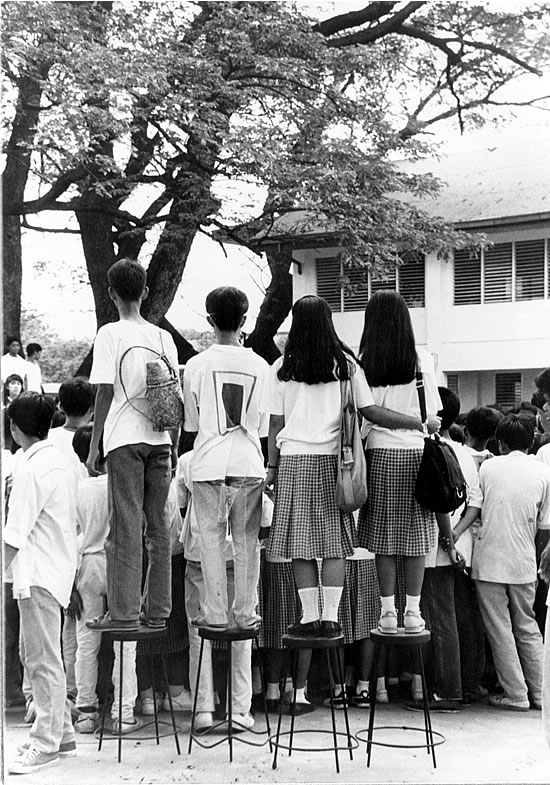
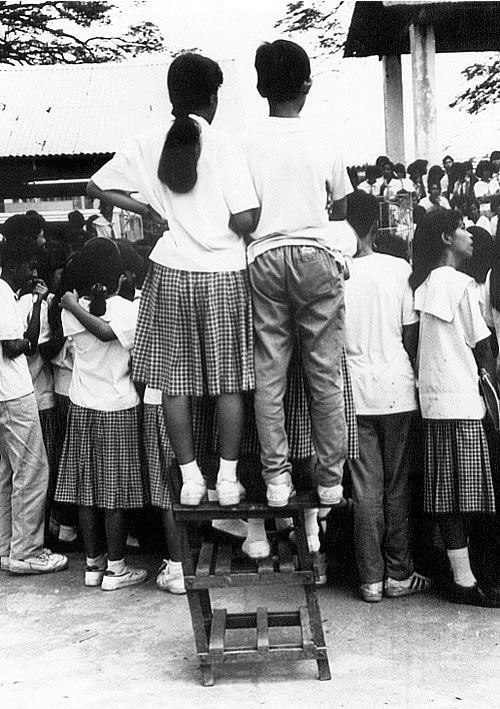
A photo essay can make use of certain themes. Various pictures taken in different places, different times of the day, can be grouped together to illustrate a certain theme, whether serious or lighthearted, significant or trivial, like the pictures below which show students using chairs in creative ways other than sitting on them.

Photo essays and themes; photo by Atty. Galacio
Photo essays and themes; photo by Atty. GalacioSpeaking of themes ... if you have seen the Oscar best picture for l989, “The Last Emperor” directed by Bernardo Bertolucci, then you probably know that the recurring thematic device used all through the movie was the opening and closing of all kinds of doors or entrances.

Relevant article: “Week Five_The Photo Essay” from CUNY Graduate School of Journalism (topics include kinds of shots like signature shot, process, interaction, clincher, etc., and how to structure your narrative)
Vary your shots

In whatever way you develop your photo essay, thematically or chronologically (we’ll discuss this next time), you have to vary your shots, your viewpoints. Use close-ups, medium shots, full shots and long shots. You have to employ a variety of lenses. You have to shoot at different times of the day; use different viewpoints (eye level, low and high). You also have to shoot using both horizontal and vertical formats.

Kinds of pictures in a photo essay


In a written essay, you have the introduction, the body, and the ending or conclusion. In a photo essay, you would need different kinds of pictures - (1) establishing shots to show your viewers the setting or context of your subject; (2) major actions, stages or developments, to illustrate your theme or subject: (3) minor pictures which can serve as transitions; and, (4) pictures that will effectively close out your photo essay.

In a written essay, you always try to end it with a punch, with a line or expression that gives it a sense of completeness, a sense that nothing has been left hanging. With a photo essay, you try to end it with a picture that also brings a sense of completeness. In literature, we call this sense of completeness as “catharsis” which means a purgation of the negative emotions created within the reader. In Hollywood film making and scriptwriting, it’s called “closure” which means that the ending must provide a sense of completeness, a sense that everything has been resolved satisfactorily.

National Geographic Live! - Alison Wright: Portraits of the Human Spirit: After confronting her own mortality in a near-fatal bus crash, photographer Alison Wright dedicates her career to capturing the human spirit through her photographs and writing.

Friday, October 12, 2007

Photojournalism (31): Photo essays and sequence shots

Update as of September 18, 2023:

If you’re a high school or grade school student in the Philippines who’s joining the photojournalism contest in the division, regional, or national press conference, I’m offering two free resources to you :

A. 900-plus interactive exercises on English grammar, vocabulary, reading comprehension, verbal analogy, etc (with around 200 megabytes total file size). The exercises have time limit and automatic scoring, with an average of 10 items per exercise.

Examples of these interactive exercises are: Common English grammar errors: Exercise 01 (nouns - confusions of number); Phrasal Verbs: Expressions with Go; English Placement Test (45 items).

B. 200-plus resources (JPG, PDF, MP4, etc.) on photography and photojournalism, with 600-plus megabytes total file size. For some examples of these resources, surf to the “Free photography e-books, cheat sheets” page.

For the download links and more information about how to use the interactive exercises, please surf to my “Better English resources and exercises” blog. Please inform your journalism teacher/schoolpaper adviser or your parents about these resources before downloading them.

If you have any question about downloading or using these free resources, please email me (after informing your journalism teacher/schoolpaper adviser or your parents). I’ll be able to reply to you within two to three days; if you don’t see my reply in your Inbox, check your Spam folder. Or, you can text me.

Also, if you win in the photojournalism contest at whatever level (district, division, regional, or national), you can send me your prizewinning pictures, and I will feature them in a blog post.

Atty. Gerry T. Galacio
gtgalacio@yahoo.com
0927-798-3138


“Hit or miss, trial and error, better luck next time, try and try again, next time make sure you’ve got film on your camera before you shoot, okay?”

These expressions best describe the emotions, the frustrations, the experiences you’ll have as you start to learn about photography. Some experiences you’d rather forget, some missed shots you’ll regret forever but just like life, photography is one activity where learning means building up through your experiences, growing by stages ... As rock star Alanis Morissette said in a hit song many years ago, “You live, you learn!”

Select your shots

One stage that you’ll go through as the photography bug hits you, is indiscriminate shooting. If you see something, you shoot it. If it’s out there, you shoot it. If something moves, you shoot it. You buy some more film, you shoot again ... As your skills improve however, you’ll become more selective in your shots. Your standards will become higher, and you’ll also realize that you don’t have enough money to buy all the film you need or want! (The high cost of film and processing, and the immediate results are some of the reasons why digital photography is such a big hit these days.)

Example of sequence shots

Remember our discussion of types of pictures and sequence shots? A sequence, as the term denotes, is a series of pictures of one subject, shot one after another. A photo sequence may or may not illustrate a certain idea or theme, but the series of pictures provides the viewers with more visual information about your subject. (Later on, you will learn that you can create a photo essay out of sequence shots.)

A. “Thoughts on graduation day” (photo essay using sequence shots with captions)


In the following pictures, I asked my Class 1990 yearbook staffer Eric to pose by the dike at the back of Rizal High School in Pasig (formerly credited in the Guinness Book of World Records as the world’s biggest high school). I was on the 3rd floor of a building with my beloved Canon AE-1 Program camera fitted with a Vivitar Series 1 70-210 mm zoom lens.

I wanted to express the contemplative mood and loneliness a senior normally goes through as graduation time comes near. I just wanted two elements in my picture - Eric and the still waters of the Marikina River flowing behind the Rizal High School campus in Pasig City. The first two pictures of the scene below were the ones I needed to express what I wanted.

But then, I saw the tugboat coming from the left. I switched on the power winder of my camera. I shot about 20 frames all in all as the tugboat passed Eric and created ripples on the water. Serendipity! I had a photo essay that could be used to illustrate life cycles, transient moments, peace and serenity, consequences and change!

We have spent four memorable years here in our beloved school, and the days leading to our graduation day have seen a thousand questions tumbling in our hearts and minds. Where do we go from here?; Rizal High School 1990; photo by Atty. Galacio
We have spent four memorable years here in our beloved school, and the days leading to our graduation day have seen a thousand questions tumbling in our hearts and minds. Where do we go from here?
For some, the future beckons brightly as they are blessed not only with talent and intelligence but also with open doors and countless opportunities.For some the future looks dark and dreary, as innocent adolescent pursuits give way to serious concerns for jobs and financial security, with a college education merely a mirage in the dry desert sand of our crushed hopes and ruined dreams. And still for some of us, there is simply no future to speak about.Rizal High School 1990; photo by Atty. Galacio
For some, the future beckons brightly as they are blessed not only with talent and intelligence but also with open doors and countless opportunities.For some the future looks dark and dreary, as innocent adolescent pursuits give way to serious concerns for jobs and financial security, with a college education merely a mirage in the dry desert sand of our crushed hopes and ruined dreams. And still for some of us, there is simply no future to speak about.
Still other questions haunt us as we rush from one graduation practice to another, from one class party to another …Will our friends in high school remember us through the passing of the years, through the changes in our lives, and through the distance of separation made more poignant when no letters come and birthdays are forgotten?; Rizal High School 1990; photo by Atty. Galacio
Still other questions haunt us as we rush from one graduation practice to another, from one class party to another …Will our friends in high school remember us through the passing of the years, through the changes in our lives, and through the distance of separation made more poignant when no letters come and birthdays are forgotten?
Will our friends still be there for us when problems come and solutions seem so elusive? Will our friends remain true to us even as they meet other people and encounter new experiences, or will the friendship we thought would never end, prove finally to be weak and temporal?; Rizal High School 1990; photo by Atty. Galacio
Will our friends still be there for us when problems come and solutions seem so elusive? Will our friends remain true to us even as they meet other people and encounter new experiences, or will the friendship we thought would never end, prove finally to be weak and temporal?
Will our friends still be there for us when problems come and solutions seem so elusive? Will our friends remain true to us even as they meet other people and encounter new experiences, or will the friendship we thought would never end, prove finally to be weak and temporal?; Rizal High School 1990; photo by Atty. Galacio
Will the joys and pains, heartbreaks and happiness we all shared be simply swept aside, never to be remembered, never to be allowed even a little space in our memories? Will the hopes and ambitions, the secret dreams we have dared to share only with our truest friends, be simply forgotten or revealed to others in careless, thoughtless ways?
Will the joys and pains, heartbreaks and happiness we all shared be simply swept aside, never to be remembered, never to be allowed even a little space in our memories? Will the hopes and ambitions, the secret dreams we have dared to share only with our truest friends, be simply forgotten or revealed to others in careless, thoughtless ways?; Rizal High School 1990; photo by Atty. Galacio
Will our names be remembered? Will our friendships last? Will our friends still be our friends? Life oftentimes has a cruel way of frustrating our dreams, of crushing our ambitions, of ending our friendships …
Will our names be remembered? Will our friendships last? Will our friends still be our friends? Life oftentimes has a cruel way of frustrating our dreams, of crushing our ambitions, of ending our friendships …; Rizal High School 1990; photo by Atty. Galacio
But our friends have made a promise always to remember … Life indeed must move on, to bigger things, to better places … and we grow up, physically, emotionally and intellectually, and we will no longer be the kind of persons we were in our high school days …
But our friends have made a promise always to remember … Life indeed must move on, to bigger things, to better places … and we grow up, physically, emotionally and intellectually, and we will no longer be the kind of persons we were in our high school days …; Rizal High School 1990; photo by Atty. Galacio
The saddest truth in the whole universe is that time changes everything.
The saddest truth in the whole universe is that time changes everything; Rizal High School 1990; photo by Atty. Galacio
But our friends have made a promise always to remember …
But our friends have made a promise always to remember …; Rizal High School 1990; photo by Atty. Galacio
But as we lie awake at night, the caressing wind carries to our consciousness the melodies of songs that brought wonder and meaning to our lives, songs that signified every turning point in our destinies, songs that we once shared and sang together as friends …
But as we lie awake at night, the caressing wind carries to our consciousness the melodies of songs that brought wonder and meaning to our lives, songs that signified every turning point in our destinies, songs that we once shared and sang together as friends …; Rizal High School 1990; photo by Atty. Galacio
Slowly, the half-forgotten lyrics become clearer and they bring us back to our high school days …
Slowly, the half-forgotten lyrics become clearer and they bring us back to our high school days …; Rizal High School 1990; photo by Atty. Galacio
Indeed, we have promised always to t remember. We can always remember. We must always remember …
Indeed, we have promised always to t remember. We can always remember. We must always remember …; Rizal High School 1990; photo by Atty. Galacio Pssst, Eric! It has been eighteen years since 1990 when I asked you to pose by the dike. You can move away from the dike now, and go on with your life, okay?

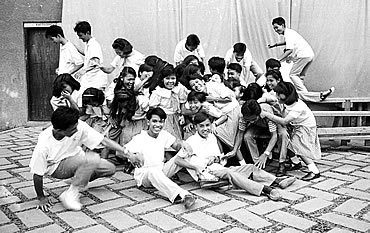
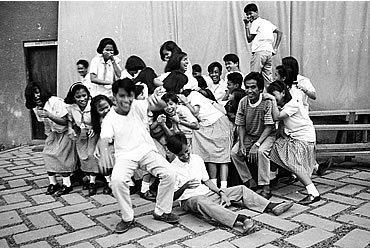
B. The pictures below are sequence shots of a senior class having their yearbook picture taken.


I shot these pictures way back in 1991 with my beloved Canon AE-1 Program camera fitted with an FD f/1.8 50 mm lens, a yellow-green filter, and a power winder. After I shot the formal class picture, the fun began. If you mouse over each picture, the caption will appear for a few seconds.


Sunday, October 07, 2007

Photojournalism (29): Shooting at night

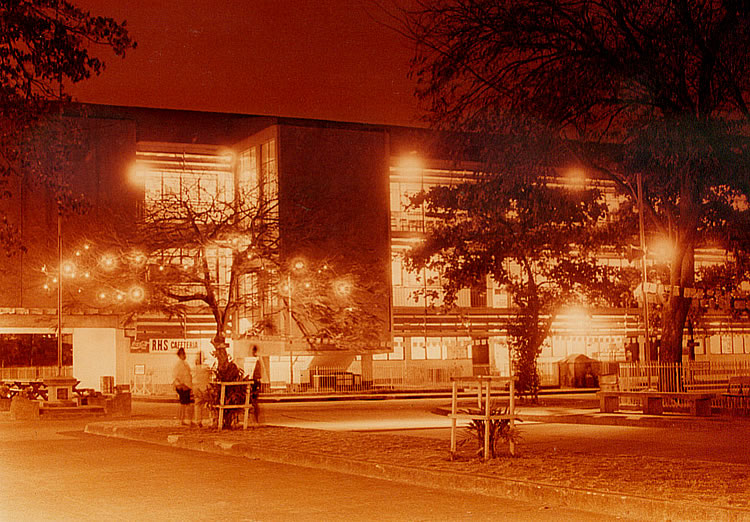
Shooting at night; B-setting; from a black and white negative, I created a color picture by experimenting with the filtration settings of Kodak's Create-a-Print machine; Rizal High School 1993; photo by Atty. GalacioWhen darkness sets in, beginning photographers like some of you, would just pack away your cameras and go home to watch your favorite telenovela. Some of you, however, might automatically turn on your camera flash. While your flash is an oftentimes indispensable tool, it creates harsh shadows, and there are situations when your flash output won’t be enough to properly illuminate your subject.

Free articles and cheat sheets from Digital Camera World:

Night photography: how to shoot popular low-light scenes

Night photography: set up your camera to shoot anything

12 common errors of night photography (and how to fix them)

Night photography tips: 9 essential steps for beginners
In this kind of situation, you have to use the B-setting on your SLR camera’s shutter speed dial. With a lot of camera models, the slowest shutter speed is 30 seconds. After this number, you’ll find the letter “B” on the shutter speed dial. With some advanced camera models, there’s no longer any B-setting. Instead, you will find slow shutter speeds of 45 to 60 seconds or even more.

(I have been using a borrowed amateur model digital camera for only a short period of time. So I don’t know yet how to shoot pictures at night using a digital camera. But once I learn how, I will tell you about it, okay?)

Here’s how to use the B-setting:


(1) Place your camera on a tripod, a table or any sturdy structure.

(2) Attach a cable release to your shutter release button.

(3) Focus on your subject.

(4) Fire the shutter, lock the cable release.

(5) Release the lock after you reach your desired exposure time.

Use a watch with a seconds hand to time your exposures. Keep a flashlight handy also, so you can always check on your settings and surroundings. Make sure you’re not stepping on a snake or something, okay?

Reciprocity failure

Take note that with long exposure times, "reciprocity failure" will occur. What does this mean? The effective ISO rating of your film decreases, resulting in underexposed shots. What’s the solution? Adjust your lens opening; using still longer exposure times will only worsen the problem. (If you're using a digital camera, there's no need to worry about reciprocity failure, okay?)

Believe it or not, the picture above (which I took way back during the 1993 National Secondary Schools Press Conference held in Rizal High School in Pasig) became controversial. When we published this picture in our yearbook, a lot of people said that the three people on the lower left hand corner were ghosts! They said, “Look at their clothes, they’re like those worn by our Spanish ancestors. And look, their images aren’t solid. They’re transparent, the light just goes through them.”

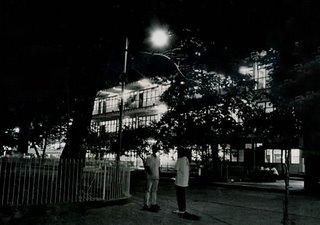
 Shooting at night; B-setting; Rizal High School 1993; photo by Atty. Galacio Look at the picture above. These aren’t ghosts; they’re my staffers whom I asked to pose underneath the lamp post. I used f/5.6 as lens opening and 30 seconds as shutter speed. Somebody walked by, between my staffers and my camera which was set on a tripod. But where is he in the picture? No matter how and where you look, you won’t find that guy. Why? He did not stay in one place long enough to be recorded in my film.

Coming back to the controversial picture above, these three people (delegates from Region 10 or 12, if I remember right) stayed in their place long enough for them to be recorded on film. But since they were moving about a little (I used f/8 at 45 seconds), their images aren’t solid but blurred, almost transparent, lacking solidity. This kind of images is called “ghost images.” Ghost images, not actual ghosts, okay?

Light streaks and trails

If your subject includes fast moving vehicles, you won’t be able to record them on film since they wouldn’t be staying in one place long enough to be recorded. But you will be able to record their lights in terms of streaks and trails. If you’re shooting color film, the light trails will be red (for brake lights) and yellow (for headlights).

Auras and Kirlian photography


Psychics believe that every person projects an “aura” which are visible to them but not to others. “Kirlian photography,” a process developed by the Russians (I stand to be corrected on this, okay?) is said to be able to record on film a person’s aura. Actually, this process records electrical discharges emitted by the human body.

How to focus when shooting at night

Because of the darkness, you might find it difficult focusing on your subject. Solution? Try focusing on distinct points of light near your subject, like the streetlights in the picture below. I took this picture of the floodway in Pasig sometime in 1997 or 1998. I used my beloved Canon AE-1 Program camera and a Vivitar 28-210 mm zoom lens to take this shot. The streetlights seem a bit out of focus; that’s because I took the shot from the middle of the Legaspi Bridge spanning the two banks of the floodway. A lot of vehicles were moving across the bridge, and, although mounted on a sturdy tripod, my camera would shake a bit as vehicles passed by. (As motorists passed by me, some would tease me by saying, “Kami na lang ang kunan mo!”)

 Shooting at night; B-setting; At nighttime, focus your camera using points of light like street lamps; Legaspi bridge, floodway in Pasig City, 1997 or 1998; photo by Atty. Galacio Also, you’ll notice that when you have locked your cable release, you wouldn’t be able to see your subject through the viewfinder. This “image blackout” occurs because the rapid return mirror is blocking your view of the image.

Bracketing your shots

It is really only experience which can tell you how long your exposures should be. Always bracket your shots, therefore. This simply means to take several shots using different exposure times. (Of course, with photo editing software, you can edit and manipulate your images to your heart’s content and to achieve the look you want.)


 Shooting at night; B-setting; Rizal High School 1993; photo by Atty. Galacio If you use small apertures or lens openings (more on this topic later on), you’ll create cross screen patterns similar to the effect created by starburst filters. In the picture above, you can see these patterns in the lights hanging on the trees.

On the bottom portion of the picture above, what can you see? Oh, my ghosts!