Tuesday, March 03, 2020

“The Tale of Nokdu” synopsis (Eps. 1-2 to 31-32, no spoilers) with in-depth analysis of its cinematography

Jump to synopsis of Eps. 1-2 (1), 3-4 (2), 5-6 (3), 7-8 (4), 9-10 (5), 11-12 (6), 13-14 (7), 15-16 (8), 17-18 (9), 19-20 (10), 21-22 (11), 23-24 (12), 25-26 (13), 27-28 (14), 29-30 (15), 31-32 (16, Finale); How I wrote these episode summaries with no spoilers; Historical backgrounders and other information; Lessons in photography from “The Tale of Nokdu” with in-depth analysis of its cinematography

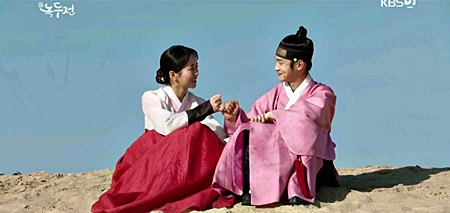
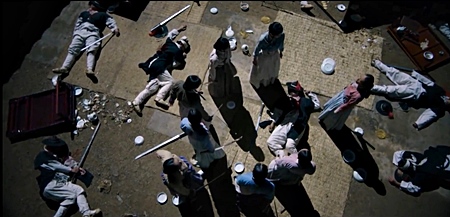
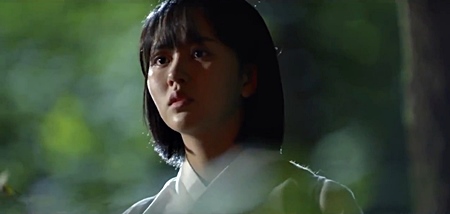
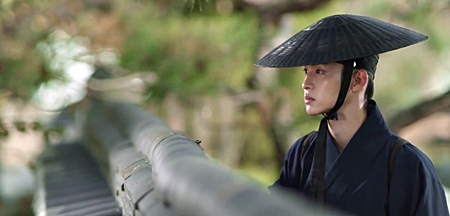
From Wikipedia: The Tale of Nokdu” is a 2019 South Korean television series starring Jang Dong-yoon, Kim So-hyun, Kang Tae-oh, and Jung Joon-ho. It is based on the webtoon by Hye Jin-yang which was published in 2014 on Naver Webtoon. It premiered on KBS2 on September 30, 2019.

Each night’s broadcast was divided into two 35-minute episodes with a commercial break in between. Thus, some websites and streaming services consider Eps. 1-2 as Ep. 1, Eps. 3-4 as Ep. 2, and so forth.

Although the series had average ratings nationwide, it was among the ten most talked about Korean dramas among the 104 primetime dramas aired during 2019. Further, it captured the heart of the generation Z in South Korea and was well-received by online viewers. According to a survey conducted by SBS, the series ranked 5th among the Korean dramas in 2019.

This drama was also broadcast in Taiwan, Philippines, Thailand, Indonesia, Singapore, Myanmar, Thailand, and Japan.

In the 2019 KBS Drama Awards, Jang Dong-yoon won “Excellence Award, Actor in a Miniseries,” while Kim So-hyun won “Excellence Award, Actress in a Miniseries.” Jung Joon-ho won “Best Supporting Actor Award.”

How I wrote these episode summaries with no spoilers


1. I assumed that you will be reading these summaries and watching the videos chronologically.

2. I narrated some of the main actions in each episode, without revealing the plot’s twists and turns.

3. At the beginning of each summary starting with Episodes 3-4, I placed in a table a recap of the major twists and turns of the previous episodes. But because you have already watched the video of the previous episode, they aren’t spoilers anymore.

4. With Episodes 31-32 (Finale), however, I included spoilers. Reason — people who have not seen the drama want to know whether it has a sad ending or a happy ending before they invest their time in watching it. And yes, this drama has a happy ending.

Episodes 1 (“First Encounter”) and 2 (“Widows’ Village”)


On a faraway island, Nokdu, his father, and brother are attacked by a team of assassins. With the help of Nokdu’s martial arts teacher, they fight off the assassins. The teacher, Master Hwang, tells Nokdu that if he chases the wounded assassin, he can find out who the mastermind is.

Nokdu ends up in the capital, still chasing the assassin. But together with Dong Joo and several other people, he is locked up in jail after someone attacks King Gwanghae on the street. The next day, all of them are brought to the interrogation grounds. To save himself and Dong Joo, he boldly asks the court officials to let him speak to King Gwanghae.

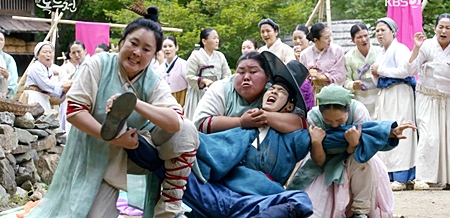
Later on, in chasing the assassin, Nokdu ends up in a village of widows that’s located beside a gisaeng house. But members of the village’s security unit (aka “Virtuous Women’s Corps”) promptly beat him up and throw him out of the village.

Note: When the vice-curator said that he wanted Lady Kim’s winged dress, he was referring to the Korean folk tale of the fairy and the woodcutter. Please read the “Historical backgrounders and other information” section below for more information.


Episodes 3 and 4


Eps. 1-2 recap:

In disguise as a man, Dong Joo plans to assassinate King Gwanghae using a bow and arrow.

Nokdu disguises himself as “Lady Kim,” a young widow who’s running away from her father-in-law; he’s accepted into the widows’ village and assigned to a room in the gisaeng house that’s occupied by Dong Joo.

Dong Joo gets into trouble with a lecherous nobleman who wants to take a young gisaeng with him. But Dong Joo stands up to the nobleman by cutting off her hair; Yul Mu, a dashing nobleman who frequents the gisaeng house as a chef, also intervenes on her behalf.

On his first day in the village, the members of the Virtuous Women’s Corps force Nokdu to go bathing with them in the river.

The vice-curator of the village woos Lady Kim (Nokdu). Yul Mu, on the other hand, continues to pursue Dong Joo.

Minister Heo is the leader of the band of female assassins known as the Muweol Corps; he orders the assassins to continue looking for Nokdu. Meanwhile, Nokdu’s father (Jung Yoon Jo) and his brother (Hwang Tae) arrive in the capital. With them are Nokdu’s martial arts teacher and his precocious, young daughter Aeng Du.

Nokdu sneaks out of Dong Joo’s room; in the woods, he spies on the meeting of the Muweol Corps assassins. Later on, he decides that he must infiltrate the group.

Flashback ... Minister Heo remembers how he spared the lives of Jung Yoon Jo and the infant he was protecting.

At night, Nokdu secretly follows a shaman and several white-clad women who walk into an isolated shrine. But as he observes what’s happening, the Muweol Corps assassins discover him and chase him as he escapes.


Episodes 5 (“Composite Sketch”) and 6 (“I Want You To Leave”)


Eps. 3-4 recap:

As he becomes suspicious of Minister Heo, King Gwanghae orders his bodyguard to continue searching for Jung Yoon Jo.

Nokdu escapes from the Muweol Corps assassins and hides in a room in the gisaeng house. But there, Dong Joo finds out his secret.
Minister Heo, Lady Chun (owner of the gisaeng house), and Sseok, the Muweol Corps’ chief assassin, search the room, but they only find Dong Joo applying makeup on Lady Kim (Nokdu). Back at the shrine, Minister Heo tells the other men in the meeting that they must speed up their plans because King Gwanghae is eliminating all the officials loyal to Prince Yeongchang.

Nokdu lies to Dong Joo about why he’s masquerading as a woman in the widows’ village; he says that he’s waiting for the woman whom he loves to arrive in the village. Afraid that her own secret might be found out, Dong Joo warns him to stick close to her at all times.

The composite sketch is circulated in the widows’ village, and Nokdu improvises a plan so that he won’t be recognized as the person in the sketch.

Nokdu hides in a closet and listens as Ssook discusses with two other Muweol Corps assassins who their next target is. Meanwhile, the lecherous nobleman orders Lady Chun to bring Dong Joo to his house.

Note: The small knife that Dong Joo was carrying is called “eunjangdo.” Please read the “Historical backgrounders and other information” section below for more information.


Episodes 7 (“Second Chance”) and 8 (“Childhood Memories”)


Eps. 5-6 recap:

The Muweol Corps assassin, who has become suspicious of Lady Kim (Nokdu), is accosted by a sword-wielding man on the mountain and fails to report to her fellow assassins.

Lady Kim (Nokdu) volunteers to kill the nobleman for the Muweol Corps assassins. But on his way to the capital, he sees Dong Joo, who’s all dressed up as a gisaeng and about to be transported in a palanquin to the lecherous nobleman’s house.

Inside the house, Dong Joo prepares her knife (“eunjangdo”), but instead of the nobleman, she finds Nokdu waiting for her.
As Nokdu explains to Dong Joo why he saved her from the lecherous nobleman, Yul Mu and his bodyguard arrive. Later, in the woods, Ssook aims her sword at Nokdu and demands to know why he abandoned his mission to kill the abusive nobleman in the capital.

Ssook and the other Muweol Corps assassins decide to give Lady Kim (Nokdu) another chance to join their group. They give her (him) a new mission — to steal the valuable elephant artifact made of iron that the real Lady Kim’s father-in-law always keeps with him.

Intrigued by what Nokdu is doing, Dong Joo follows him to the capital.

As he continues with his reconnaissance of the house of Lady Kim’s father-in-law, Nokdu finds out that the real Lady Kim has been captured and is being brought back to the house.

In the widows’ village, after hearing that Lady Kim has been captured, Ssook decides to go to the capital.


Episodes 9 (“I Like Lord Yul Mu”) and 10 (“Who Do You Like?”)


Eps. 7-8 recap:

Using the gold frog that the real Lady Kim gave to him, Nokdu buys Dong Joo from Lady Chun and adopts her. But he asks Dong Joo to sign a promissory note for all his expenses.

In the capital, Dong Joo secretly visits her childhood home where she remembers how her family was killed on orders of King Gwanghae. Later, she learns that Yul Mu, to whom she was betrothed in childhood, bought the house and maintained it in good order.

Nokdu steals the iron elephant using the magnetite and the bow and arrow that Dong Joo made. He then rescues the real Lady Kim, but Ssook arrives.
Soldiers arrive and rescue Lady Kim (Nokdu) and Dong Joo from Lord Park and his men.

While Master Hwang (Nokdu’s martial arts teacher) and his daughter Aeng Du search the capital for Nokdu, Yoon-jo and his son are attacked by assassins. Meanwhile, the Dowager Queen and Prince Yeongchang are implicated in a shamanic curse against King Gwanghae.

In the gisaeng house, jealousy rages among the vice-curator and Hwa Su, the gisaeng. Having gotten drunk, Dong Joo begins revealing everyone’s secret, frightening Nokdu. Just then, Aeng Du arrives with her father Master Hwang and recognizes Nokdu in his Lady Kim disguise.

Nokdu monitors the secret meeting in the shrine between Minister Heo and his allies; meanwhile, in the palace, the Dowager Queen is arrested on Kjng Gwanghae’s order.

Note: The dead pig represents year of King Gwanghae’s birth year. Please read the “Historical backgrounders and other information” section below for more information.


Episodes 11 (“Yul Mu Knows Nokdu’s Secret”) and 12 (“Yul Mu’s True Colors”)


Eps. 9-10 recap:

Yul Mu summoned the soldiers who arrested Lord Park and his men.

During the rowdy gathering at the gisaeng house, Lady Kim (Nokdu) kisses Yul Mu.

Flashback ... King Gwanghae’s son was born on November 19. He ordered Yoon-jo to bury his son, but Minister Heo spared the lives of Yoon-jo and the baby.

Through Aeng Du’s talkativeness, Yul Mu finds out that Lady Kim is actually a man masquerading as a woman. He finds a half-naked Nokdu who has just kissed Dong Joo.
Despite his misgivings, Yul Mu agrees to keep quiet about Nokdu disguising himself as Lady Kim. But he worries about Dong Joo sleeping in the same room with Nokdu.

Flashback ... Minister Heo remembers how he got from Dong Joo’s father the previous king’s royal command that names Prince Yeongchang as his successor.

Present times ... Minister Heo’s bodyguard tells him that he found the corpse of one of their assassins; the assassin was tortured.

After promising Dong Joo that he will win her heart, Nokdu follows Master Hwang’s advice on how to woo women. Later on, however, Dong Joo decides that it’s time for her to leave the widows’ village.

Ssook and the other Muweol Corps assassins are ordered to go the capital and kill the court official who arranged Prince Yeongchang’s exile. Lady Kim (Nokdu) offers to go with them, but they refuse.

Yoon-jo sneaks into Minister Heo’s quarters, but while they’re talking, King Gwanghae arrives.

The minor official in Gangwha Island where Prince Yeongchang has been exiled stops by the gisaeng house on his way to his father’s birthday celebration in the capital. After overhearing the official bragging with the gisaengs, Nokdu follows him and, in the woods, threatens him with a knife.

Note: For more information about King Injo, please read the “Historical backgrounders and other information” section below.


Episodes 13 (“I Will Leave Soon”) and 14 (“Secrets About Nok Du’s Birth”)


Eps. 11-12 recap:

Lady Chun kills the minor official from Ganghwa Island and orders Lady Kim (Nokdu) to warn Ssook and the other assassins about the trap. She also makes a deal with Yul Mu.

Yul Mu barges into the meeting at the shrine between Minister Heo and his allies. To their shock, he says that he has killed Prince Yeongchang and that he will be the next King.

Outside the shrine, Nokdu comes face to face with King Gwanghae.
King Gwanghae finds nothing suspicious in the shrine. Meanwhile, Yul Mu continues to try to convince Minister Heo to support him in his desire to become king.

Lady Chun orders the Muweol Corps assassins to relocate to their base in the capital; she also plans to visit Minister Heo and tells Lady Kim (Nokdu) to go with her.

After the incident in the kitchen, Nokdu, Dong Joo, and Aeng Du go to a river for a picnic.

The vice-curator of the widow’s village is brought to the palace, and King Gwanghae orders him to reveal everything about the village and the gisaeng house.

Despite Nokdu’s pleas for her to stay in the village, Dong Joo decides to leave for the capital. Yul Mu also tries to stop her, but she’s adamant about leaving.

Minister Heo warns Lady Chun about Yul Mu’s bloodthirsty nature; he also orders his men to attack and kill Yul Mu.

While Nokdu confronts Minister Heo, the dozens of thugs hired by Yul Mu arrive at the widows’ village and attack everyone in sight. From the mountain, Dong Joo sees the burning village and rushes there.

Note: For more information about the veiled hat for women during the Joseon Dynasty, please read the “Historical backgrounders and other information” section below.


Episodes 15 (“Without Saying Goodbye”) and 16 (“Reunion Between Father and Son”)


Eps. 13-14 recap:

Yul Mu finds out from Yoon-jo’s son, Hwang-tae, about Nokdu’s real identity.

As he tries to rescue Hwang-tae, Nokdu finds out that he is King Gwanghae’s son.

Nokdu and Yul Mu rush to the widows’ village, but a huge thug is choking Dong Joo in a death grip.
Yul Mu takes Dong Joo to safety, while the massacre and the fighting continue in the widows’ villages and the gisaeng house.

The next day, Lady Chun orders the widows to disperse at the pier and the gisaengs brought to a government office. But she herself is captured by soldiers sent by King Gwanghae.

After caring for Nokdu and his injuries for several days, Dong Joo leaves for the capital. There, she begins befriending the palace maids. Later on, one of the maids promises to help her if she finds a man for her.

Along with Master Hwang and Aeng Du, Nokdu also goes to the capital to look for Dong Joo and to confirm his real identity. The vice-curator offers them his financial help and allows Nokdu to assume the identity of his distant cousin, Yeon Soo.

While still looking for Dong Joo, Nokdu decides to take the military service exam to be able to meet King Gwanghae in person. But as he sneaks into Minister Heo’s house, he’s confronted by King Gwanghae’s bodyguard and soldiers.


Episodes 17 (“Yul Mu Misleading Widows”) and 18 (“Trap For Yul Mu”)


Eps. 15-16 recap:

Lady Chun is killed by Yul Mu’s bodyguard.

Nokdu meets King Gwanghae, who’s in disguise as the Chief Administrative Officer and using the swing. On the other hand, Dong Joo meets King Gwanghae in the marketplace, mistaking him to be the man who the palace maid wanted to meet.

Nokdu finds Yoon-jo in Minister Heo’s house, but Yoon-jo refuses to confirm if he is King Gwanghae’s son.

While escaping from King Gwanghae’s bodyguard and soldiers, Nokdu meets Dong Joo. As they hide in a darkened room, King Gwanghae finds them.
Nokdu refuses to let Dong Joo go and forces her to stay in his lodging place. The next day, Dong Joo reunites with the vice-curator, Master Hwang, and Aeng Du. Later, she meets the palace maid again, who suggests a way for her to get into the palace.

Yul Mu asks Ssook and the other Muweol Corps assassins to come over to his side; later, he tells Minister Heo’s allies that they should launch their revolt even without Minister Heo.

While leaving the clinic, Nokdu and Dong Joo meet the Chief Administrative Officer (King Gwanghae) again. Meanwhile, Minister Heo tries to convince Yoon-jo to depose King Gwanghae and place Nokdu on the throne.

Nokdu secretly sets up a meeting with Hwang Tae, but Yul Mu finds about it through his bodyguard. As Hwang Tae goes to the gambling place that Dong Joo visited earlier, Yul Mu and his bodyguard see Nokdu.

Note: For more information about the “mugwa” (military service exams) during the Joseon Dynasty and the “Bang Bang Eui” ceremony for those who pass the civil service and military exams, please read the “Historical backgrounders and other information” section below.


Episodes 19 (“Heo Yun Framed”) and 20 (“The Queen’s Jewel”)


Eps. 17-18 recap:

Yul Mu lies to the Muweol Corps assassins that Minister Heo ordered the killing of Lady Chun.

Nokdu kidnaps Yul Mu and brings him to a bamboo grove, but Yul Mu’s bodyguard catches up with them. Meanwhile, Master Hwang takes Hwang Tae to a different place and questions him.

Nokdu passes the military service exams, ranking first. During the welcome ceremony, he comes face to face with King Gwanghae.
Nokdu is stunned to find out that the man whom he befriended in the marketplace is none other than King Gwanghae. He also sees Yul Mu, who smirks at him. Later on, Yulmu threatens everyone — Nokdu, Master Hwang, Aeng Du, and the vice-curator — and forces Dong Joo to leave with him.

After giving his final instructions to his bodyguard, Minister Heo goes to the palace. But while he’s talking with the Queen, King Gwanghae arrives.

King Gwanghae’s bodyguard brings Nokdu and other soldiers to raid Minister Heo’s house. As Yoon-jo tries to escape, Minister Heo’s bodyguard fights off the soldiers and hastily gives Nokdu something that will prove his real identity.

To her surprise, Dong Joo again meets the Chief Administrative Officer (King Gwanghae). Later on, the gamblers who were locked up meet Dong Joo on the street, and they chase her into a plague-ravaged village.


Episodes 21 (“Dong Joo Enters The Palace”) and 22 (“Your Son Is Alive”)


Eps. 19-20:

King Gwanghae orders that Minister Heo be arrested. He has been informed by Yul Mu that Minister Heo has kept secret that his son is still alive.

Ssook rescues Yoon-jo and Minister Heo’s bodyguard.

Nokdu meets the Queen in the palace, and he notices that her broken pendant (“norigae”) is the other half of the pendant that Minister Heo’s bodyguard gave to him.

Nokdu saves Dong Joo from the well where she has been trapped for the last two days.
Dong Joo finally enters the palace as a “musuri” (laundry maid) for the Queen’s attendant. Meanwhile, Nokdu is ordered to accompany the former servants of Lord Yi Yeong-kyung (Dong Joo’s father) in looking for the family’s burial site.

In the dungeon, King Gwanghae interrogates Minister Heo, with Hwang-tae testifying that he grew up with the King Gwanghae’s son who expressed his desire to become king.

After getting drunk, King Gwanghae dreams of the shaman’s prediction that a royal child who will be born on November 19 will become the next king.

In the marketplace, Nokdu and Dong Joo reunite with the three women of the Virtuous Women’s Corps.

Minister Heo’s bodyguard pleads with Ssook to sneak a letter from Yoon-jo for the Queen. Later, Yul Mu sees Dong Joo inside the palace. Enraged, he tries to force Dong Joo to go with him, but Nokdu intervenes. The Queen arrives and sees the altercation.

Note: For more information about the difference in the giving of shoes as a gift during the Joseon Dynasty and modern times, please read the “Historical backgrounders and other information” section below.


Episodes 23 and 24 (“Find The Merit List”)


Eps. 21-22 recap:

Kjng Gwanghae kills Minister Heo and orders his bodyguard to dump the body outside the palace.

Yul Mu tells his co-conspirators about Minister Heo’s death and how they should proceed in deposing King Gwanghae during the annual ancestral visit to the royal tombs.

The Queen finds out from Yoon-jo that her son is still alive. But King Gwanghae orders Yoon-jo arrested. As she runs after King Gwanghae, the Queen loses her “norigae” (pendant), which Nokdu picks up.

Dong Joo prepares to shoot King Gwanghae with her bow and arrow, but a royal guard catches her lurking in the shadows. She’s stunned when she realizes that the Chief Administrative Officer whom she has been meeting is none other than King Gwanghae.
King Gwanghae orders the royal guard to open Dong Joo’s box. Later on, he interrogates Yoon-jo in the dungeon.

Ssook tells Nokdu about Yul Mu’s secret document — the “merit list” of all the conspirators in Yul Mu’s plan to depose King Gwanghae. When Ssook says that only Yul Mu has the key to the safe where the merit list is kept, Nokdu begins thinking of how to get the key.

Yul Mu tells his co-conspirators that King Gwanghae tried to kill his own son years ago; he also says that he will bring King Gwanghae and his son together.

In the palace, the Queen frantically looks for her missing “norigae” (pendant). But the royal guards refuse to allow her to search the palace for her pendant.

With the help of Master Hwang and the vice-curator, Nokdu locks up Hwang-tae.


Episodes 25 (“Nokdu Is The Boy” and 26 (“Go, Now!”)


Eps. 21-22 recap:

Dong Joo finally finds out that Nokdu is King Gwanghae’s son.

Nokdu steals Yul Mu’s merit list. But in the dungeon, he overhears King Gwanghae tell Yoon-jo that he must kill his own son to keep the throne.
Yul Mu asks Nokdu to join him in his plan to depose King Gwanghae. Later on, King Gwanghae promotes Nokdu as a royal guard.

As Hwang-tae is released from prison, Nokdu tells him that Yoon-jo is in the dungeon; to keep King Gwanghae away from the dungeon and from harming Yoon-jo, Nokdu begins spreading the rumor about what King Gwanghae did to his son 20 years ago.

In the marketplace, Dong-joo meets the servants from her childhood days, and they take her to her family’s burial site. They warn her that if it’s found out that she’s still alive, all of them will be in danger.

After witnessing how King Gwanghae interrogated Yoon-jo and killed the minister, Nokdu accepts Yul Mu’s offer in deposing King Gwanghae. Later on, he asks King Gwanghae’s bodyguard to return the missing “norigae” to the Queen.


Episodes 27 (“Plan of Revolt”) and 28 (“Dong Joo Stands Before the King”)


Eps. 25-26 recap:

Nokdu and Dong Joo say goodbye to each other.

Yul Mu introduces Nokdu to his co-conspirators as King Gwanghae’s son. Later, after the meeting, Yul Mu orders his bodyguard to kill Nokdu after their coup becomes successful.

The servant betrays to King Gwanghae’s bodyguard Dong-joo’s plan to assassinate King Gwanghae. But Dong Joo escapes from the gisaeng house; as King Gwanghae’s bodyguard and his men pursue her, Nokdu catches up with her. After Dong Joo confirms that she knows that he is King Gwanghae’s son, Nokdu orders her to run away.
While King Gwanghae is on his way to the royal tombs, the Queen rushes to the dungeon and sets Yoon-jo free. To her shock, she finds out that her son is none other than the young royal guard who found and returned the “norigae” to her.

Dong Joo secretly follows King Gwanghae to the royal tombs.

When King Gwanghae finds out that Yoon-jo has escaped and that the Queen is missing, he abandons the ancestral visit and orders that the security in the palace be strengthened. But his hasty return to the palace is foiled when the bridge breaks under the pouring rain.

In the capital, Yul Mu launches his revolt; he enters the palace and sets free the Queen Dowager.

King Gwanghae finds out that the young man whom he knows as Yeon Soo is none other than his son. Enraged at the betrayal, he takes a sword and begins searching for Nokdu. But Dong Joo and the minister, one of Yul Mu’s co-conspirators, follow him into the woods.


Episodes 29 (“Dong Joo and Nokdu Promise Forever”) and 30 (“The King is Back”)


Eps. 27-28 recap:

King Gwanghae mocks Dong Joo that he had to kill her family because they were plotting against him. When Dong Joo shoots the minister who was about to strike Nokdu with his sword, King Gwanghae rushes her. But he falls off the cliff into the waters below.

Nokdu reveals to King Gwanghae’s royal guards about Yul Mu’s treasonous plot. In the palace, he and the royal guards confront Yul Mu and his men.
Despite the Queen’s assurance that Nokdu is her son and is the rightful successor to the throne, an all-out fight occurs between Yul Mu’s forces, on one hand, and the royal guards led by Nokdu and the Minister of War’s men, on the other hand.

During the fight, Yul Mu captures Dong Joo as she tried to shield Nokdu who was helping the Minister of War. Meanwhile, despite Yoon-jo’s pleas, Hwang-tae refuses to abandon Yul Mu.

As Yul Mu and his men press their attack, the Muweol Corps assassins arrive and rescue Nokdu. The Minister of War dies, and Nokdu faces off, one on one, with Yul Mu’s bodyguard.


Episodes 31 (“Dong Joo’s Decision”) and 32 (“Wedding Ceremony”): Finale, with spoilers


Eps. 29-30 recap:

King Gwanghae survives the fall from the cliff. But in the palace, he believes the Queen Dowager’s lie that Nokdu led the revolt in order to take the throne.
The Queen helps Nokdu and Dong Joo to escape from the palace. But at the river, the others — the Virtuous Women’s Corps and Hwang-Tae — refuse to leave without Nokdu, despite Master Hwang’s assurances about Nokdu’s safety.

Days later, Yul Mu presents to King Gwanghae a decomposing body, saying that it’s Nokdu’s body. Later, as some palace guards are taking the body out of the palace, the Queen stops them. After lifting the cover and looking at the body, she smiles.

On a faraway island, Nokdu and Dong Joo get married.

Nine years later ... Yul Mu overthrows King Gwanghae in a coup; he reveals that just like Nokdu, he was born on November 19. His father had overheard the shaman’s prophecy about a royal child being born that day who will someday take the throne; his father hid the truth about his birthday to avoid King Gwanghae’s murderous ways.

The Queen joins Nokdu and Dong Joo on the island.


Historical backgrounders and other information

1. In Episodes 1 and 2, why were the widows living by themselves in the village? Why was Lady Kim being pursued and sought to be killed by her father-in-law and his men?

From “Society in the Joseon Dynasty” (Wikipedia):

Women were expected to be faithful to their husbands beyond death so widows were not allowed to remarry. In lower classes such marriages still happened, as families, for financial reasons, married off the burdensome widows to men who could not afford to marry otherwise.

While the breaking of the rule in lower classes was widely ignored by authorities, yangban widows were forbidden to remarry, or their children would be cast out of the noble class. Members of the royal lineage were treated even more strictly, with Seongjong of Joseon ordering the execution of his cousin when he discovered she had cohabited with a servant after being widowed.

As women could not be the heads of a household anymore, widows often were considered financial burdens and sometimes driven to commit suicide. Women were expected to protect their virtue at any cost, and by the late Joseon era they often wore small knives called paedo attached to the norigae (the colourful pendant hanging from the upper part of the hanbok), to commit suicide rather than dishonor their families even by giving cause to gossips.

From “Merry Widows!” (The Korea Times):

In old Korea, widows were viewed with deep suspicion. Everybody with even a cursory knowledge of pre-1900 Korean literature knows that widows were usually depicted as lecherous creatures, driven by their insatiable and immoral sexual desires ― and, as we shall see, any sexual desire in their case was immoral by definition.
For more information, please read “Women’s Life During the Choson Dynasty - International Journal of Korean History” (PDF) and “Korean Perceptions of Chastity, Gender Roles, and Libido” (ScholarWorks).

2. When the vice-curator said that he wanted Lady Kim’s "winged dress," he was referring to Korean folk tale of the fairy and the woodcutter. From “The Fairy and the Woodcutter: tragic love, Korean-style” (Korea.net):

“The Fairy and the Woodcutter is one of the most popular of all Korean folktales. Almost all children in Korea grow up reading a version of this love story. The story has three well-known versions that differ mainly in plot length.”

The “woodcutter would be able to marry one of the fairies by hiding the fairy’s winged clothing—her only means of flight.”

3. “Eunjangdo” is the small knife that Lady Kim (Nokdu) showed to Dong Joo in Ep. 3 and which Dong Joo hid in her gisaeng dress when she went to the house of the lecherous nobleman in Ep. 6. From “A weapon to test fidelity and soup” (Korean JoongAng Daily):
But due to its delicate features and small size, the eunjangdo was considered to be a female accessory. Eventually it became a symbol of chastity for unmarried women while married women carried it as a symbol of fidelity. Eunjangdo were kept underneath the hanbok top to be drawn if a woman felt that her life was threatened. They became a necessary accessory for all refined ladies to carry, along with a comb and a mirror.

Some folklore experts say eunjangdo were not designed for self-defense. They say a woman would use her eunjangdo to stab herself rather than submit to an attacker.

4. The king portrayed in this drama is Gwanghae-gun or Prince Gwanghae, the 15th king of the Joseon dynasty (4 June 1575 – 7 August 1641; reigned 1608–1623). His personal name was Yi Hon. As he was deposed in a coup d’état, later official historians did not give him a temple name like Taejo or Sejong.

Gwanghaegun was the second son of King Seonjo, born to Lady Kim (Gongbin), a concubine. When Japan invaded Korea to attack the Ming Empire, he was installed as Crown Prince. When the king fled north to the border of Ming, he set up a branch court and fought defensive battles. During and after the Seven Year War (1592–1598), he acted as the de facto ruler of the Joseon Dynasty, commanding battles and taking care of the reconstruction of the nation after the devastating wars, in the place of old and weak King Seonjo.

Although it brought prestige to him, his position was still unstable. He had an elder but incompetent brother Prince Imhae (Imhaegun) and a younger but legitimate brother Grand Prince Yeong-chang (Yeong-chang Daegun), who was supported by the Lesser Northerners faction. Fortunately for Gwang-hae, King Seonjo’s abrupt death made it impossible for his most favorite son Yeong-chang Daegun to succeed to the throne.

Although Gwanghaegun is one of only two deposed kings who were not restored and given the temple name (the other one being Yeonsangun), many people consider him a victim of feuds between political factions. However he did a better job of caring for his country than his predecessor King Seonjo, or his successor King Injo. They both contributed to invasions—the Japanese invasions of Korea (1592–1598), the Seven Year War; and the Manchu Invasion.

In modern South Korea, Gwanghaegun is considered one of the wiser kings rather than a despot.

5. The character “Yul Mu” will take the throne in Ep. 16 as Injo of Joseon, the 16th king of the Joseon dynasty in Korea (7 December 1595 – 17 June 1649, r. 1623–1649). He was the grandson of Seonjo and son of Grand Prince Jeongwon. King Injo was king during both the first and second Manchu invasions, which ended with the surrender of Joseon to the Qing dynasty in 1636.
The coup of 1623:

Although King Gwanghaegun was an outstanding administrator and great diplomat, he was largely unsupported by many politicians, scholars, and aristocrats because he was not the first-born and he was born of a concubine. Greater Northerners tried to stomp out those opinions, suppressing Lesser Northerners and killing Prince Imhae, the oldest son of Seonjo, and Grand Prince Yeongchang, the queen’s son. It was not Gwanghaegun’s plan to keep his throne; and in fact, he actually tried to bring minor factions into the government, but was blocked by opposition from members of the Greater Northerners, such as Jeong In-hong and Yi Icheom. The actions made Gwanghaegun even more unpopular among wealthy aristocrats, and they finally began plotting against him.

In 1623, members of the ultra-conservative Westerners faction, Kim Ja-jeom, Kim Ryu, Yi Gwi and Yi Gwal, launched a coup that resulted in the dethroning of Gwanghaegun, who was sent into exile on Jeju Island. Jeong In-hong and Yi Yicheom were killed, and followed suddenly by the Westerners replacing the Greater Northerners as the ruling political faction. The Westerners brought Injo to the palace and crowned him as the new King of Joseon. Although Injo was king, he did not have any authority since almost all of the power was held by the Western faction that dethroned Gwanghaegun.

6. Military service examination (Mugwa) during the Joseon Dynasty

The military examination selected 190 candidates in the first stage, of whom 28 were allowed to pass the second stage. Of these, 70 came from the capital and the remainder from the various provinces, with Gyeongsang contributing 30, Chungcheong and Jeolla contributing 25, and the remaining provinces 10 candidates each.

“Aisahwa” (aka “eosahwa”) was a hat
with branched flowers awarded by the kings
for the top student (changwon kupchae)
in the royal government exam.
The military examinations tested a mixture of military and literary criteria. The first stage of the test was a practical test of various military skills, focused on Korean archery but the second stage, in which the successful applicants were selected, was an oral examination of applicants’ knowledge of the Confucian canon and certain classics of military thought. Of importance were Sun Tzu’s Art of War, as well as Hanbizi and Wuzi. The third stage, in which the candidates were ranked, was again based on practical military skills. These include horsemanship, and mounted archery. The story of Yi Sunshin failing the Mugwa the first time due to falling off his horse during this phase, at which point he applied a hasty tourniquet using willow branches, and finishing his mounted archery portion is well known.

From “Archery in Joseon Kingdom” (The Korea Times):

According to the only extant copy of Mugwa Chongyo (Records on Military Service Exam) housed at the Jangseogak Archives, regularly held mugwa exam tested the applicants in six subject areas: mokjeon (wooden arrow), cheoljeon (iron arrow), pyeonjeon (split arrow), gisa (fighting on horseback), gichang (spear fighting on horseback), and gyeokgu (sport played on horseback; similar to polo game). The first four subjects among these were for judging one’s archery skills. After the Imjin War, gisa and gyeokgu were dropped and the following 5 new subjects were added to the exam: gichu (shooting dummy targets on horseback with arrow), gwanhyeok (target archery), yuyeopjeon (willow leaf arrow), jochong (matchlock) and pyeonchu (striking dummy targets on horseback with iron whip). Although the matchlock arquebus was adopted after the Imjin War, archery still represented a significant part of the military service exam, especially with the addition of gwanhyeok and yuyeopjeon. This illustrates that the mastery of archery was essential in order to become a military officer during the Joseon era.

7. In several scenes, King Gwanghae played with Minister Heo a strategy board game called “janggi” (Korean chess). It is similar to “xiangqi” or Chinese chess.


8. The dessert with shaved ice that Yul Mu prepared for Dong Joo is similar to “patbingsu” (“bingsu).” Bingsu was introduced to Korea during the Japanese colonial period, but according to “Snowy delights and variations on bingsu” (Korea Herald), shaved ice treats existed even during the Joseon Dynasty. Ice, however, was a valuable commodity during the Joseon Dynasty.

Summer on ice: How ice became an essential part of summer life in Korea” (Korea Herald):

During the Joseon era (1392-1910), ice was a national asset under the control of the king, and accordingly, a luxury for noblemen.

Harvested from rivers and ponds in the winter, ice blocks were stored at facilities called “binggo.” They were used for ancestral rituals, for medical purposes and to keep food cool. Seoul districts Seobinggo and Dongbinggo have their origins in the history of ice storage.

“Keeping food cool, the ancient way” (Korea JoongAng Daily):
Since the year 505, or the 6th year of King Jijung’s reign, until the arrival of freon and electricity centuries later, Koreans used stone bunkers to store blocks of ice throughout the year. These seokbinggo, literally “stone ice storage,” were located around the country. Local governments sometimes delivered ice to palaces, but mostly used ice as a means to prevent special local products from spoiling on the way to a palace.

“Feeling the heat: The luxury of ice” in Joseon (Korea Times) by Robert Neff:
The Korean government maintained two large ice storage facilities at Seobinggo and Dongbingo, where huge slabs of river ice (nearly two meters long and about 12.5 centimeters thick) were covered with straw and preserved throughout the year. Court officials and others who possessed “bingpae” ― an ice ration card ― were regularly able to obtain a certain amount of this valuable commodity (based on their rank) for their own use.

The common people, however, had to either purchase ice on the black market or from ice merchants. The black market ice ― obtained illegally from one of the government ice storage facilities ― was probably considered to be safer but much more difficult to obtain and so most people had to rely on local ice vendors.

Lessons in cinematography and photography from “The Tale of Nokdu”


A. An “arc shot” is when the camera moves in an arc or fully around the subject (some sources call this “orbit shot”). Perhaps the most famous arc shot is from the movie “Matrix” when the camera moves around Neo as he dodges the bullets being fired at him.

In this scene from Ep. 20, Yul Mu’s bodyguard is tailing Nokdu. He runs after Nokdu but loses him at the street corner; the cinematographer then uses an arc shot to show his confusion and frustration as he loses sight of Nokdu. While the camera moves clockwise, the bodyguard turns counterclockwise as he searches for Nokdu.

You might ask, “But what’s special about this arc shot? Cinematographers have been using arc shots in movies and dramas for decades.” Right, but in this scene, the cinematographer adds a “rack focus” at the end of the shot. As the image of Yul Mu’s bodyguard becomes out of focus, the image of a woman with a head covering (“jangot”) becomes in focus as she appears from the left. Then, as that woman becomes out of focus, the bodyguard again becomes in focus. (The next scene shows that the woman with the “jangot” is actually Nokdu as he contacts Ssook.)


B. In a cross dissolve, one image disappears, while another image appears in the same frame. In the scene below, as the camera moves to the right, we have cross dissolves of Yoon-jo, Minister Heo, and King Gwanghae — the three men whose lives are inextricably linked to that fateful night when Nokdu was born. The shot ends with King Gwanghae impulsively deciding to go and visit Minister Heo that rainy night.


C. Cross cutting: In Ep. 10, as Dong Joo and Lady Kim (Nokdu) go back home after their fishing trip, Yul Mu gives her some candy, which she promptly gives to Lady Kim because it’s her birthday. Lady Kim (Nokdu) happily gobbles up the candies. Meanwhile, in the palace, the Queen has another misunderstanding with King Gwanghae as she mentions again how her son (Nokdu) would probably love candies if he had lived. As King Gwanghae leaves in a huff, a candy falls from the pile, and as it rolls off, the scene cuts to Nokdu running after a candy that’s rolling on the ground and then stuffing it into his mouth. It’s such a great scene in terms of cinematography and writing (to show the bond between Nokdu and the Queen).


D. Tracking shot: In Eps. 11-12, the assassins from the Muweol Corps disguise themselves as kitchen women. This tracking (continuous) shot shows them as they busily prepare the food, with the continuous shot ending with a view of Ssook’s back as she cooks some food; the next shot shows Ssook, front view, as the camera zooms in on her. (I’m a photographer, not a cinematographer or film major; I think the zoom in shot used on Ssook is called a “dolly zoom.”)


E. The scene that probably most impressed me most about this drama in terms of cinematography and acting is in Eps. 7-8 when Dong Joo visited the childhood home where her family was massacred. The cinematographer used more than 30 different shots (crane shot, close up, wide shot, low angle shot, Dutch angle shot, etc.) in showing Dong Joo as she hesitated in opening the door and her traumatic memories of that event. But the best cinematographer in the world wouldn’t be able to do anything if the actor in the scene sucked. In this scene, Kim So-hyun showed off her excellent acting skills — her facial expressions, the way she bit her lower lip — in portraying her terror of visiting her childhood home. I love Kim So-hyun!

I divided this scene into two GIFs (Part 1 and Part 2) because the GIF program I use has a limit of 30 seconds per GIF.

Dong Joo returns home, Part 1


Dong Joo returns home, Part 2


F. “The Tale of Nokdu” uses a lot of Dutch angle or Dutch tilt shots. But unlike “Mr. Sunshine” where the Dutch angle shots are sometimes exaggerated and uncalled for, in this drama, the Dutch angle shots are generally used judiciously and without calling attention to themselves. Here’s a GIF of some Dutch angle shots from this drama.


Posted below are 90-degree Dutch angle shots.


Posted below is an example of a Dutch angle shot that is hardly noticeable.


Dutch angle with rack focus


Dutch angle shot in motion (GIF)

In this scene from Ep. 10, a drunk Nokdu topples to his side into a shallow ditch; as he topples, the trio of women from the Muweol Corps are seen from his point of view as the cinematographer uses a Dutch angle.


G. “The Tale of Nokdu” uses a lot of low angle shots; some of these are dramatic low angle shots. Here’s a GIF of some low angle shots from this drama.


H. The cinematographer uses three devices to show that a character or several characters are facing an emotionally tense moment:

(1) The character or characters are framed with out of focus, black borders of a sword rack, a panel, post, or some other object. (I’ve seen this device used in “My Love From The Star” and “Mr. Sunshine.”)


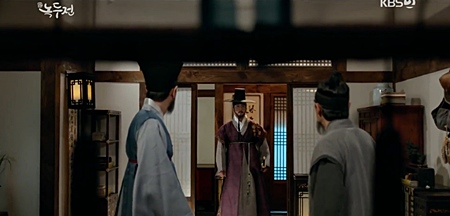
(2) The character or characters are shot against the light.


(3) The character or characters are placed in a quadrant and sometimes shot with a Dutch angle.


I. Other lessons in photography

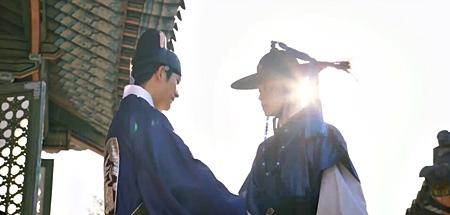
Lens flare, shooting against the light
Focal center of interest
Conveying depth through foreground and background blur
Warm colors
Lines of direction, partial frame
Reflection
Leading lines
Shallow depth of field
Bokeh (aesthetic quality of the blurred areas of a photo
Short siding, shooting against the light
High angle shot
Out of focus foreground element as a partial frame
Natural frames
Sidelighting
Warm colors
Warm colors, foreground and background blur
Background blur
Bokeh
Shallow depth of field
Natural frames
Shallow depth of field
Linear perspective, low angle shot
Shooting against the light
Reflection, shallow depth of field
Natural frames
Symmetry and balance
Shooting against the light

Monday, March 02, 2020

“SKY Castle” synopsis by episode (Eps. 1-20, no spoilers) with in-depth analysis of its cinematography


Jump to synopsis of Ep. 1-2; 3; 4; 5; 6; 7; 8; 9; 10; 11; 12; 13; 14; 15; 16; 17; 18; 19; 20 (Finale); How I wrote these episode summaries with no spoilers; Cast of characters; Historical backgrounders and other information; Lessons in cinematography and photography from “SKY Castle”

From Wikipedia: “Sky Castle” is a 2018-2019 South Korean television series (genres: satire, drama, black comedy). The highest-rated drama in Korean cable television history, it is about the college entrance examination, private education, and the medical field in South Korea. It was written by Yoo Hyun-mi, who wrote the 2012 hit “Bridal Mask” (aka “Gaksital”).

“SKY Castle” won Best Drama awards in the 12th Korea Drama Awards and the 24th Asian Television Awards; it also won the Best Director award in the 55th Baeksang Arts Awards. It has been broadcast in Malaysia, Indonesia, Thailand, Philippines, Sri Lanka, and India.

The word “SKY” is an acronym used to refer to the three most prestigious universities in South Korea: Seoul National University, Korea University, and Yonsei University. The term is widely used in South Korea, both in media broadcast and by the universities themselves.

How I wrote these episode summaries with no spoilers


1. I assumed that you will be reading these summaries and watching the videos chronologically.

2. I narrated some of the main actions in each episode without revealing the plot’s twists and turns.

3. At the beginning of each summary starting with Episode 3, I placed in a table a recap of the major twists and turns of the previous episode. But because you have already watched the video of the previous episode, they aren’t spoilers anymore.

4. I followed this structure all throughout, except for Ep. 20 (Finale) where I included some spoilers. Reason - most people want to know if the drama has a happy ending or a sad ending before they invest the time in watching it.

Cast of characters:


Kim Joo Young
(topnotch academic coach)
Kang family: Joon Sang (father, an orthopedic surgeon); Suh Jin (mother, who relentlessly drives her daughters towards academic success); Yeh Su (eldest daughter); Yeh Bin (youngest daughter)

Hwang family: Chi Young (father, a neurosurgeon); Soo Im (mother; writer of children’s books); Woo Joo (son; the competitor of Yeh Su in admission to Seoul National University’s Medical School)

Hye Na
(Yeh Su’s academic
rival and the love
interest of Woo Joo)
Cha family: Min Hyuk (father; a law professor who drives his twin boys to reach the top of the academic and professional pyramid); Seung Hye (mother, who’s constantly pressured by her husband’s ambitions); Se Ri (daughter, a student in Harvard University): Suh Joon and Ki Joon (twins)

Woo family: Yang Woo (father, an orthopedic surgeon); Jin Hee (mother, who copies everything that Suh Jin does); Soo Han (14-year old son, who’s academically lazy and wants to run away from home)

From top left, clockwise: Kang family,
Hwang family; Woo family, and Cha family


Episodes 1-2


Suh Jin organizes a party in honor of her friend Myung Joo, whose son Young Jae has been admitted into the prestigious Seoul National University’s Medical School. Her husband Joon Sang objects to holding the party, but she pushes through with it in order to learn Young Jae’s “portfolio" (grades, list of academic club memberships and extra-curricular activities) that her daughter Yeh Su can use as her guideline. She invites to the party her friends from the exclusive, ultra-rich neighborhood known as “SKY Castle.”

Suh Jin and Seung Hye find out about the highly-recommended academic coaches who can guarantee entrance into the SKY universities. One of the coaches, Kim Joo Young, chooses to train Suh Jin’s daughter Yeh Su but rejects Seung Hye’s twins. Later, Suh Jin begs her mother-in-law to help pay for Kim Joo Yung’s extravagant fees.

Kim Joo Young finds out that another student, Woo Joo, tied with Yeh Su for the top spot in academics; she orders Suh Jin to befriend Woo Joo’s mother, Soo Im.

Myung Joo returns alone from her family’s foreign travels; later on, her husband and her son Young Jae disappear from SKY Castle.

Woo Joo and his parents move into the house previously owned by Myung Joo. During their first meeting, his mother Soo Im recognizes Suh Jin as someone from her high school days.


Episode 3


Eps. 1-2 recap:

Young-jae refuses to continue with his medical studies and cuts off ties with his parents. Deeply depressed, his mother Myung Joo takes her own life.

Soo Im, who grew up in an orphanage, asks Suh Jin if she is her high school friend, Mi Hyang. But Suh Jin denies it.

Soo Im’s husband, Chi Young, is appointed to the position in the hospital that was left vacant by Young Jae’s father.

After reading Young Jae’s diary, Suh Jin confronts Kim Joo Young and then slaps her.
Through Young Jae’s diary in his tablet, Suh in finds out about Kim Joo Young’s connection to Young Jae’s decision to leave his parents and his studies. She thinks that Kim Joo Young destroyed Myung Joo’s family and could destroy her own family.

After firing Kim Joo Young as Yeh Su’s academic coach, Suh Jin begins looking for another coach.

While the conflict in the hospital between Chi Young and Joon Sang intensifies, Seung Hye and Soo Im start becoming friends. Finding out that Soo Im is a children’s book author, Seung Hye invites her and her son Woo Joo to join the Sky Castle book club. But, later on, conflicts arise in the club when Woo Joo contradicts Yeh Su's interpretation of the book being discussed and Soo Im offends Min Hyuk by calling the book club an utter comedy.


Episode 4


Suh Jin threatens Soo Im not to reveal her past to anyone in Sky Castle.

Despite Suh Jin’s objection, her husband Joon Sang joins the next session of the book club and then votes on whether the club should be continued or disbanded.

Seung Hye and Min Hyuk get into another fight after he vents his anger and frustration on one of the twins by locking him up in the vault-like study room.

Soo Im decides to write a book about teenagers; on her way to Yeh Bin’s school for an interview, she sees Yeh Bin, Soo Han, and their classmates in a convenience store.

When Yeh Su continues to nag her and becomes frantic about the upcoming midterm exams, Suh Jin begs and bribes Kim Joo Young to come back as Yeh Su’s coach. But Kim Joo Young refuses to answer her calls; she also entertains Seung Hye and Min Hyuk’s offer for her to coach their sons.

In the hospital, Chi Young gets into trouble with an idol he’s scheduled to operate on; with Joon Sang’s blessing, Yang Woo contacts all his friends in media to publicize what happened.

Episode 5: “At Any Cost”


Ep. 4 recap:

The book club is disbanded.

The hospital president steps in and saves Chi Young from Jang Soon and Yang Woo’s plan to discredit him.

Soo Im sees Yeh Bin, Soo Han, and their classmates shoplifting in a convenience store.
After Suh Jin begs on her knees, Kim Joo Young accepts being Yeh Su’s coach again. But as Suh Jin leaves, Young Jae barges into the office and attacks Kim Joo Young with a knife.

Suh Jin and Jin Hee warn Soo Im not to interfere with their kids. But later on, Soo Im catches Yeh Bin shoplifting again.

In the hospital, a distraught man creates chaos by threatening to kill the surgeon who operated on his mother.

When Kim Joo Young returns as Yeh Su’s coach, Min Hyuk feels insulted and decides to coach his twins by himself. But, concerned with the welfare of her twins, Seung Hye orders some workers to demolish the vault-like study room’s door and walls.

In Shinhwa High School, Hye Na questions her history teacher’s methods and argues with Yeh Su. Later, when Teacher Jo notices that Yeh Su has become jealous of Hye Na because of Woo Joo, he reports it Kim Joo Young.

Episode 6: “Meritocracy”


Ep. 5 recap:

After cutting all of Seung Hye’s credit cards with a pair of scissors, Min Hyuk demands that she repair the study room within three days.

Chi Young accepts the president’s offer for him to become executive director of Joonam University Hospital.

Suh Jin pays off the convenience store’s owner to delete the footage of Yeh Bin’s shoplifting.

Hye Na’s mother calls up Joon Sang.
Hye Na’s mother, Eun Hye, calls up Joon Sang, asking for a favor. Joon Sang tries to call her back later on, but he hangs up when Suh Jin enters his room.

Seung Hye and Min Hyuk agree that if their sons improve with their academics by following his method, she will have the vault-like study room restored.

Soo Im becomes interested in Hye Na and asks Woo Joo to invite her to their house. But Woo Joo says that they’re not really close and that he just worries about Hye Na’s sick mother. After Woo Joo leaves, Chi Young assures Soo Im that she’s doing well as a mother.

In the hospital, a disgruntled, former patient appears and chases after Joon Sang with a knife.

Yeh Bin finds out about the deal that her mother made with the owner of the convenience store; after Suh Jin picks her up, she threatens to give herself up to the police.

In a coffee shop, a woman goes up to Kim Joo Young, calls her Jennifer, and inquires about Kay. But Kim Joo Young brushes her off.

After Yeh Su mocks her for getting poor grades in school, Yeh Bin steals her mother’s bag and some jewelry and then runs away.

Episode 7: “Never-ending Rivalry”


Ep. 6 recap:

Soo Im is Woo Joo’s stepmother.

Joon Sang uses his gas gun to defend himself against the disgruntled, former patient.

Kim Joo Young goes some place and hands over some crayons to Teacher Jo, who gives them to a teenage girl named Kay.

Soo Im and Yeh Bin find Young Jae’s diary in the tablet.

Soo Im stops Yeh Bin from reading Young Jae’s diary any further, and later on, Suh Jin tries to explain everything to Yeh Bin.

Flashback ... when his parents kick Ga Eul out of the house, Young Jae goes berserk, and his father threatens to disown him.

After a meeting with all of Yeh Su’s tutors, Kim Joo Young scolds her, saying that, despite all her advantages and resources, Hye Na is still better than her.

Yang Woo’s back pains become worse, but his wife Jin Hee tells him not to trust Joon Sang and instead ask Chi Young to operate on him.

After redesigning the study room, Seung Hye tries to soothe Min Hyuk’s wounded pride and change his attitude towards their sons’ upbringing and education.

The rivalry between Yeh Su and Hye Na increases when both of them decide to run for school president.

Episode 8: “At Gunpoint”


Ep. 7 recap:

Hye Na supports her mother’s medical needs by illicitly doing a schoolmate’s requirements in exchange for money.

Suh Jin orders Kim Joo Young to help Yeh Su become the school president. As they’re saying goodbye, Myung Joo’s husband drives up and asks Suh Jin for Kim Joo Young’s contact number.
Young Jae’s father (Park Soo Chang) forces Kim Joo Young into his car and drives off, but Suh Jin quickly follows them.

Later on, in a bar, Park Soo Chang tells Joon Sang how Kim Joo Young destroyed his family. At home that night, Joon Sang orders Suh Jin to terminate Kim Joo Young’s services.

As Soo Im continues the research for her new book, she asks for Seung Hye’s help in meeting Kim Joo Young. But when Suh Jin finds out about it, she warns Soo Im to stay away from Kim Joo Young.

While Yang Woo continues to plead with Joon Sang to operate on him, Jin Hee tries to win back Suh Jin’s friendship.

Woo Joo joins Hye Na as her vice-presidential candidate; meanwhile, Suh Jin tells Yeh Su to pick one of Seung Hye’s sons as her running mate.

Kim Joo Young tells Suh Jin to blackmail Hye Na into withdrawing her candidacy.

Episode 9: “A Celebration Party”


Ep. 8 recap:

Kim Joo Young finds out about Hye Na’s illicit activities in helping a schoolmate in exchange for money.

With no other candidate, Yeh Su becomes school president.

After her mother dies, Hye Na finds out that Joon Sang is her biological father.

As Hye Na calls up Joon Sang, Suh Jin listens in secretly. Later on, with Woo-joo’s help, Hye Na begins befriending Yeh Su in school.

Flashback ... Kim Joo Young’s daughter meets an accident that leaves her mentally impaired.

With Kim Joo Young’s information, Suh Jin and Jin Hee plan to humiliate Soo Im during the party in Yeh Su’s honor.

Min Hyuk threatens to file a case against Soo Im; when Soo-im persists in writing about what happened to Myung Joo and Young Jae, her husband Chi Young asks her if she’s doing it because of what happened to her student Yeon Du.

Kim Joo Young tells Teacher Jo that they must stop Soo Im from writing her book; later on, she orders Teacher Jo to search Hye Na’s apartment.


Episode 10: “Kwak Mi Hyang's Reveal”


Ep. 9 recap:

Soo Im had a troubled student, Yeon Du, who took her own life.

Kim Joo Young tries to manipulate Soo Im by meeting her in the cemetery where Yeon Du is buried and saying that she was Yeon Du’s tutor.

Seung Hye finds out that Min Hyuk got from Suh Jin a complete list of all test questions that have been asked in their sons’ high school subjects.

Kim Joo Young finds out about the connection between Hye Na and Joon Sang.

Kim Joo Young tells Suh Jin to take Hye Na as Yeh Bin’s stay-in tutor.

Suh Jin refuses to follow Kim Joo Young’s suggestion to hire Hye Na as Ye Bin’s stay-in tutor.

Nearly all of the 200 residents of Sky Castle sign the petition; led by Min Hyuk and Suh Jin, the residents then confront Soo and demand that she stop writing her book.

Kim Joo Young continues to manipulate Soo Im by going to the cemetery on Yeon Du’s death anniversary.

Joon Sang finds out about a possible conflict between Chi Young and the hospital president; he sees his chance to get promoted, and so, he contacts Min Hyuk and asks for his help.

After the recent exams, Hye Na takes first place, one of Seung Hye’s sons takes second place, while Yeh Su lands in fourth place.

Episode 11: “Hye Na’s Arrival”


Ep. 10 recap:

During the meeting, Suh Jin is forced to confess her impoverished background as the daughter of a man who sold ox blood in a public market. Jin Hee and the other Sky Castle residents are shocked and begin ostracizing her.

Kim Joo Young finally convinces Suh Jin to accept Hye Na as a stay-in tutor.

Hye Na moves into the basement of Suh Jin and Joon Sang’s house and begins tutoring an excited Yeh Bin, despite Yeh Su’s hostility.

Kim Joo Young takes Soo Im to see and talk to Young Jae’s father. Soo Im pleads with him that her book can help save other young people in situations similar to that of Young Jae.

Because of Hye Na, Yeh Bin’s grades improve, thus qualifying her to the next higher level; finding out about it, Jin Hee asks Suh Jin to let Hye Na tutor her son Soo Han, too.

Seung Hye and Min Hyuk’s daughter, Se-ri, arrives from Harvard for the Christmas holidays. But her welcome party turns sour when Suh Jin and Jin Hee get into a fight.

Coming home from the party, Hye Na imagines herself spending happy times with her father Joon Sang and half-sister Yeh Bin. But while she’s looking at the pictures in Joon Sang’s computer, she’s caught by Suh Jin.

Episode 12: “Another Daughter”


Ep. 11 recap:

Soo Im decides to stop writing her book.

Through a DNA test, Suh Jin verifies that Hye Na is Joon Sang’s daughter.
After coming from the DNA clinic, Suh Jin catches Hye Na inside her jewelry room. With Yeh Bin insisting later on that Hye Na eat with them, she rages in silence, thinking about Hye Na’s motives in coming into her house.

Kim Joo Young visits her daughter Kay. Meanwhile, Soo Im becomes suspicious about Kim Joo Young’s claims about Yeon Du.

As he argues with his mother Jin Hee about his poor grades, Soo Han breaks all of his mother’s expensive tableware; that night, he runs away from home.

Suh Jin hears Hye Na mock Yeh Su about her unrequited love for Woo Joo; she orders Hye Na into her car and then drives out into an isolated road.

At the library, Suh Jin meets her mother-in-law and her friend; the friend turns out to be the woman who previously recognized Kim Joo Young as somebody named Jennifer from Fairfax, Virginia.


Episode 13: “Coach Kim’s Past”


Ep. 12 recap:

Soo Im finds out that Kim Joo Young lied to her about knowing Yeon Du.

Seung Hye finds out from her sister that Se-ri lied about being a Harvard University student.

Suh Jin and Hye Na strike a deal — Suh Jin will have Hye Na recognized as Joon Sang’s daughter but only after Yeh Su has been admitted into SNU’s Medical School. Hye Na agrees but on the condition that she will eat together with the family and be free to roam around the house.

Suh Jin finds out that Kim Joo Young is the suspect in her husband’s murder in Virginia.

Suh Jin searches the Internet for information about “Jennifer Kim.” Later, she meets Soo Im and asks her why she thinks Kim Joo Young is dangerous.

Seung Hye and Min Hyuk get into a fight over Se-ri; meanwhile, Suh Jin decides to confront Kim Joo Young about the murder case against her.

Hye Na becomes demanding, asking Suh Jin to redecorate her basement room and to get her a credit card.

With the help of Min Hyuk, Joon Sang continues with his scheme of being appointed as director of the hospital’s Office of Planning and Coordination by helping the hospital president with his political plans.

Young Jae reunites with his father.

Episode 14: “Yeh Su in Coach Kim’s Grasp”


Ep. 13 recap:

Kim Joo Young takes Suh Jin to her house to see Kay and to explain that the case against her was dropped from lack of evidence.

Hye Na and Woo Joo find out that Se-ri lied about being a Harvard student; later, Joon Sang also finds out about it.

Young Jae urges Soo Im to continue writing her book.

Kim Joo Young manipulates Yeh Su the way that she manipulated Young Jae.

Suh Jin finds out from Teacher Jo that Kim Joo Young knew that Hye Na is Joon Sang’s daughter.

Suh Jin fires Kim Joo Young as Yeh Su’s academic tutor. She also demands for a refund of the fees that she paid, but Kim Joo Young is unfazed.

Min Hyuk finally finds out that Se-ri never qualified for Harvard University. When Se-ri comes home, he slaps her, in front of Seung Hye and their sons.

Chi Young publishes a newspaper article questioning the “crude medical commercialism” and the “dishonest or deceitful practices
that prevail in the university hospital. The article infuriates the hospital director and angers Joon Sang.

To break Kim Joo Young’s hold on Yeh Su, Suh Jin asks for Soo Im’s help; they arrange a study group composed of Yeh Su, Woo Joo, and Hye Na. But on the way to the library, Yeh Su sees Hye Na kissing Woo Joo.

Soo Im confronts Kim Joo Young on why she lied about Yeon Du; when Kim Joo Young says that it’s the parents’ fault what happened to their children, she vows to expose her.

Episode 15: “Hye Na’s Death”


Ep. 14 recap:

Yeh Su refuses to give up Kim Joo Young as her academic coach.

During a fight with Yeh Su, Hye Na blurts out that they are half-sisters. After Suh Jin confirms it, Yeh Su storms out of their house and goes to Kim Joo Young’s office.

When Suh Jin threatens her, Hye Na says that she will publish on social media that she’s the illegitimate daughter of Joon Sang.

Later on, during Woo Joo’s birthday party, Yeh Na tells Kim Joo Young that she really wants to kill Hye Na.

During Woo Joo’s birthday party, Hye Na falls from a 4th floor balcony and is rushed to the hospital. Chi Young prepares to operate on her, but Joon Sang orders him to transfer her to another hospital.

While at the ICU waiting to be taken to another hospital, Hye Na dies.

Suh Jin finds Hye Na’s cellphone and becomes afraid that Yeh Su had pushed Hye Na from the balcony. Later on, she searches Hye Na’s room and destroys everything that could implicate Yeh Su.

The police begin investigating Hye Na’s death as a possible murder case.

Episode 16: “Woo Joo’s Arrest”


Ep. 15 recap:

Woo Joo blames his father Chi Young for Hye Na’s death; he says that it was just like when his mother died.

Kim Joo Young tells Suh Jin that they must turn someone into a scapegoat to turn attention away from Yeh Su. Later, Woo Joo is arrested for Hye Na’s death.
After the police present their evidence against Woo Joo, Soo Im and her lawyer return to the guest house where Hye Na died and begin investigating on their own.

When the police investigators won’t believe that Woo Joo was framed, Soo Im asks Woo Joo if Hye Na had a problem with anyone. Woo Joo remembers that Hye Na hated Yeh Su’s coach, Kim Joo Young.

Despite her doubts, Suh Jin allows Yeh Su to stay with Kim Joo Young for a week.

With Hye Na dead, Woo Joo arrested, and Yeh Su skipping class, Min Hyuk tells his sons to take the opportunity to become number one in their class. But his eldest son defends Woo Joo and his youngest son breaks his precious pyramid.

Jin Hee reveals to Soo Im and Seung Hye that Hye Na was Jang Soon’s illegitimate daughter.

During the funeral, Yeh Bin finds out that Hye Na was her half-sister.

Episode 17


Ep. 16 recap:

Soo Im warns Su Jin that she will reveal everything about Hye Na and Yeh Su.

Woo Joo is formally charged with Hye Na’s murder.

Joon Sang finally learns that Hye Na was her illegitimate daughter.

Suh Jin finds out that Hye Na confronted Kim Joo Young about the copies of the previous exams that she gave to Yeh Su.

Suh Jin tells Joon Sang that he himself killed Hye Na when he ordered her transferred to another hospital. Later, she also finds the audio recording that Hye Na made of her conversation with Kim Joo Young about the leaked questions in the exams where Yeh Su placed first ahead of her.

Soo Im rushes to Kim Joo Young’s office and accuses her of killing Hye Na and framing her son Woo Joo.

Joon Sang visits the columbarium where Hye Na’s remains are kept. Later, he meets his mother in a coffeeshop.

When Suh Jin confronts her about the exam leakages that enabled Yeh Su to top her class, Kim Joo Young warns her that Yeh Su could be expelled from school and fail to qualify for SNU Medical School.

Yeh Su sees Soo Im beg on her knees for her mother Suh Jin to help Woo Joo; later, she visits Woo Joo in jail.

Episode 18


Ep. 17 recap:

In remorse, Joon Sang blames his mother for everything that has gone wrong in his life.

The security guard in the Sky Castle guest house from where Hye Na fell disappears.

After overhearing Suh Jin and Yeh Su talk their suspicions that Kim Joo Young killed Hye Na, Joon Sang confronts Kim Joo Young.
Joon Sang barges into Kim Joo Young’s office, but Suh Jin stops him from taking her to the police station. Later on, Joon Sang packs his bags, leaves the house, and goes to look for his friend, Young Jae’s father.

To keep Teacher Jo silent, Kim Joo Young bribes him with a luxury apartment.

Fed up with Min Hyuk’s domineering ways, Seung Hye tells him that she wants a divorce. But Min Hyuk demands that she write a 10-page letter of repentance.

With Joon Sang suddenly taking a leave, the hospital president finds out the truth about Joon Sang and Hye Na.

Soo Im meets the woman who recognized Kim Joo Young as “Jennifer” from Fairfax, Virginia; the woman tells her Kim Joo Young’s husband wanted a divorce and full custody of Kay.

Unable to get over his guilt over Hye Na and Woo Joo, Joon Sang decides to resign from the university hospital.

Episode 19


Ep. 18 recap:

Seung Hye and her children leave their house, despite Min Hyuk’s threats.

Park Soo Chang advises Joon Sang that even if Yeh Su gets accepted into SNU Medical School, her life will be destroyed.

Despite his mother’s pleas, Joon Sang decides to forget about becoming the next hospital president. He tells Suh Jin that she and Yeh Su must confess before everyone about the leaked exam questions.

When Yeh Su, however, fares badly in the mock exams, Suh Jin accepts from Kim Joo Young the set of leaked questions for the midterm exams.
Despite Soo Im’s pleas, Suh Jin refuses again to help her and Woo Joo. Meanwhile, Yeh Bin begins to rebel, and Yeh Su is unable to sleep because of her guilt and worries.

Suh Jin and Yeh Su later on decide to accept all the possible consequences of their actions; Suh Jin brings the leaked exam questions and Hye Na’s recording of her conversation with Kim Joo Young to the police station.

The police officers raid Kim Joo Young’s office and seize all her records. At the house where Kay is staying, Teacher Jo finds out about the raid and quickly decides to take Kim Joo Young to a secure place. But she stops him and goes back to the house.

The police officers also arrest the teacher who has been supplying the exam questions to Kim Joo Young.

Kim Joo Young goes into Kay’s room (which she has not done for a very long time) and gazes at her lovingly. Later, she prepares a meal for herself and Kay.

Episode 20, Finale: “Goodbye, Sky Castle” (with spoilers)


Ep. 19 recap:

Woo Joo is cleared of the charges against him.

Suh Jin and Joon Sang beg on their knees for Woo Joo’s forgiveness.

Kim Joo Young and Teacher Jo are arrested for the murder of Hye Na and the theft of the official exam questionnaires.

Woo Joo is released from prison; later on, he decides to drop out of school to spend time finding out who he is and what he really wants to do in life. When his parents Chi Young and Soo Im try to encourage him to at least finish high school, he says that he learned from Hye Na’s death how fragile life is.

When Min Hyuk accepts all of her conditions, Seung Hye returns home with their children.

Yeh Su also drops out of school and prepares to take the GED to qualify for college; later on, she forms a study group with Seung Hye’s sons. Yeh Bin, meanwhile, continues to improve with her academic ranking.

Soo Im finishes writing her book and gives the first copies to Young Jae and his father; meanwhile, Young Jae decides to go to college and enroll in a counseling program.

Soo Im arranges for Kay to be taken cared of in a facility outside of Seoul. Later on, she brings Kay to visit Kim Joo Young in jail.

Joon Sang decides to resign from the university hospital and promises Suh Jin that he will become a better husband, a better father, and a better son. Before leaving Sky Castle for good, he, Suh Jin, Yeh Su, and Yeh Bin visit the columbarium where Hye Na’s ashes are stored.


Historical backgrounders and other information


1. Spoiler alert: “Se Ri” is the character who’s the daughter of law professor Cha Min Hyuk and Seung Hye. Her parents think that she’s a student in Harvard University, but she actually deceived her parents.

“Se Ri” is based on the Korean girl who made international headlines in 2015 by claiming to have been accepted into Harvard and Stanford. Although the girl was a student in the elite Thomas Jefferson High School for Science and Technology in Alexandria, Virginia, it turned out later on that, due to parental pressure to excel in academics, she faked her admission into these universities. For more information, please read “Korean teen fakes Harvard-Stanford university admissions in spectacular fashion - all to impress parents” (Independent) and “Student caught in Ivy League admissions lie” (USA Today).


2. The word “SKY” is an acronym used to refer to the three most prestigious universities in South Korea: Seoul National University, Korea University, and Yonsei University. The term is widely used in South Korea, both in media broadcast and by the universities themselves. (Wikipedia)

While Seoul National University is a public institution, Yonsei University and Korea University are private, research universities. Yonsei is the result of a merger in 1957 between Yonhi College and Severance Union Medical College. Severance traces its roots to Korea’s first hospital of Western medicine established in 1885 by American (Presbyterian) medical missionaries. The 2010 drama “Jejoongwon” is a fictionalized account of these American medical missionaries and their first Korean students. (The female lead star in “Jejoongwon” is Han Hye-jin, who played “So Seo No” in “Jumong.)


3. South Korean cram schools (“Hagwon”)

International viewers are oftentimes surprised upon seeing, beginning in Ep. 1, the young characters of this drama still going to classes late into the evenings. These scenes show what is known in Korea as cram schools or “hagwon.” From Wikipedia: “Hagwon is the Korean-language word for a for-profit private institute, academy or cram school prevalent in South Korea. Although most widely known for their role as “cram schools,” where children can study to improve scores, hagwons actually perform several educational functions.”

From “Hagwons in South Korea”:
A day in the life of a South Korean Student

Park leaves her home for school at 7:30 a.m. which she attends until 4:00 p.m. She returns home for a quick bite, leaving again for private lessons at her hagwon from 6:30 p.m. until 9:00 p.m.

After her hagwon lessons conclude, she heads back to school for a study session until 11 p.m.

From “Kim Ki-hoon: South Korea’s Cram School King” (The Diplomat):
Last year [2013] South Korean parents dropped $17 billion on hagwon tuition – a figure so high it even attracts investments from Goldman Sachs, the Carlyle Group and A.I.G.

For more information about Korea’s cram schools, please read (1) “Why South Koreans are trapped in a lifetime of study”, (2) “Backlash as Seoul plans longer cram school’s hours” (BBC News, 2016), and (3) “The $4 Million Teacher” (Wall Street Journal).


4. How much of reality is “Sky Castle” based on?
The wealthy in Korea are split into two. The ones in Apgujung have family wealth that’s been passed down for generations and generations so they’re not obsessed with their children studying hard while the ones in Chungdam are mostly high ranking politicians who are obsessed with their children studying hard and following their path. If you notice in ‘Sky Castle’, most of the parents of the students are high profile.

Yes, there really are coordinators who are paid 5 million won [four thousand US dollars] per hour.

5. “Study Cube”

Ep. 2 has at least two scenes that show Yeh Su and a “Study Cube.” It’s a wooden box just big enough for one person and has a built-in desk, bookshelf, white board, LED light, outlet and ventilation grill, and a footrest that serves as a massage bar. The “Study Cube” is manufactured by Emok, a Korean company, and retails for about US $2,200.

From “Box set - TV drama stirs debate over South Korea's cutthroat education culture” (Reuters):

Sales of the “studycube,” a 2.5 million won ($2,235) wooden closet less than one square metre in size where students can hide themselves away to focus on their homework, for example, have soared eight-fold after it was featured in the show [SKY Castle], according to the company which makes it.

The Reuters article says that these “study cubes” appeared in Korea about seven years ago. One student interviewed in the article said that if parents forced their children to use the studycube, it would be like a “rice chest,” which is a reference to the historical figure Crown Prince Sado, who died after he was locked up in a rice chest by his father King Yeongjo. (You can see this scene in Ep. 1 of “Yi San” aka “Lee San, Wind of the Palace.”)

For more information, please watch this YouTube video titled “SKY Castle Study Cube: A Human Cage?”

6. Korean drama ‘SKY Castle’ blamed for inspiring copycat murder of doctor
A popular South Korean TV drama has come under fire for allegedly triggering a copycat crime after a doctor was stabbed to death by a patient in Seoul this week, underscoring the vulnerability of the country’s medical personnel.

The victim, a 47-year-old psychiatrist, died in hospital from multiple chest wounds two hours being assaulted.

7. Fewer top CEOs went to SKY universities (Korea JoongAng Daily)
The proportion of CEOs at the top 500 companies in Korea that graduated from the three most prestigious universities - Seoul National, Korea and Yonsei - has hit a three-year low.
Graduates of the so-called SKY - named after the first letters of their names - universities made up 44.8 percent of CEOs, down 4.1 percentage points from last year and 7.7 percentage points from three years earlier, according to CEO Score, a corporate management information provider, on Wednesday.

8. How to get into SKY Universities (Yonsei, Korea University)


9. The Korean Ivy League: SKY Universities


10. A Day in the Life: Yonsei University Student


Lessons in cinematography and photography from “SKY Castle”


A. In-depth analysis of the drama’s cinematography

1. Eyeline match and the 180-degree rule - for the most part, this drama’s cinematographer followed what is called “eyeline match” and the “180-degree rule.” But I’ve seen several instances when the cinematographer (or probably the editor) did not follow eyeline match. Look at the examples below:

Ep. 1


In the picture above, Myung Joo is frame left and looking to the right; based on eyeline match, viewers would expect that the person she’s talking to (Suh Jin) would be on the right side of the frame (or center frame) and looking to the left. But in the picture below, Su Jin is frame right and looking to the right.


Ep. 9

In the first picture below, Kim Joo Young is frame right and looking to the left; thus, viewers would expect that the person she's speaking to (Suh Jin) would be shown frame left and looking to the right. Instead, as you can see in the second picture below, Suh Jin is frame right and looking to the left.


But, as Shakespeare said, there’s a certain method to the cinematographer’s madness; despite the eyeline mismatch, the viewer’s head or eyes don’t have to move from side to side in looking for Suh Jin (whether in the picture for Ep. 1 or for  Ep. 9). She’s in almost the same exact spot where Myung Joo or Kim Joo Young was in the previous frame. (Notice that I used the qualifier “almost” because sometimes, the cinematographer misses synchronizing the shots.)

2. Recurring technique (multiple images) - in several scenes, the cinematographer creates multiple images of a character, as you can see in the pictures from Ep. 1 and Ep. 9 below. (Of course, instead of being created in-camera, these images could have been added during the post-processing stage.) The cinematographer seems to use these images to show that a character is anxious or confused. But although these images are gorgeous, they are unnecessary. Why? It’s not only because these images call attention to themselves, but also because this is what actors are trained or have the natural ability to do, that is, show different kinds of emotions with their facial expressions, body language, nuances in speech, etc.

For more information on how cinematographic techniques can overwhelm actors and acting, please read “The Ongoing Crisis of Cinematography” by Film Critic Hulk.


3. Changes in aspect ratio - The term “aspect ratio” refers to the proportion of an image’s width to its height. It is commonly expressed as two numbers separated by a colon, for example, 16:9, where 16 is the width, 9 is the height. (16:9 is the aspect ratio for computer monitors, mobile devices, standard YouTube videos, and HD television.)

Aspect Ratios - Tomorrow’s Filmmakers


Video Aspect Ratio Explained -
How Different Aspect Ratios Affect Your Video Style


The cinematographer of “SKY Castle” imitates Wes Anderson’s style (in his award-winning film “The Grand Budapest Hotel”) of using different aspect ratios when showing scenes of the present or of the past. For more information, please read “The Aspect Ratios of The Grand Budapest Hotel” and “What’s the significance behind the three different aspect ratios in “The Grand Budapest Hotel?”

For example, in Episode 4, when Soo Im and Suh Jin confront each other, the cinematographer uses 16:9 aspect ratio. (I found a Reddit thread that says “SKY Castle” actually uses 16:9 aspect ratio but was made to appear like it’s wider at 21:9 by adding the horizontal black bars.) But when Soo Im flashes back to their high school days, the cinematographer uses a squarish aspect ratio, either 1.33:1 (the traditional TV box) or 1.37:1 (the so-called Academy ratio). I’m not sure of what ratio the "SKY Castle" cinematographer used to shoot scenes from the past, but since 1.33:1 and 1.37:1 are almost the same, most people use the term “4:3” to describe both of these ratios.

Present event: Notice that the black bars are at the top and bottom portion of the frame (“letterboxing”).


Past event: Notice that the black bars are now on the left and right sides of the frame (“pillarboxing”).


In Ep. 9, you can see an extended use of the 4;3 aspect ratio (“pillarboxing”) when Soo Im remembers her troubled student, Yeon Du, who took her own life.

4. The miserable ugliness of short siding (reverse lead room) - I explained why I hate “short siding” in my synopsis and review of “Mr. Sunshine.” My dislike for short siding has only been reinforced by the numerous short-sided shots of one character confronting another in “SKY Castle.” From my point of view as a photographer who learned and who practice “filling the frame,” “reading pictures from left to right,” and using “negative space,” this drama’s short-sided shots are some of the ugliest shots that I have ever seen in K-dramas; for examples, see the pictures below of Suh Jin from Ep. 8, Kim Joo Young in Ep.9, and Min Hyuk in Ep. 3.


In contrast, look at the two images below of Seung Hye and her husband Min Hyuk from Episode 1. They’re arguing (again) about how to raise their sons, especially in regard to academics; Min Hyuk is verbally and emotionally abusive towards Seung Hye. To emphasize the fragile relationship between them, the cinematographer places Min Hyuk and Seung Hye at the edge of the frames, with lots of lead room. What can I say? These shots are brilliant.


In contrast to “SKY Castle,” the 2016 blockbuster “Descendants of the Sun” hardly ever used short siding. Also, if you review the opening scene of Quentin Tarantino’s “Inglorious Basterds” featuring the German colonel and the French farmer, you won’t see a single short-sided shot. And yet, the tension in that scene is so palpable; Tarantino says that scene is probably the best in his career.

B. Other lessons in photography from from “SKY Castle”

Natural frames, low angle shot
Conveying depth through foreground and background blur
Establishing shot
Line of direction
Low angle shot, keystoning, Dutch angle
Reflection
Reflection
Rule of Odds, low angle shot, keystoning
Rule of Odds
Foreground and background blur, sidelighting
Steelyard principle
Symmetry and balance, vertical lines
Rim lighting
Chiaroscuro (interplay of light and shadow). low-key lighting
Symmetry and balance