Friday, October 12, 2007

Photojournalism (31): Photo essays and sequence shots

Update as of September 18, 2023:

If you’re a high school or grade school student in the Philippines who’s joining the photojournalism contest in the division, regional, or national press conference, I’m offering two free resources to you :

A. 900-plus interactive exercises on English grammar, vocabulary, reading comprehension, verbal analogy, etc (with around 200 megabytes total file size). The exercises have time limit and automatic scoring, with an average of 10 items per exercise.

Examples of these interactive exercises are: Common English grammar errors: Exercise 01 (nouns - confusions of number); Phrasal Verbs: Expressions with Go; English Placement Test (45 items).

B. 200-plus resources (JPG, PDF, MP4, etc.) on photography and photojournalism, with 600-plus megabytes total file size. For some examples of these resources, surf to the “Free photography e-books, cheat sheets” page.

For the download links and more information about how to use the interactive exercises, please surf to my “Better English resources and exercises” blog. Please inform your journalism teacher/schoolpaper adviser or your parents about these resources before downloading them.

If you have any question about downloading or using these free resources, please email me (after informing your journalism teacher/schoolpaper adviser or your parents). I’ll be able to reply to you within two to three days; if you don’t see my reply in your Inbox, check your Spam folder. Or, you can text me.

Also, if you win in the photojournalism contest at whatever level (district, division, regional, or national), you can send me your prizewinning pictures, and I will feature them in a blog post.

Atty. Gerry T. Galacio
gtgalacio@yahoo.com
0927-798-3138


“Hit or miss, trial and error, better luck next time, try and try again, next time make sure you’ve got film on your camera before you shoot, okay?”

These expressions best describe the emotions, the frustrations, the experiences you’ll have as you start to learn about photography. Some experiences you’d rather forget, some missed shots you’ll regret forever but just like life, photography is one activity where learning means building up through your experiences, growing by stages ... As rock star Alanis Morissette said in a hit song many years ago, “You live, you learn!”

Select your shots

One stage that you’ll go through as the photography bug hits you, is indiscriminate shooting. If you see something, you shoot it. If it’s out there, you shoot it. If something moves, you shoot it. You buy some more film, you shoot again ... As your skills improve however, you’ll become more selective in your shots. Your standards will become higher, and you’ll also realize that you don’t have enough money to buy all the film you need or want! (The high cost of film and processing, and the immediate results are some of the reasons why digital photography is such a big hit these days.)

Example of sequence shots

Remember our discussion of types of pictures and sequence shots? A sequence, as the term denotes, is a series of pictures of one subject, shot one after another. A photo sequence may or may not illustrate a certain idea or theme, but the series of pictures provides the viewers with more visual information about your subject. (Later on, you will learn that you can create a photo essay out of sequence shots.)

A. “Thoughts on graduation day” (photo essay using sequence shots with captions)


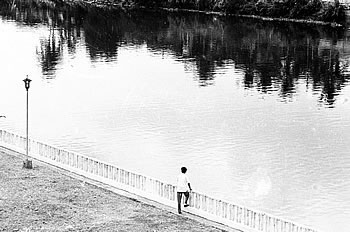
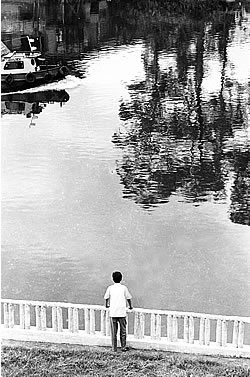
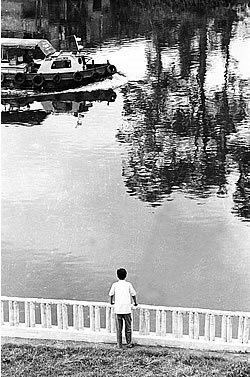
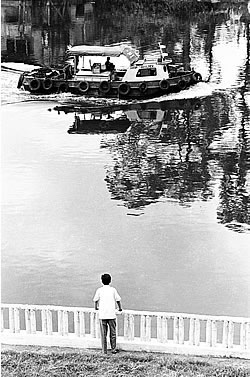
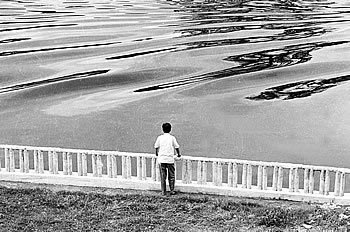
In the following pictures, I asked my Class 1990 yearbook staffer Eric to pose by the dike at the back of Rizal High School in Pasig (formerly credited in the Guinness Book of World Records as the world’s biggest high school). I was on the 3rd floor of a building with my beloved Canon AE-1 Program camera fitted with a Vivitar Series 1 70-210 mm zoom lens.

I wanted to express the contemplative mood and loneliness a senior normally goes through as graduation time comes near. I just wanted two elements in my picture - Eric and the still waters of the Marikina River flowing behind the Rizal High School campus in Pasig City. The first two pictures of the scene below were the ones I needed to express what I wanted.

But then, I saw the tugboat coming from the left. I switched on the power winder of my camera. I shot about 20 frames all in all as the tugboat passed Eric and created ripples on the water. Serendipity! I had a photo essay that could be used to illustrate life cycles, transient moments, peace and serenity, consequences and change!

We have spent four memorable years here in our beloved school, and the days leading to our graduation day have seen a thousand questions tumbling in our hearts and minds. Where do we go from here?; Rizal High School 1990; photo by Atty. Galacio
We have spent four memorable years here in our beloved school, and the days leading to our graduation day have seen a thousand questions tumbling in our hearts and minds. Where do we go from here?
For some, the future beckons brightly as they are blessed not only with talent and intelligence but also with open doors and countless opportunities.For some the future looks dark and dreary, as innocent adolescent pursuits give way to serious concerns for jobs and financial security, with a college education merely a mirage in the dry desert sand of our crushed hopes and ruined dreams. And still for some of us, there is simply no future to speak about.Rizal High School 1990; photo by Atty. Galacio
For some, the future beckons brightly as they are blessed not only with talent and intelligence but also with open doors and countless opportunities.For some the future looks dark and dreary, as innocent adolescent pursuits give way to serious concerns for jobs and financial security, with a college education merely a mirage in the dry desert sand of our crushed hopes and ruined dreams. And still for some of us, there is simply no future to speak about.
Still other questions haunt us as we rush from one graduation practice to another, from one class party to another …Will our friends in high school remember us through the passing of the years, through the changes in our lives, and through the distance of separation made more poignant when no letters come and birthdays are forgotten?; Rizal High School 1990; photo by Atty. Galacio
Still other questions haunt us as we rush from one graduation practice to another, from one class party to another …Will our friends in high school remember us through the passing of the years, through the changes in our lives, and through the distance of separation made more poignant when no letters come and birthdays are forgotten?
Will our friends still be there for us when problems come and solutions seem so elusive? Will our friends remain true to us even as they meet other people and encounter new experiences, or will the friendship we thought would never end, prove finally to be weak and temporal?; Rizal High School 1990; photo by Atty. Galacio
Will our friends still be there for us when problems come and solutions seem so elusive? Will our friends remain true to us even as they meet other people and encounter new experiences, or will the friendship we thought would never end, prove finally to be weak and temporal?
Will our friends still be there for us when problems come and solutions seem so elusive? Will our friends remain true to us even as they meet other people and encounter new experiences, or will the friendship we thought would never end, prove finally to be weak and temporal?; Rizal High School 1990; photo by Atty. Galacio
Will the joys and pains, heartbreaks and happiness we all shared be simply swept aside, never to be remembered, never to be allowed even a little space in our memories? Will the hopes and ambitions, the secret dreams we have dared to share only with our truest friends, be simply forgotten or revealed to others in careless, thoughtless ways?
Will the joys and pains, heartbreaks and happiness we all shared be simply swept aside, never to be remembered, never to be allowed even a little space in our memories? Will the hopes and ambitions, the secret dreams we have dared to share only with our truest friends, be simply forgotten or revealed to others in careless, thoughtless ways?; Rizal High School 1990; photo by Atty. Galacio
Will our names be remembered? Will our friendships last? Will our friends still be our friends? Life oftentimes has a cruel way of frustrating our dreams, of crushing our ambitions, of ending our friendships …
Will our names be remembered? Will our friendships last? Will our friends still be our friends? Life oftentimes has a cruel way of frustrating our dreams, of crushing our ambitions, of ending our friendships …; Rizal High School 1990; photo by Atty. Galacio
But our friends have made a promise always to remember … Life indeed must move on, to bigger things, to better places … and we grow up, physically, emotionally and intellectually, and we will no longer be the kind of persons we were in our high school days …
But our friends have made a promise always to remember … Life indeed must move on, to bigger things, to better places … and we grow up, physically, emotionally and intellectually, and we will no longer be the kind of persons we were in our high school days …; Rizal High School 1990; photo by Atty. Galacio
The saddest truth in the whole universe is that time changes everything.
The saddest truth in the whole universe is that time changes everything; Rizal High School 1990; photo by Atty. Galacio
But our friends have made a promise always to remember …
But our friends have made a promise always to remember …; Rizal High School 1990; photo by Atty. Galacio
But as we lie awake at night, the caressing wind carries to our consciousness the melodies of songs that brought wonder and meaning to our lives, songs that signified every turning point in our destinies, songs that we once shared and sang together as friends …
But as we lie awake at night, the caressing wind carries to our consciousness the melodies of songs that brought wonder and meaning to our lives, songs that signified every turning point in our destinies, songs that we once shared and sang together as friends …; Rizal High School 1990; photo by Atty. Galacio
Slowly, the half-forgotten lyrics become clearer and they bring us back to our high school days …
Slowly, the half-forgotten lyrics become clearer and they bring us back to our high school days …; Rizal High School 1990; photo by Atty. Galacio
Indeed, we have promised always to t remember. We can always remember. We must always remember …
Indeed, we have promised always to t remember. We can always remember. We must always remember …; Rizal High School 1990; photo by Atty. Galacio Pssst, Eric! It has been eighteen years since 1990 when I asked you to pose by the dike. You can move away from the dike now, and go on with your life, okay?

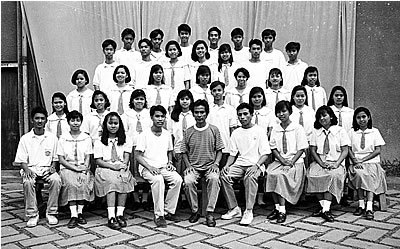
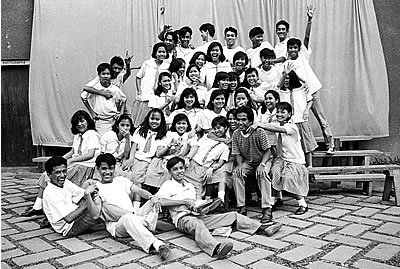
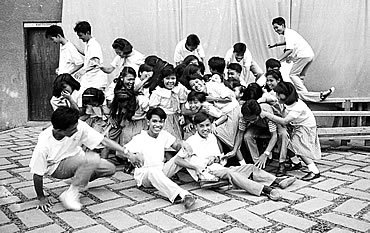
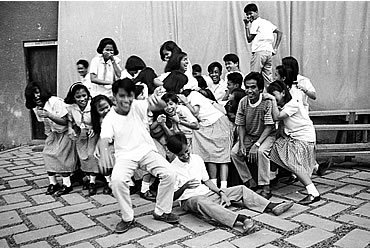
B. The pictures below are sequence shots of a senior class having their yearbook picture taken.


I shot these pictures way back in 1991 with my beloved Canon AE-1 Program camera fitted with an FD f/1.8 50 mm lens, a yellow-green filter, and a power winder. After I shot the formal class picture, the fun began. If you mouse over each picture, the caption will appear for a few seconds.



Sunday, October 07, 2007

Photojournalism (29): Shooting at night

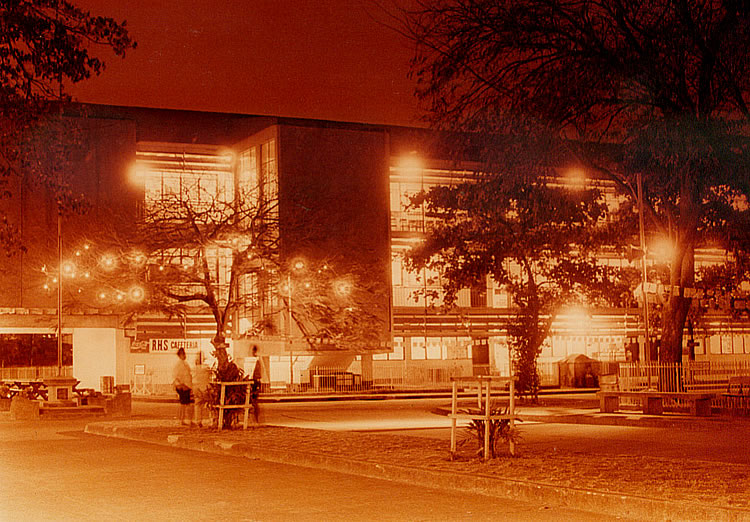
Shooting at night; B-setting; from a black and white negative, I created a color picture by experimenting with the filtration settings of Kodak's Create-a-Print machine; Rizal High School 1993; photo by Atty. GalacioWhen darkness sets in, beginning photographers like some of you, would just pack away your cameras and go home to watch your favorite telenovela. Some of you, however, might automatically turn on your camera flash. While your flash is an oftentimes indispensable tool, it creates harsh shadows, and there are situations when your flash output won’t be enough to properly illuminate your subject.

Free articles and cheat sheets from Digital Camera World:

Night photography: how to shoot popular low-light scenes

Night photography: set up your camera to shoot anything

12 common errors of night photography (and how to fix them)

Night photography tips: 9 essential steps for beginners
In this kind of situation, you have to use the B-setting on your SLR camera’s shutter speed dial. With a lot of camera models, the slowest shutter speed is 30 seconds. After this number, you’ll find the letter “B” on the shutter speed dial. With some advanced camera models, there’s no longer any B-setting. Instead, you will find slow shutter speeds of 45 to 60 seconds or even more.

(I have been using a borrowed amateur model digital camera for only a short period of time. So I don’t know yet how to shoot pictures at night using a digital camera. But once I learn how, I will tell you about it, okay?)

Here’s how to use the B-setting:


(1) Place your camera on a tripod, a table or any sturdy structure.

(2) Attach a cable release to your shutter release button.

(3) Focus on your subject.

(4) Fire the shutter, lock the cable release.

(5) Release the lock after you reach your desired exposure time.

Use a watch with a seconds hand to time your exposures. Keep a flashlight handy also, so you can always check on your settings and surroundings. Make sure you’re not stepping on a snake or something, okay?

Reciprocity failure

Take note that with long exposure times, "reciprocity failure" will occur. What does this mean? The effective ISO rating of your film decreases, resulting in underexposed shots. What’s the solution? Adjust your lens opening; using still longer exposure times will only worsen the problem. (If you're using a digital camera, there's no need to worry about reciprocity failure, okay?)

Believe it or not, the picture above (which I took way back during the 1993 National Secondary Schools Press Conference held in Rizal High School in Pasig) became controversial. When we published this picture in our yearbook, a lot of people said that the three people on the lower left hand corner were ghosts! They said, “Look at their clothes, they’re like those worn by our Spanish ancestors. And look, their images aren’t solid. They’re transparent, the light just goes through them.”

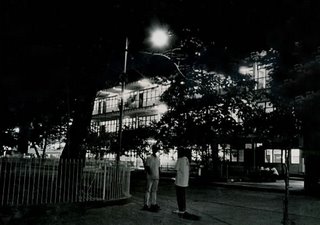
 Shooting at night; B-setting; Rizal High School 1993; photo by Atty. Galacio Look at the picture above. These aren’t ghosts; they’re my staffers whom I asked to pose underneath the lamp post. I used f/5.6 as lens opening and 30 seconds as shutter speed. Somebody walked by, between my staffers and my camera which was set on a tripod. But where is he in the picture? No matter how and where you look, you won’t find that guy. Why? He did not stay in one place long enough to be recorded in my film.

Coming back to the controversial picture above, these three people (delegates from Region 10 or 12, if I remember right) stayed in their place long enough for them to be recorded on film. But since they were moving about a little (I used f/8 at 45 seconds), their images aren’t solid but blurred, almost transparent, lacking solidity. This kind of images is called “ghost images.” Ghost images, not actual ghosts, okay?

Light streaks and trails

If your subject includes fast moving vehicles, you won’t be able to record them on film since they wouldn’t be staying in one place long enough to be recorded. But you will be able to record their lights in terms of streaks and trails. If you’re shooting color film, the light trails will be red (for brake lights) and yellow (for headlights).

Auras and Kirlian photography


Psychics believe that every person projects an “aura” which are visible to them but not to others. “Kirlian photography,” a process developed by the Russians (I stand to be corrected on this, okay?) is said to be able to record on film a person’s aura. Actually, this process records electrical discharges emitted by the human body.

How to focus when shooting at night

Because of the darkness, you might find it difficult focusing on your subject. Solution? Try focusing on distinct points of light near your subject, like the streetlights in the picture below. I took this picture of the floodway in Pasig sometime in 1997 or 1998. I used my beloved Canon AE-1 Program camera and a Vivitar 28-210 mm zoom lens to take this shot. The streetlights seem a bit out of focus; that’s because I took the shot from the middle of the Legaspi Bridge spanning the two banks of the floodway. A lot of vehicles were moving across the bridge, and, although mounted on a sturdy tripod, my camera would shake a bit as vehicles passed by. (As motorists passed by me, some would tease me by saying, “Kami na lang ang kunan mo!”)

 Shooting at night; B-setting; At nighttime, focus your camera using points of light like street lamps; Legaspi bridge, floodway in Pasig City, 1997 or 1998; photo by Atty. Galacio Also, you’ll notice that when you have locked your cable release, you wouldn’t be able to see your subject through the viewfinder. This “image blackout” occurs because the rapid return mirror is blocking your view of the image.

Bracketing your shots

It is really only experience which can tell you how long your exposures should be. Always bracket your shots, therefore. This simply means to take several shots using different exposure times. (Of course, with photo editing software, you can edit and manipulate your images to your heart’s content and to achieve the look you want.)


 Shooting at night; B-setting; Rizal High School 1993; photo by Atty. Galacio If you use small apertures or lens openings (more on this topic later on), you’ll create cross screen patterns similar to the effect created by starburst filters. In the picture above, you can see these patterns in the lights hanging on the trees.

On the bottom portion of the picture above, what can you see? Oh, my ghosts!

Monday, October 01, 2007

Photojournalism (28): Silhouettes

Silhouette; from a black and white negative, I created a color picture by experimenting with the filtration settings; Rizal High School 1993; photo by Atty. Galacio
Silhouette of branches of acacia tree against a bright, cloudy sky; from a black and white negative, I created a color picture by experimenting with the filtration settings; Rizal High School 1993; photo by Atty. Galacio The dictionary defines “silhouette” as an “image in which only the outline shape of a dark subject appears against a lighter background.” This word came from Etienne de Silhouette, the Minister of Finance in France way back in 1759. He cut out portraits of people from black paper and pasted them on light-colored backgrounds. Incidentally, the original Book of Lists listed “silhouette” as one of the ten most beautiful sounding words in the English language.

Shooting against the light creates silhouettes


Remember our lesson on the quality and direction of light? Generally, you should shoot your subjects with the sun behind you. Shooting against the light (“contra luz”) creates high contrast that leads to burned out highlights and solid shadows.

If you do want, however, to create silhouettes, shooting against the light is exactly the thing to do. By taking your exposure reading from the brightly-lit background, objects in the foreground will be reduced to their outlines. Sometimes, however, to show the context of your image, you should have some details still visible in the foreground.

Backgrounds for silhouettes

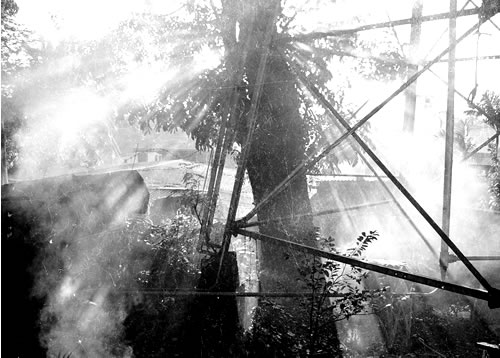
Usually, the bright sky serves as the background for silhouette shots (as in the two pictures above). You can also use water backgrounds, shaded subjects against sunlit backgrounds, and atmospheric backgrounds like haze, fog, and smoke (as in the picture below).

Silhouettes are created when you shoot against the light; photo by Atty. Galacio

Relevant articles:

How to Take Great Silhouette Photos With Your iPhone

How to Photograph Silhouettes in 8 Easy Steps - dPS

14 Tips for Shooting Stunning Silhouettes - Improve Photography

How to Photograph Silhouettes With a DSLR Camera - Lifewire

Tips for Shooting Killer Silhouette Photos - PetaPixel

How to capture a silhouetted sunset

Monday, September 24, 2007

Photojournalism (27): Reflections

Greek mythology tells us the story of Narcissus, a handsome young man, who passed by a river one day. Bending down to drink, he saw his reflection on the surface of the water. Fascinated with how handsome he was, Narcissus fell in love with himself. Psychologists have, therefore, coined the term “narcissism” to refer to a person’s extreme love of self.

Speaking of reflections and extremes, one extremely fine way of expressing your creativity is to shoot objects and/or their reflections on glass, windows, water, etc. Reflections can be used in a variety of ways:

(1) to create abstract designs;

(2) to portray a timeless world of dreams and fantasies; and

(3) to create romantic and nostalgic images (as in the picture below of a high school barkada obviously enjoying each other’s company).

Reflections; you can focus on either the reflection or the subject itself; if you want both in sharp focus, use a small lens opening; Rizal High School 1996; photo by Atty. GalacioShoot the reflection alone, or shoot the object and its reflection

You may choose either to shoot the reflection alone, or both the object and its reflection. When shooting both, you have to use a small aperture or lens opening (more on this topic later) to render both elements sharp. You should also focus on the reflection rather than on the object creating the reflection.

Reflections; vertical format; learning how to see; Rizal High School 1989; photo by Atty. GalacioLook at the picture above. Since you can’t turn your computer monitor upside down, stand up and then look at this picture with your head upside down. I know it’s a little bit acrobatic but hey it’s worth it! You will know what this picture is all about. The image of the trees, students and building are all repeated as reflections in the water in the foreground area. This is probably the best picture I have ever taken in my life. Hoo-ya!

I took the picture shown above way back in October 1989. I’ve noticed previously that every time it rained hard, the front area of the gymnasium of Rizal High School in Pasig would become flooded, and there would be reflections on the water of the trees and that building on the background. I decided that this would make a good subject for a photograph. And so I brought my beloved Canon AE-1 Program SLR camera everyday with me to school, and waited for the rain to come. I brought along my camera every day for one month, and it didn’t rain for one whole month! And so one day, I simply gave up and left my camera at home. Guess what happened? It rained hard that day!

I went home after the lunch break (pizza!), got my camera and loaded it with Negrapan (a black and white film manufactured in Spain). I knew I couldn’t use color film because the water was muddy brown in color; with monochrome film, it didn’t matter. I didn’t have a zoom lens at that time and so I used my Canon FD f/1.8 normal lens. I got back to school at around four in the afternoon. I focused on the reflections, and because it was late afternoon, I was forced to use a slow shutter speed of 1/30 sec. with an f/5.6 lens opening, for the right depth of field. (Later on we’ll discuss shutter speeds, lens openings and depth of field.)

Reflections; vertical format; learning how to see; human interest; Rizal High School 1991; photo by Atty. GalacioIn the picture above, I first saw the reflection of the water tank. To provide some human interest, I asked this kid to pose beside the reflection.

Learn from other photographers

My imitation and tribute to Henri Cartier Bresson, father of photojournalism; Rizal High school 1991; photo by Atty. GalacioOne way of developing your style is by “imitating” the work of photographers whose work you admire. The picture above is my imitation of Hénri Cartiér Brésson’s famous photograph of a man jumping over a puddle of water. In that classic photograph, the man and his reflection echoed the graceful pose of a dancer in a poster at the left side of the picture. I didn’t have a dancer nor a poster, but I did have a blurry student, ripples on the water, and reflections of the building and students in the background. Yes! Yes! Step aside, Hénri!

Monday, September 17, 2007

Photojournalism (26): Shadows

William Henry Fox Talbot, considered as the father of photography, once said, “Photography is the art of fixing a shadow.” Historians of photography however, are not really sure about what he meant by this statement. Anyway, shadows are fascinating subjects for your photographs.

The sun, being the primary source of light for much of photography and being much larger than the earth, creates shadows wherever the photographer or the subject may be. To borrow the title of a C. S. Lewis book, the earth is a “shadowlands” and anyone aspiring to become a good photographer, must always be on the lookout for interesting shadows. And following Fox Talbot’s definition of photography, photographers must become “shadow masters.”

Late afternoon shadows; 1990; photo by Atty. Galacio
Shadows at mid-afternoon; photo by Atty. GalacioKinds of shadows: cast or contained

Cast shadows are created on a separate subject, not on the main subject itself (like in the picture below of the shadows of the trash can and the three students passing by it).

Shadows at high noon; 1991; photo by Atty. GalacioContained shadows, on the other hand, are inside the boundaries of the subject. Most of the time, there are cast and contained shadows interplaying with one another (as in the picture below).

Cast and contained shadows;1991; photo by Atty. GalacioCreating a sense of mystery or intrigue with shadows

To create mystery or intrigue, you can exclude the object forming a cast shadow; the shadow itself becomes the main subject.
The picture below is a cropped portion of the picture above of the shadow of the trees falling upon the flagpole.

Cropped portions of shadows as abstract patterns; photo by Atty. Galacio
Notice the shadow on the cement floor; photo by Atty. GalacioAt first glance, the picture above seem to be out of place here since it looks like it’s an illustration for a lesson on converging verticals or vanishing points. Notice however, that on the cement floor, you’ll find a shadow which spells out the word “paaralan.” Our school’s main building has huge stone markers on the roof spelling out “Mataas na Paaralan ng Rizal” and every day at around 2:30 in the afternoon, the sun would cast the shadows of these markers on the floor below. As the sun sets down, these shadows disappear, only to return again the next day.

Remember that opening scene in the classic movie “Rebel Without a Cause” starring James Dean, Natalie Wood and Sal Mineo? This movie, by the way, was the inspiration for the “Rush, Rush” video of Paula Abdul and Keanu Reeves many, many years ago. James Dean got into trouble with his classmates on the first day of classes when he stepped unintentionally on the school marker.

I taught in Rizal High School from 1984 up to 1995. Every afternoon when I would see that “paaralan” shadow and students stepping on that shadow without even noticing it, I would have the urge to grab these students, hold them up by the collar, and scream at them, “Who do you think you are? James Dean?” But I would probably have gotten into trouble if I did, and so I just kept these things to myself ...

As a creative photographer, you’ve got to see photo opportunities other people miss

What’s my point? Well, one, as a creative photographer, you’ve got to see photo opportunities where other people might simply see insubstantial, ephemeral shadows on concrete floors.

Two, watch classic movies (no, “Takot Ako sa Darling Ko” starring Joey de Leon and Jenny Syquia isn’t a classic) and good music videos (like the oldie “When You’re Gone” by The Cranberries with its creative use of flare, sidelighting, and its haunting setting - the Dachau concentration camp where thousands of Jews were exterminated during World War II by the Nazis). Photography is all about images and what better way to learn about images than from movies and music videos? But choose only those music videos with a positive viewpoint and general patronage imagery, okay?

I don’t know why but a lot of photographers do not like having their pictures taken. Well, one way a photographer can be present in a picture without being obtrusive or too obvious is to include his or her shadow in the photograph (needless to say, the light source must be behind the photographer to achieve this kind of effect).

Monday, September 10, 2007

Photojournalism (25): Shooting groups; Rule of Odds

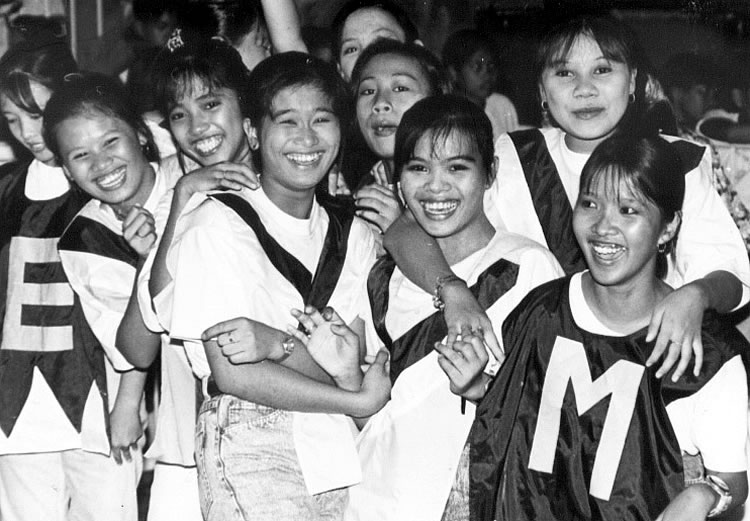
Shooting groups; focal point of interest; fill the frame; 1992; photo by Atty. GalacioThe Greek philosopher Aristotle, in describing human nature, once said: “Man is a political animal, gregarious by nature.” In simpler terms, he was saying that everyone wants to belong to or needs to belong to a group, to an association, to a club, or to a “berk” in today’s lingo.

In the picture above, we have a group of students practicing for a choral interpretation competition. I don’t know why, but these students and their costumes always make me think of a group of lemmings on the way to self-destruction.

Goal in shooting groups: convey the group’s sense of unity and belonging

It’s easier to shoot odd-numbered groups; 1996; photo by Atty. GalacioWhen you’re shooting groups, your goal is to convey to your viewers the sense of unity and belonging (like in the picture above of a group of high school friends), and the collective identity of the group. This can be done in several ways:

(1) by choosing the appropriate setting or background;

(2) the use of props or uniforms, like the uniforms of the modern dancers below;

Shooting groups; establish sense of identity through props or uniforms; photo by Atty. Gerry T. Galacio
(3) by making the members feel relaxed and comfortable so that they’ll react naturally, spontaneously with one another like the girl scouts below.

Shooting groups; establish camaraderie with your subjects; 1996; photo by Atty. GalacioFormal group shots: observe the group’s hierarchy

Group shots can be formal or informal, serious or lighthearted. When positioning the members for a formal shot, you’ll oftentimes have to follow the group’s hierarchy - officers in the front rows (like in the picture above of the Rizal High School 1992 yearbook staff), the older family members in the middle ...

Shooting informal groups: choose high POV, establish rapport with your subjects, and shoot several frames; 1996; photo by Atty. GalacioInformal group shots: anything goes

For informal shots like the picture above, you should let the individuals choose whatever positions, gestures and expressions they want. You have to establish rapport with the group members; talk to them, humor them, capture their attention by whatever silly antics you can do ...

Free articles and cheat sheets on shooting groups:

How to Take Great Group Photos (Digital Photography School)

Posing Guide: 21 Sample Poses to Get You Started with Photographing Groups of People

16 Do’s and Don’t to Photograph Large Groups

How to Take Sharp Family and Group Portraits

Ideal Lighting for Large Group Family Photos Indoors (SLR Lounge)

How To Crush Wedding Group Shots Every Time

14 Tips For Better Group Portrait Photographs
Choosing your viewpoint in shooting groups; shoot several frames

Remember our lesson in choosing your viewpoint? For group shots, you should use a high angle point of view so that everyone can be seen. Shoot several frames of the group since there will always be some people who are not ready, or with their eyes closed. By taking several shots, you can choose later on which picture contains the best facial expressions from the group members.

Focal point or center of interest; odd-numbered groups (Rule of Odds)

Compose your group shot in such a way it has a focal point or center of interest, like that girl in the middle of the front row of the very first picture in this post.

Keep in mind the “Rule of Odds” — it is easier to shoot an odd-numbered group rather than an even-numbered group. With an odd-numbered group, you can simply place one of the group members in the middle of the frame. You can then distribute the others to the left and right of that group member.

Triangular composition in shooting groups

You may also follow a triangular composition where you have several rows, with each row getting successively smaller. In the picture above, I got a triangular composition with the students forming the base and the head of Rizal’s statue being the apex of the triangle.

Shooting groups: using a triangular shape; 1993; photo by Atty. GalacioFill the frame

By whatever way you compose your group shot, make sure that you fill the frame, that there are no wasted spaces around your subject, like in the picture above of the modern dancers. Study the four corners of the subject before taking the shot. And always use a small aperture for a wide depth of field (more on this topic later).

If you’re shooting several rows, make sure that the rows are not too wide. Otherwise, you’ll have lots of empty, wasted spaces at the bottom and top portions of your picture. Remember, fill the frame with your subject! Study the four corners of your image before shooting.

How to shoot class pictures


Shooting formal class pictures; 1992; photo by Atty. GalacioHere are the steps in shooting class pictures:

(1) Ask the students to line up according to height, smallest student in front.

(2) Position the class adviser in the middle of the first row. Place the president of the class and the vice-president to the right and to the left of the adviser.

(3) The other officers of the class should be distributed evenly according to height on either side of the adviser. The taller officers should be placed nearer the center while the smaller officers should be placed at the edges.

(4) The first row should be odd numbered with about a maximum of nine individuals comprising the row.

(5) The class muse and escort should be placed in the middle of the second row, immediately behind of the class adviser.

(6) Since the first row is odd numbered, the second row should be even numbered. Place the other students in between the students in the first row. Start with the smaller guys and girls. The idea is to place the taller members of the class in the last rows.

(7) Arrange your 3rd, 4th and 5th rows. Unless you have 70 to 80 students in a class, 4 to 5 rows will be enough. Stand back, look at the group. Make sure there are no unsightly gaps, and that everyone can be seen.

(8) Always bracket your shots. Take your pictures in a brisk manner because students easily lose interest (just like in math class!). After the formal shots, you can now have some fun with your informal shots, as in the picture below. Enjoy!

After the formal shots, take candid shots of the students and teachers; 1992; photo by Atty. Galacio

Sunday, September 02, 2007

Photojournalism (24): Types of pictures

Update as of September 18, 2023:

If you’re a high school or grade school student in the Philippines who’s joining the photojournalism contest in the division, regional, or national press conference, I’m offering two free resources to you :

A. 900-plus interactive exercises on English grammar, vocabulary, reading comprehension, verbal analogy, etc (with around 200 megabytes total file size). The exercises have time limit and automatic scoring, with an average of 10 items per exercise.

Examples of these interactive exercises are: Common English grammar errors: Exercise 01 (nouns - confusions of number); Phrasal Verbs: Expressions with Go; English Placement Test (45 items).

B. 200-plus resources (JPG, PDF, MP4, etc.) on photography and photojournalism, with 600-plus megabytes total file size. For some examples of these resources, surf to the “Free photography e-books, cheat sheets” page.

For the download links and more information about how to use the interactive exercises, please surf to my “Better English resources and exercises” blog. Please inform your journalism teacher/schoolpaper adviser or your parents about these resources before downloading them.

If you have any question about downloading or using these free resources, please email me (after informing your journalism teacher/schoolpaper adviser or your parents). I’ll be able to reply to you within two to three days; if you don’t see my reply in your Inbox, check your Spam folder. Or, you can text me.

Also, if you win in the photojournalism contest at whatever level (district, division, regional, or national), you can send me your prizewinning pictures, and I will feature them in a blog post.

Atty. Gerry T. Galacio
gtgalacio@yahoo.com
0927-798-3138


Pictures can be classified in the following ways:
  1. unique images
  2. words and numbers
  3. juxtaposition
  4. point pictures
  5. sequence shots
  6. establishing shots
  7. key personalities

We have just taken up photographic composition, and one other way for you to decide how best to compose your photographs is to think about what type of picture you want.

Unique images

Unique images; Rizal High School 1992; photo by Atty. Galacio
What do bored people usually say? “Done that, been there, seen it before!” This category covers all photographs whose impact lies on their never having been seen before. I’m sure you’ve heard the song “Footprints in the Sand.” It was a number one hit on the Billboard gospel chart many, many years ago, and then it crossed over, again as number one, into the pop chart. Well, the picture above can be titled “Footprints in the Corridor.” It was about 8 AM, and I came across a group of students who were participating in a Speech Festival. They had covered their whole bodies with a chalk-like powder. To get to the venue of the competition, they had to walk though the corridor, leaving their footprints all over the place.

I hesitated shooting the footprints. I wanted to save my Kodak Tri-X film for the contest, and I wasn’t sure if those footprints had any significant value as the subject of a photograph. (I also kept thinking about Alexander Defoe and his fictional character Robinson Crusoe finding that single footstep on the beach.) I managed to shoot two frames before the janitor mopped away those footprints.

Try shooting the audience, the spectators

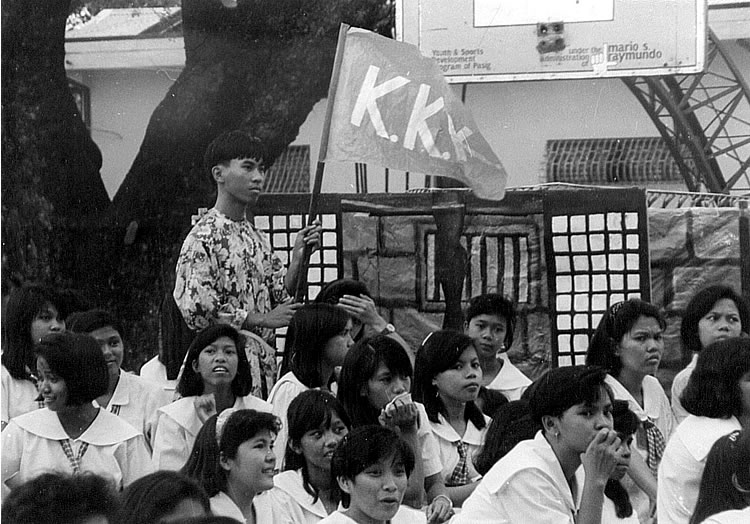
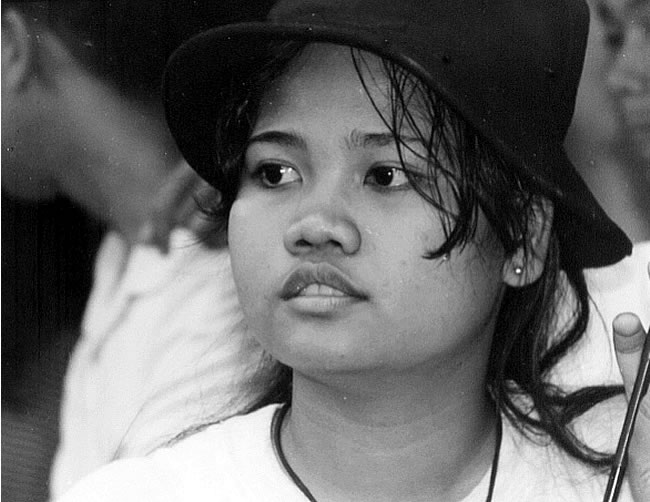
Unique images;photo by Atty. GalacioWho knows, you might be able to shoot an interesting spectator like this Katipunero in the picture above? Notice that he’s the only guy in the picture. You might also be able to shoot a girl, watching from the sidelines, who has too much make-up, as in the picture below.

Shoot the audience;photo by Atty. Galacio
Or you can turn the tables and try shooting the photographers covering an event as in the picture below. Here, my attention was caught by that old photographer (kneeling) on the right.

Shoot the photographers; photo by Atty. Galacio 

Words, letters, numbers

These elements may be used to attract the viewer’s attention. Always be on the lookout for announcements or ads which have humorous, grammatical errors.
In the picture below, the words written in chalk on the hollow blocks, at first glance, seem to have been the handiwork of a dyslexic individual. On a closer look, however, the letters spell out several words and names like “Guess,” “Ryan” and “Gwen.” Speaking of dyslexia, did you know MI-3 actor Tom Cruise and singer-actress Cher suffered from dyslexia?

Words, letters and numbers; photo by Atty. GalacioJuxtaposition

In juxtaposition, you combine two or more images into a single photograph in order to express an idea, emotion, or to show a certain relationship.
In the picture below, for example, I combined the images of man (the students), nature (the towering acacia tree) and a man-made object (the partially hidden backboard on the right). Symbolism? Possibly, Mother Nature reigns supreme over everything, or something of that sort …

Juxtaposition;photo by Atty. GalacioPoint pictures; fillers

Point pictures are those used by publications to illustrate certain portions of an article or used as fillers for layout purposes.
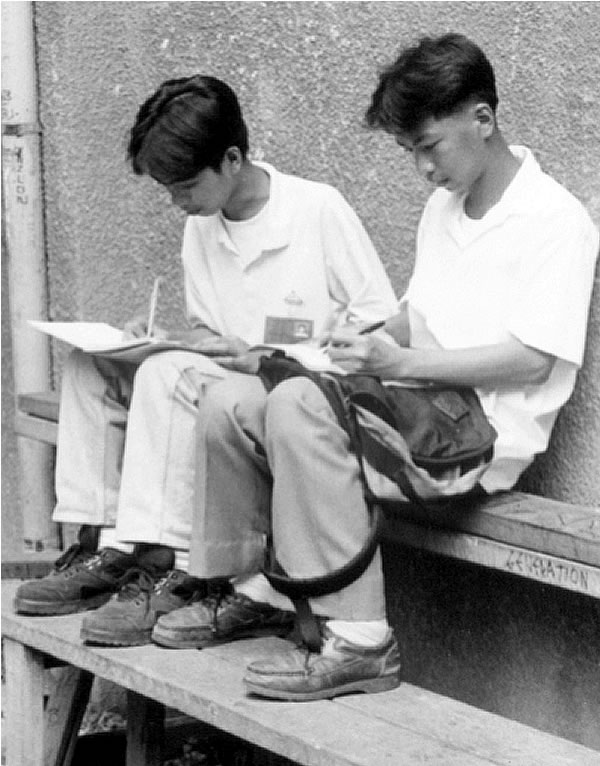
(When we discuss campus news photography, I will tell you about shooting and keeping stock pictures.) For example, the picture below of students studying can be used for a variety of articles.

Point pictures; photo by Atty. GalacioSequence shots

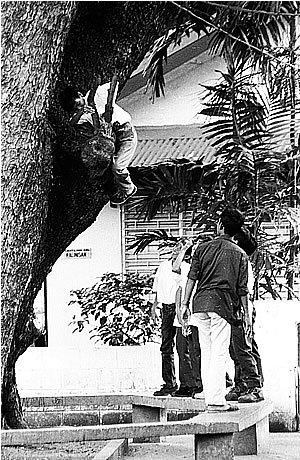
Sequence shots are several pictures of the same subject generally taken from the same viewpoint, showing various emotions or the progress of any action. In the first picture below, an adventurous freshman climbs up the acacia tree on a dare by his classmates. In the second picture, that freshman now faces the greatest dilemma of his young life — how to get down from that tree. Poor kid! The last time I looked, he was still up on that tree, and his classmates are already in college! Really! No kidding!

Sequence shots; photo by Atty. Galacio
The pictures below are sequence shots of a senior class having their yearbook picture taken. I shot these pictures way back in 1991 with my beloved Canon AE-1 Program camera fitted with an FD f/1.8, 50 mm lens with a yellow-green filter and power winder. (This kind of filter makes black and white pictures more vibrant.)  After I shot the formal class picture, the fun began. If you mouse over each picture, the caption will appear for a few seconds.


Establishing shots

Establishing shots are usually wide angle shots that show the viewer the physical context or the setting of an event, activity or program - What is the program all about? Who are the participants? Who are the spectators? Where is the venue?


Establishing shot; Rizal High School, Batibot area,  1992; photo by Atty. Galacio
Establishing shots; photo by Atty. Galacio
Establishing shot; photo by Atty. Galacio 

Key personalities

The key personalities in any program or activity may be the lead actors, actresses, directors, the judges, etc.


Key personalities; photo by Atty. Galacio


Be a better writer or editor through StyleWriter 4: this software checks 10,000 words in 12 seconds for hundreds of style and English usage issues like wordy and complex sentences, passive voice, nominalization, jargon, clichés, readability, spelling, etc.

StyleWriter 4 graphs your style and sentence variety, and identifies your writing habits to give an instant view of your writing. You can learn to adjust your writing style to suit your audience and task. You can learn, for example, the writing style of Newsweek, Time, The Economist, and Scientific American.

StyleWriter 4 is widely used in the US federal government (for example, the Environmental Protection Agency). It can be used by educators, students, and professionals in various fields - business, law, social or physical science, medicine, nursing, engineering, public relations, human resources, journalism, accounting, etc. Download your free 14-day trial copy now.