Sunday, February 24, 2008

Creative writing: Picture no. 10 “Desiderata”

“In the face of all aridity and disenchantment, love is as perennial as the grass.”

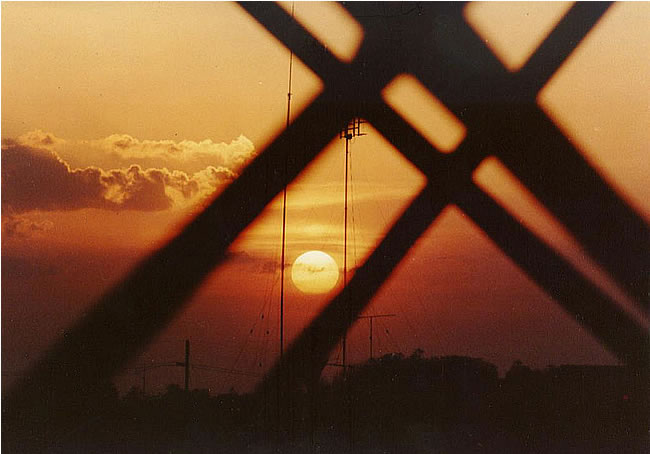
I took this picture in November 2006 in Tagaytay City, south of Manila which is the capital city of the Philippines. Baguio City, several hundred miles north of Manila, is known as the Philippines’ summer capital because of its very cool climate. Tagaytay, however, runs a very close second as a tourist destination because of its cool climate and breathtaking views.

To my mind, the selection that best suits this picture is the poem “Desiderata” by Max Erhman. This poem in the minds of a lot of people was written anonymously and was found inscribed in Old St. Paul’s Church in 1692. The truth, however, is that Erhman wrote this poem in 1927. He was a lawyer who obtained degrees in English (DePauw University) and Philosophy (Harvard). “Desiderata” is Latin for “something desired as essential.” There is a controversy as to whether “Desiderata” is copyrighted or already part of the public domain.

“Desiderata” by Max Erhman

Go placidly amid the noise and the haste,
and remember what peace there may be in silence.

As far as possible, without surrender,
be on good terms with all persons.
Speak your truth quietly and clearly;
and listen to others,
even to the dull and the ignorant;
they too have their story.
Avoid loud and aggressive persons;
they are vexatious to the spirit.

If you compare yourself with others,
you may become vain or bitter,
for always there will be greater and lesser persons than yourself.
Enjoy your achievements as well as your plans.
Keep interested in your own career, however humble;
it is a real possession in the changing fortunes of time.

Exercise caution in your business affairs,
for the world is full of trickery.
But let this not blind you to what virtue there is;
many persons strive for high ideals,
and everywhere life is full of heroism.
Be yourself. Especially do not feign affection.
Neither be cynical about love,
for in the face of all aridity and disenchantment,
it is as perennial as the grass.

Take kindly the counsel of the years,
gracefully surrendering the things of youth.
Nurture strength of spirit to shield you in sudden misfortune.
But do not distress yourself with dark imaginings.
Many fears are born of fatigue and loneliness.

Beyond a wholesome discipline,
be gentle with yourself.
You are a child of the universe
no less than the trees and the stars;
you have a right to be here.
And whether or not it is clear to you,
no doubt the universe is unfolding as it should.

Therefore be at peace with God,
whatever you conceive Him to be.
And whatever your labors and aspirations,
in the noisy confusion of life,
keep peace in your soul.
With all its sham, drudgery, and broken dreams,
it is still a beautiful world.
Be cheerful. Strive to be happy.
Hey, why don’t you try writing your own poem or essay based on this picture?

Tuesday, February 19, 2008

Creative writing: Picture no. 9 “Youth is not a time of life”

“Youth is not a time of life”


General Douglas MacArthur, on his 75th birthday (January 26, 1955), gave a speech to the Los Angeles County Council, American Legion, Los Angeles, California. During that speech, he quoted a poem about youth and growing old. It has become a classic since then, oftentimes quoted by elderly people celebrating their birthday, anniversary, or special occasions. Since Gen. Macarthur quoted the poem without attribution, people have oftentimes thought that he wrote the poem himself. But that poem was actually written by Samuel Ullman (1840–1924).

The version most often associated with Gen. MacArthur goes like this:

Nobody grows old merely by living a number of years. People grow old by deserting their ideals. Years may wrinkle the skin, but to give up interest wrinkles the soul. In the central place of every heart, there is a recording chamber; so long as it receives messages of beauty, hope, cheer, and courage, so long are you young. When the wires are all down and your heart is covered with the snows of pessimism and the ice of cynicism, then, and then only, are you grown old.
The original version by Samuel Ullman however goes like this:

Youth is not a time of life—it is a state of mind. It is not a matter of red cheeks, red lips and supple knees. It is a temper of the will; a quality of the imagination; a vigor of the emotions; it is a freshness of the deep springs of life. Youth means a temperamental predominance of courage over timidity, of the appetite for adventure over a life of ease. This often exists in a man of fifty, more than in a boy of twenty. Nobody grows old by merely living a number of years; people grow old by deserting their ideals.

Years may wrinkle the skin, but to give up enthusiasm wrinkles the soul. Worry, doubt, self-distrust, fear and despair—these are the long, long years that bow the head and turn the growing spirit back to dust.

Whether seventy or sixteen, there is in every being’s heart a love of wonder; the sweet amazement at the stars and starlike things and thoughts; the undaunted challenge of events, the unfailing childlike appetite for what comes next, and the joy in the game of life.

You are as young as your faith, as old as your doubt; as young as your self-confidence, as old as your fear, as young as your hope, as old as your despair.

In the central place of your heart there is a wireless station. So long as it receives messages of beauty, hope, cheer, grandeur, courage, and power from the earth, from men and from the Infinite—so long are you young. When the wires are all down and the central places of your heart are covered with the snows of pessimism and the ice of cynicism, then are you grown old, indeed!
Hey, now that you have read what Gen. MacArthur (or Samuel Ullman, to be accurate) said about youth and growing old, why don’t you try writing your own composition on this topic?

Monday, February 11, 2008

Creative writing: Picture no. 8 “Please Hear What I'm Not Saying”


I took this picture some 15 years ago during a choral interpretation competition in Rizal High School in Pasig City, Philippines. This school was once credited in the Guinness Book of World Records as being the world’s largest high school, with its total population at one point in time reaching up to 26,000 students. Several years ago, however, the school’s annexes became independent schools and the population of the main campus dwindled to around 8,000.

Anyway, you will notice that the faces of the students in this picture (except for about two students) are masked by dramatic make-up that complements their all-black attire. A selection that is appropriate for this picture is the poem “Please Hear What I’m Not Saying”. This poem has had several variations floating around in the Internet and in print publications, oftentimes reported as having been written anonymously. But the original version of this poem was written by Charles C. Finn. For more of his poetry, please visit Finn's website. Below is the original version of the poem as written by Finn.

Please Hear What I'm Not Saying

Don’t be fooled by me.
Don’t be fooled by the face I wear
For I wear a mask, a thousand masks,
Masks that I’m afraid to take off
And none of them is me.

Pretending is an art that’s second nature with me,
but don’t be fooled,
for God’s sake don’t be fooled.
I give you the impression that I’m secure,
that all is sunny and unruffled with me,
within as well as without,
that confidence is my name and coolness my game,
that the water’s calm and I’m in command
and that I need no one,
but don’t believe me.

My surface may be smooth but
my surface is my mask,
ever-varying and ever-concealing.
Beneath lies no complacence.
Beneath lies confusion, and fear, and aloneness.
But I hide this. I don’t want anybody to know it.
I panic at the thought of my weakness exposed.
That’s why I frantically create a mask to hide behind,
a nonchalant sophisticated facade,
to help me pretend,
to shield me from the glance that knows.

But such a glance is precisely my salvation,
my only hope, and I know it.
That is, if it is followed by acceptance,
If it is followed by love.
It’s the only thing that can liberate me from myself
from my own self-built prison walls
from the barriers that I so painstakingly erect.
It’s the only thing that will assure me
of what I can’t assure myself,
that I’m really worth something.
But I don’t tell you this. I don’t dare to. I’m afraid to.

I’m afraid you’ll think less of me,
that you’ll laugh, and your laugh would kill me.
I’m afraid that deep-down I’m nothing
and that you will see this and reject me.

So I play my game, my desperate, pretending game
With a façade of assurance without
And a trembling child within.
So begins the glittering but empty parade of Masks,
And my life becomes a front.
I tell you everything that’s really nothing,
and nothing of what’s everything,
of what’s crying within me.
So when I’m going through my routine
do not be fooled by what I’m saying.
Please listen carefully and try to hear what I’m not saying,
what I’d like to be able to say,
what for survival I need to say,
but what I can’t say.

I don’t like hiding.
I don’t like playing superficial phony games.
I want to stop playing them.
I want to be genuine and spontaneous and me
but you’ve got to help me.
You’ve got to hold out your hand
even when that’s the last thing I seem to want.
Only you can wipe away from my eyes
the blank stare of the breathing dead.
Only you can call me into aliveness.
Each time you’re kind, and gentle, and encouraging,
each time you try to understand because you really care,
my heart begins to grow wings --
very small wings,
but wings!

With your power to touch me into feeling
you can breathe life into me.
I want you to know that.
I want you to know how important you are to me,
how you can be a creator--an honest-to-God creator --
of the person that is me
if you choose to.
You alone can break down the wall behind which I tremble,
you alone can remove my mask,
you alone can release me from the shadow-world of panic,
from my lonely prison,
if you choose to.
Please choose to.

Do not pass me by.
It will not be easy for you.
A long conviction of worthlessness builds strong walls.
The nearer you approach me
the blinder I may strike back.
It’s irrational, but despite what the books may say about man
often I am irrational.
I fight against the very thing I cry out for.
But I am told that love is stronger than strong walls
and in this lies my hope.
Please try to beat down those walls
with firm hands but with gentle hands
for a child is very sensitive.

Who am I, you may wonder?
I am someone you know very well.
For I am every man you meet
and I am every woman you meet.

Sunday, January 27, 2008

Photojournalism (40): Where do we go from here?

I took this picture 1997 or 1998 along the floodway in Pasig; by playing around with the filtration settings, I was able to come with this dramatic shot of the lights along the floodway; I was in the middle of the Legaspi Bridge at around 7 PM, and I used my beloved Canon AE-1 Program camera with a Vivitar 28-210 mm zoom lens; photo by Atty. Galacio Remember the 1990’s movie “Jerry Maguire” starring Tom Cruise and Cuba (Show me the money!) Gooding Jr.? After Tom’s character gets fired from the sports management company, he desperately tries to convince other employees to come along with him to form another company. But, besides the goldfish, the only one who responds to his call is the lovestruck accountant, played by the absolutely! gorgeous! Reneé Zellwegger! (If National Artist for Literature José Garcia Villa had his “comma, comma” poems, I also have my own “exclamation point poetic device,” okay?) Anyway, what did Tom Cruise say? “This could be the start of something fun!”

Free street photography e-books
by Thomas Leuthard:

Going Candid - An unorthodox
approach to Street Photography


Collecting Souls - What Street
Photography means to me


Street Faces – The Art of Candid
Street Portraiture
This series is merely an introduction to photojournalism, and I sincerely hope that by browsing the 39-plus articles, you’ve been inspired to learn more about photography on your own. This could really be the start of something fun for you! A lot of people, however, will surely discourage you from pursuing your interest in photography by saying that it’s a very! expensive! hobby! (Okay, okay, enough of this José Garcia Villa wannabe stuff!)

Photography is indeed a hobby to a lot of people, but it is also a bread and butter profession for others, a lifelong pursuit for some, and a deliberately chosen means of self-expression for a very few. Whatever photography may be to you, certain sacrifices have to be made if you want to excel in this art, or in any art form, for that matter. N.V.M. Gonzales, a literary giant among Filipinos (my favorite among his stories is “Blue Skull and Dark Palms”), during his teenaged years, walked five kilometers a day in getting to and from the town hall that had the only typewriter in that place. Talk about dedication and sacrifice!

But “expensive” need not be the word to describe photography. You can always use “re-loaded” film, which costs less than the regular films. Or, you can hone your skills by volunteering to take pictures of birthdays or programs where other people naturally would have to shoulder the expenses. Of course, with the advent of digital photography, there’s no need to even buy film. You just have to shoot your pictures, download your images through your computer’s USB cable, and you’re ready to shoot again!

In terms of SLR cameras, you can find relatively inexpensive manual camera models on the market. Or you can choose to buy a second hand camera ... Me, I really started learning about photography by borrowing the camera of my staffer, but you already know the story from the Introduction to this series, right? Right!

Photography is an art form that is accessible for all. You don’t need formal studies in order to be a good photographer. As Ernst Haas said, “If art is aristocratic, then photography is its democratic voice.” This statement however is not meant to disparage photography as an art form. (“Disparage” - I love these high sounding words!) Anyone can learn photography but not everyone can be a good photographer. There aren’t that many Vic Valencianos, Lita Puyats, Mandy Navaseros,Toch Arellanos, Vic Sisons, or Ed Santiagos, among us, you know!

http://www.digitalcameraworld.com/2014/02/07/77-photography-techniques-tips-and-tricks-for-taking-pictures-of-anything/The best way to improve yourself as a photographer is to show your pictures to people whose opinion you respect like your teachers, classmates, or the pizza delivery guy! These people, if they’re honest enough, will tell you not only what’s good but more importantly, what’s bad with the photographs you have taken. Avoid people who only say good things about your pictures; they probably just want to borrow money from you! Wig Tysman, a well-known fashion photographer, once said that his best critic is his wife who would lovingly ask him over breakfast, “Were you sane when you took this picture?” She’s my kind of woman!

Richard Avedon, circa 1996, is the most influential photographer in the world, ranking number one in an American Photo survey of the 100 most important people in photography. By the way, model Kate Moss, along with other super models like Cindy Crawford, was ranked number 82 in that survey! Anyway, not very many people know that Avedon learned about photography when, as a merchant marine at age 19, he was given the job of shooting ID pictures. Avedon, in the book Evidence 1944-1994, stated, “I must have taken pictures of maybe one hundred thousand baffled faces before it occurred to me I was becoming a photographer.” From IDs to fashion and portraits - way to go, Mr. Avedon!

Sebastião Salgado, an economist considered as the world’s best photojournalist, practically didn’t know anything about photography until his wife, Leila, an architect, gave him a camera as a gift. The first time he looked through the viewfinder, however, Salgado was hooked on photography! Boy, I wish I had a wife who will give me a camera! I mean, I mean, I mean, I mean, boy, I wish I had a wife!

By whatever way you fall in love with photography, OR if you do have the talent for it, use it, nurture it, share it! Starting now! As Julia Roberts’s best friend in the movie “My Best Friend’s Wedding” says, “If you really love someone, you’ve got to say it, out loud! Otherwise, the moment will just pass you by.” Me, as I mentioned in the Introduction to this series, I fell in love with photography when I fell in love with a beautiful actress named, what’s her name again? Beth Tamayo? No, already spoken for! Sandra Bullock? No, too intense! Ally Macbeal? No, too weird! Buffy, the really cute Vampire Slayer? No, no, too violent! Julia Roberts? Wow! Cameron Diaz? Wow! Oh, yes, now I remember, Murphy Brown! Yes!

A spark of the divine fire

Martha Foley’s short story “One With Shakespeare” chronicles a young girl’s exquisite discovery of her talent for writing. Through the encouragement of her high school teacher, the girl realizes that just like Shakespeare, she also had that creative potential, that “spark of the divine fire.” She begins to savor the emotions, the expressions, the ideas her words could bring forth. She begins to learn how to create memorable images in the mind’s eye through words. Looking out the windows of the library, she sees the flower filled trellis and her mind is filled with images of “black sentinels against the sky.”

Perhaps your talent isn’t in photography but in creative writing or journalism. But this series on photojournalism can still help you through an activity known as “writing through seeing.” Sometimes, you run out of ideas or topics to write about. What you can do is to look at the pictures in this series, and use them as your inspiration, as starting points for writing descriptions, narration, expositions, dialogues, short stories, etc.

I took this picture 1990 or 1991 using my favorite Kodak Tri-X black and white film. Using Kodak's Create-A-Print machine, I came up with different colored variations by playing around with the filtration settings; photo by Atty. Galacio
Silhouette, natural frames and rule of thirds; photo by Atty. GalacioFor example, you can write a description of your feelings as you look at the solitary branch against the sunset above. Write about the glorious sunsets in Boracay when you went there last summer. Write about how you felt, what you thought about as you and your family spent time together along Baywalk. Write about how you felt getting turned down for the tenth time by the same girl (ouch!)

Creative writing through seeing; vertical format; photo by Atty. Galacio You can use the picture above of the guy up on a tree to learn how to write dialogue; notice that the girl with a white T-shirt is looking up at the guy, and there’s a heart-shaped piece of paper with the words “Happy Valentine” on the tree.

In my 12 years of teaching, two of the best student writers I ever had the pleasure of teaching were Mylah Reyes-Roque (from Rizal High School in Pasig, Class ’87; she recently won a UNICEF award for her Newsbreak magazine article on child prisoners), and Cyrille Cucio from Quezon City Science High School Class ‘84. But Cyrille went into medicine rather than journalism or creative writing. (She is now working in a New York City hospital.) When we met several years after high school, I told Cyrille that I was disappointed with her because she wasted her talent for writing. Well, writing’s loss is medicine’s gain, I suppose... or she could be the next Arturo B. Rotor of Philippine literature! In case you’ve forgotten, Rotor, a medical doctor, wrote the classic short story “Zita.”

Whatever your talent may be, nurture it, share it. That talent, that "spark of the divine fire" is a gift from God.

Tuesday, January 01, 2008

“The Rose”

Where do we go from here? 2007 is over and we’re on the first day of 2008. We don’t know what this year will bring as these verses tell us:

Joshua 3:4 “that ye may know the way by which ye must go: for ye have not passed this way heretofore.”

James 14-15 “Whereas ye know not what shall be on the morrow. For what is your life? It is even a vapour, that appeareth for a little time, and then vanisheth away. For that ye ought to say, If the Lord will, we shall live, and do this, or that.”
As a way of saying thanks for all of you who browsed my blogs and websites (Legal Issues and Family Matters; Better English for Filipinos; and English for Asians and Africans) this year, please let me share with you this story entitled simply “The Rose”. Max Lucado popularized this story in his 1992 book “And The Angels Were Silent”. It surfaced in the Internet sometime in 1996 and has since then achieved the status of an urban legend. It has even become sermon illustrations (please see for example “Easter After Tremors: The Call to Love” by Mark Daniels).

Most reproductions of this story (whether in print or the Internet) state either that the story’s author is unknown or that it originally came from Max Lucado. However, the real author is someone named S. I. Kishor and the story was first published in Collier’s magazine sometime in 1943. In Lucado’s book, it appeared without attribution and was entitled “The People with the Roses.’ In the 1996 Canfield and Hansen collection “A 3rd Serving of Chicken Soup for the Soul”, S.I. Kishor was correctly identified as the author. Be that as it may, “The Rose” has become a runaway favorite among Internet users.

“The Rose” by S. I. Kishor

John Blanchard stood up from the bench, straightened his Army uniform, and studied the crowd of people making their way through Grand Central Station. He looked for the girl whose heart he knew, but whose face he didn't, the girl with the rose.

His interest in her had begun thirteen months before in a Florida library. Taking a book off the shelf he found himself intrigued, not with the words of the book, but with the notes penciled in the margin. The soft handwriting reflected a thoughtful soul and insightful mind. In the front of the book, he discovered the previous owner's name, Miss Hollis Maynell. With time and effort he located her address. She lived in New York City. He wrote her a letter introducing himself and inviting her to correspond. The next day he was shipped overseas for service in World War II.

During the next year and one month the two grew to know each other through the mail. Each letter was a seed falling on a fertile heart. A romance was budding. Blanchard requested a photograph, but she refused. She felt that if he really cared, it wouldn’t matter what she looked like.

When the day finally came for him to return from Europe, they scheduled their first meeting - 7:00 PM at the Grand Central Station in New York. “You'll recognize me,” she wrote, “by the red rose I'll be wearing on my lapel.”

So at 7:00 he was in the station looking for a girl whose heart he loved, but whose face he'd never seen. I'll let Mr. Blanchard tell you what happened:

A young woman was coming toward me, her figure long and slim. Her blonde hair lay back in curls from her delicate ears; her eyes were blue as flowers. Her lips and chin had a gentle firmness, and in her pale green suit she was like springtime come alive. I started toward her, entirely forgetting to notice that she was not wearing a rose.

As I moved, a small, provocative smile curved her lips. “Going my way, sailor?” she murmured. Almost uncontrollably I made one step closer to her, and then I saw Hollis Maynell. She was standing almost directly behind the girl. A woman well past 40, she had graying hair tucked under a worn hat. She was more than plump, her thick-ankled feet thrust into low-heeled shoes.

The girl in the green suit was walking quickly away. I felt as though I was split in two, so keen was my desire to follow her, and yet so deep was my longing for the woman whose spirit had truly companioned me and upheld my own. And there she stood. Her pale, plump face was gentle and sensible, her gray eyes had a warm and kindly twinkle. I did not hesitate. My fingers gripped the small worn blue leather copy of the book that was to identify me to her.

This would not be love, but it would be something precious, something perhaps even better than love, a friendship for which I had been and must ever be grateful. I squared my shoulders and saluted and held out the book to the woman, even though while I spoke I felt choked by the bitterness of my disappointment. “I'm Lieutenant John Blanchard, and you must be Miss Maynell. I am so glad you could meet me; may I take you to dinner?”

The woman's face broadened into a tolerant smile. “I don't know what this is about, son,” she answered, “but the young lady in the green suit who just went by, she begged me to wear this rose on my coat. And she said if you were to ask me out to dinner, I should go and tell you that she is waiting for you in the big restaurant across the street. She said it was some kind of test!”

It's not difficult to understand and admire Miss Maynell's wisdom. The true nature of a heart is seen in its response to the unattractive.

Happy New Year!

Thursday, December 27, 2007

Creative writing: Picture no. 7

The joys of photography


Silhouette, natural frames and rule of thirds; photo by Atty. Galacio
World literature tells us the tragic story of Faust who vowed to bargain away his soul if he could find one perfect moment of happiness. He would eternally forfeit his soul if upon finding that one perfect moment of happiness, he would utter the words, “Stay, you are so beautiful.” He couldn’t find that happiness in his relationships, in society, in achievements, but he did find it in a small village by the sea, with the sun setting down, and mothers calling upon their small children to come back to their homes. In the simple joys of these village folks, Faust found his one perfect moment of happiness. At last, he said the words, “Stay, you are so beautiful!” and his soul was eternally forfeited.

Photography has the power to capture not only our perfect moments of love and happiness, but also searing images of cruelty and poverty. It has the power to preserve in a rectangular frame the beauty of a thousand sunsets, the joys of parents seeing their child just learning how to walk on its own, the sublime happiness of students graduating after four years of hard work and sacrifice.

Unlike Faust, however, we do not have to bargain away our souls in order to capture our perfect moments of happiness. We only have to pick up our cameras, look at the world through the viewfinder, and as life passes before our lenses, capture these perfect moments of happiness on film, as we say in our hearts and minds, “Stay, you are so beautiful!”

Wednesday, December 26, 2007

Creative writing: Picture no. 6


I hate it when schooldays are over. There’s a dreariness in the air that depresses me. Even the rooms that once were filled with laughter are now empty and bare, the fine dust gathering on the wooden chairs, the windows shutting out the light from the dying sun.

Outside the once green grass now turns to deep brown in the parched ground, the trees bare of any leaves, their twisted black branches reaching upwards toward the sky in vain supplication for a little rain. The wind blows and creates swirling clouds of dust that sweep the school grounds and the empty hallways that once echoed the sounds of hurrying feet and young, excited voices.

School days are over, summer is here.

We’ve said our final goodbyes to our dear friends a thousand times, not really wanting each goodbye to be the last and final sad farewell. We cling to our friends, we hold hands tightly as we walk around the school one final time; we visit the rooms that were once our safe and secure refuge from the harshness of life.

We go through the paces of graduation practices, and laugh at the silly mistakes we make. But deep inside us, we feel a cold hand clutching our hearts, knowing that each day brings us closer to the moment when separation from our dear friends becomes inevitable, a moment steeped in profound sadness and absolute finality.

We close our eyes and hope that time can stand still; we will hold this day like a precious diamond in our hands, hold it up and reflect upon its exquisite beauty. If only time can stand still, we will forever be happy, together …

ALL ETERNITY FROZEN IN A SINGLE MOMENT OF YOUTH.

Tuesday, December 25, 2007

Season’s greetings

Click here to know what this season is all about

Monday, December 24, 2007

Creative writing: Pictures 1 to 5

Okay, now that you know how creative writing through seeing works, why don't you try out your writing skills with these pictures?

Photo by Atty. Gerry T. Galacio; all rights reserved
Picture no. 1 (reflections, nostalgia)

Photo by Atty. Gerry T. Galacio; all rights reserved
Picture no. 2 (circles, a sense of belonging)

Photo by Atty. Gerry T. Galacio; all rights reserved
Picture no. 3 (street children, simple joys)

Photo by Atty. Gerry T. Galacio; all rights reserved
Picture no. 4 (sunset, golden hours, innocence of childhood)

Photo by Atty. Gerry T. Galacio; all rights reserved
Picture no. 5 (former Main Building of Rizal High School
in the Philippines; credited in the 1990's by the Guinness
Book of World Records as the world's biggest high school,
with enrollment reaching 26,000 students at one point)

Friday, December 14, 2007

Photojournalism (39): Correct exposure

Free cheat sheets:

The 3 Elements of Exposure

Manual Photography Cheat Sheet

Mastering manual exposure with an SLR camera

Beginner’s free printable cheat sheet: Introducing ISO, shutter speed and aperture and how they are manipulated to give correct exposure

Night exposure guide
Aperture and shutter speed combinations, also known as the ugliest topic in photography!

What is the basic nature of photography as a medium of artistic expression? In 1839, when William Henry Fox Talbot presented the process of photography to the Royal Society in London, he described the image he produced as having been “copied from nature,” that is, it looked exactly like the way it was in real life. Basically that’s what photography is all about – recording in film or in memory sticks (if you’re into digital photography) what exists out there in the empirical world.

Perhaps, this is the reason why some painters and sculptors look down on photographers. But as you may know by now, good photographs are not just record shots of what exists out there. Photography is definitely not an art form secondary to painting and other visual arts, and we should not feel inferior to those who draw or paint. Photographers are artists in the fullest sense of the word. As the title for an André Kertész biography puts it, photographers are “poets with a camera.” As Jacques Lipchitz said, “Copy nature and you infringe on the work of our Lord. Interpret nature and you are an artist.” Or as Georges Braque stated, “Great art picks up where nature ends.”

(While we’re in the quotation-citing mode, here’s my favorite quotation I made up myself: “Pizza is the best thing to ever happen in human history.”)

What “exposure” means

The term “exposure” means allowing the light to reach or strike the film inside your camera. With single lens reflex (SLR) cameras, exposure involves the following mechanical procedures: you depress the shutter release button; the lens opens to whatever aperture you have set; the mirror flips up out of the way; the focal plane shutter curtains open and close according to the shutter speed you have set; the mirror returns to its original position; and the lens is fully open again.

The proper exposure is achieved by the correct combination of shutter speed and lens aperture. The shutter speed controls the duration of the exposure, and the aperture controls the brightness of the image. The shutter speed and the aperture must always work hand in hand. The correct or proper exposure isn’t however a single shutter speed/aperture combination. For example, if the proper exposure for a particular scene or subject is 1/250 sec at f/11, you can achieve the same result by using the combination of 1/125 sec at f/16.

For a more detailed discussion, please refer to the Wikipedia article on “exposure.”

Here are the general rules on exposure:

(1) Bright lighting conditions - use a fast shutter speed and a small aperture;

(2) Dim lighting conditions - use a slow shutter speed and a wide aperture;

(3) The slower the shutter speed, the smaller the aperture should be;

(4) The higher the shutter speed, the bigger the aperture.

The Sunny 16 Rule

You’re shooting a subject that is lighted frontally by direct sunlight; in simpler terms, your subject is facing the sun. What’s the correct shutter speed and lens opening? Simply follow the Sunny 16 rule expressed in the formula - 1/ISO at f/16. Here are the steps:
(1) Set your aperture ring to f/16;

(2) Set your shutter speed dial to whatever speed is closest to your film’s ISO rating; for example, if your film is ISO 100, set your speed at either 1/125 sec or 1/90 sec; if your film is ISO 400, set your speed at 1/500 sec.

(4) Shoot your picture. That’s it. Piece of cake! (or should I say, piece of pizza!)
Overexposure and underexposure

When you hang around professional photographers or serious hobbyists, you will very often hear them talk about “overexposed” and “underexposed” shots.

(1)  A picture is “underexposed” when you use either too fast a shutter speed or too small an aperture. The result is a picture that is too dark, loss of details in the shadow areas and grayish highlights.

(2) A picture is “overexposed” when you use a shutter speed that’s too slow or an aperture that’s too big.

The term “stop” refers to either the aperture or the shutter speed. When you set your lens to an aperture between f/11 and f/16 for example, that’s a half-stop. The phrase “stopping the lens down” simply means setting your lens to the smallest aperture or opening possible under the prevailing lighting conditions.

Errors in setting the shutter speed or aperture could lead either to overexposure or underexposure. “Underexposure” is produced either by too fast a shutter speed or, and results in a picture that is too dark, with loss of detail in the shadows and gray instead of white highlights. “Overexposure” on the other hand, may be produced either by a shutter speed that’s too slow or by an aperture that’s too big. Overexposed pictures are too light, with grayish shadows and “bleached out” highlights.

Slight errors in shutter speed and aperture combinations can be offset when you have your pictures printed, or when you edit your pictures with your photo editing software (I prefer Macromedia Fireworks). It is usually better when pictures are overexposed rather than underexposed. Why? Because it is easier to correct overexposed shots. The subject details may be faint but they’re there and can be easily be brought up in the photo studio.

Difficult exposure conditions


1. Shooting against the light: As a general rule, the sun or your light source must always be behind you (the subject is therefore frontally lit). If the source of light however is behind your subject, you’ll be shooting against the light. Your camera meter will be fooled by the brightness of the situation and your subject will come out too dark. Thus, if you’re shooting portraits, the background will be light and the faces of your subjects will come out too dark.

How do you remedy this situation? Open your lens by one to two stops. If your meter tells you to use f/11, turn your aperture ring to f/8 or f/5.6. Or, if your camera meter tells you to use 1/500 sec, set your shutter speed dial to 1/250 or 1/125 sec.
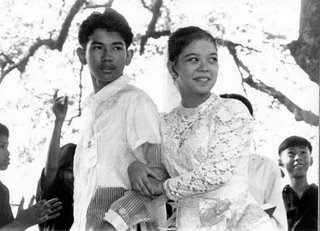
Avoid shooting against the light; Open your lens by one to two stops. If your meter tells you to use f/11, turn your aperture ring to f/8 or f/5.6. Or, if your camera meter tells you to use 1/500 sec, set your shutter speed dial to 1/250 or 1/125 sec.;Rizal High School 1996; photo by Atty. Galacio In the picture above, I had no choice except to shoot my high school students Dindo and Gracie. Why? They were too young to get married. Just kidding! Just kidding! Rewind! Rewind!

Okay, okay, rewind, in the picture above, I had no choice except to shoot my high school students Dindo and Gracie against the light. They were performing on an outdoor stage at 3 in the afternoon. The camera’s light meter, seeing all that background light, called for f/11, so I used f/5.6, giving my subjects two stops more exposure. If I had used f/11, the background would have come out all right but Dindo and Gracie would turn out too dark, their faces totally engulfed in shadows. Their light toned bridal costumes added to the problem on what the correct exposure was, but I didn’t want to go crazy thinking about this. I simply opened up the lens two stops more because of the bright background.

2. Light subject against a dark background, OR a dark subject against a light background: Your SLR camera’s reflected light meter will be fooled by either the brightness or the darkness of the background. Most of us can’t afford to buy a handheld light meter and so we can’t do any incident light reading which is the right solution for these situations. What’s the practical solution? Come very close to your subject so that it more than fills the frame and then measure the light through your camera’s TTL (through the lens) meter.

Light subject against a dark background, OR a dark subject against a light background;  Come very close to your subject so that it more than fills the frame and then measure the light through your camera’s TTL (through the lens) meter;photo by Atty. GalacioThese friends in the picture above, wearing dark toned shirts, were standing against a light toned wall. Here’s what to do. Mark your location. Come in close until your subjects’ faces fill up your viewfinder viewfinder. Meter your subjects and set your lens opening or shutter speed accordingly. Move back to your original location. Shoot! (If you’re using a zoom lens, zoom in on your subjects’ faces, meter, set your aperture, zoom out and then shoot.)

As rules of thumb, if your subject is against a bright background, set your camera two stops more than what the TTL meter indicates. If your subject is against a dark background, set your camera one stop less than the meter reading.

3. High lighting contrast: The scene has a higher brightness range than normal film can handle. While our eyes can differentiate objects in a scene with a brightness range of 1:1000, normal film only has a brightness range of about 1:100. Solutions? Use a graduated filter (please see the Wikipedia article on photographic filters) to help you deal with the high contrast, as when you’re shooting landscapes. Or, work with the situation, not against it, by coming up with a silhouette.
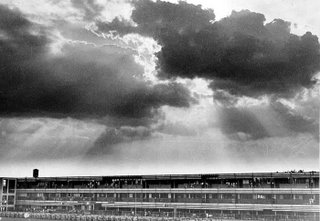
If you base your exposure on the bottom portion of the picture, the sky will be completely burned out, and the clouds won’t record at all on the film. On the other hand, if you meter for the clouds, then the building will turn out too dark. Solution? Average your exposure; if the sky calls for f/16 and the foreground is at f/8, use f/11 as your opening; Rizal High School 1990; photo by Atty. Galacio
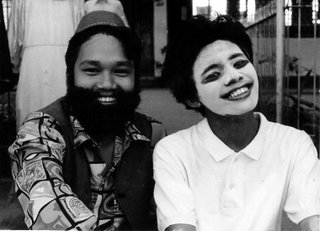
Rizal High school 1995; photo by Atty. Galacio The two pictures above are situations that call for “averaging” your exposure. In the first picture, if you base your exposure on the bottom portion of the picture, the sky will be completely burned out, and the clouds won’t record at all on the film. On the other hand, if you meter for the clouds, then the building will turn out too dark. Solution? Average your exposure; if the sky calls for f/16 and the foreground is at f/8, use f/11 as your opening.

In the second picture above, where should you base your exposure - on Richard, the bearded guy on the left, or on the guy on the right who obviously has used too much skin whitener?

If you meter for Richard, he’ll come out okay but the guy on the right will turn out too light, with no details on his face or shirt. But if you meter for him instead, Richard will turn out too dark. Solution? Average your exposure.
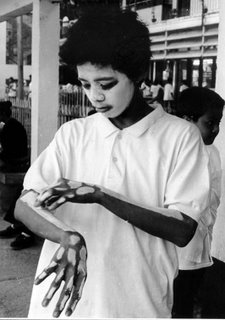
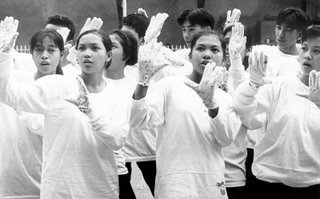
Set your aperture one stop wider than what your camera meter indicates. If your meter calls for f/5.6, use f/4. ;photo by Atty. Galacio
Set your aperture one stop wider than what your camera meter indicates. If your meter calls for f/5.6, use f/4. ;photo by Atty. Galacio In the first picture above, the student had a white shirt, white spots all over his hands and forearms, and too much skin whitener on his face. In the second picture above, the students had white shirts and white gloves. In this kind of situation, your camera meter will be over-influenced by all that whiteness. Result? The students’ faces in, and everything else about this student in the first picture, could turn out too dark. Solution? Set your aperture one stop wider than what your camera meter indicates. If your meter calls for f/5.6, use f/4.
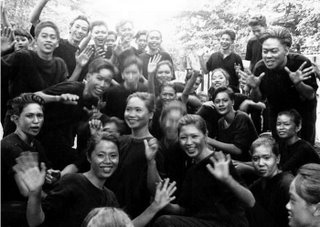
When your subjects have predominantly dark tones, use an opening one stop less than the meter reading. If the meter calls for f/8, set your lens to f/11. OR, instead of 1/250, use 1/500 sec. ;photo by Atty. Galacio In the picture above, the students were wearing dark toned shirts and some had gold paint on their faces. If I followed the camera’s meter reading, the shirts will turn out properly exposed but the faces of the students could turn out too light. Solution? When your subjects have predominantly dark tones, use an opening one stop less than the meter reading. If the meter calls for f/8, set your lens to f/11. OR, instead of 1/250, use 1/500 sec.

Bracketing your shots

Bracketing is a technique professional photographers always use. It simply means taking extra pictures with one-half to one stop more exposure, and one-half to one stop less exposure than that indicated by the camera meter. If the reading is f/8, you should take another shot at f/5.6 (more exposure), and another shot at f/11 (less exposure). With some lenses, you can set the lens between apertures (e.g. between f/11 and f/16); that’s a half-stop.

Bracketing is absolutely essential when you’re using slide film. With color negative/color print films, it isn’t necessary since this kind of film has a wide latitude for exposure errors. Errors can be offset during the printing stage, as I mentioned above.

What if you have to maintain your aperture like when you really need the depth of field? In our example, maintain f/8 as your lens opening; if your shutter speed is 1/250 sec, shoot one frame with 1/125 (more exposure), and another at 1/500 sec (less exposure). Some camera models have an auto-bracketing feature; there’s no need to fiddle around with settings!

Photography is a technology-based art form

“From today, painting is dead!” This was the cry of doom and despair by French painter Laroche way back in 1839 when photography was introduced to the world. History has proven him wrong, however; painting is still a flourishing art form. With the advent of personal computers and their revolutionary impact on almost all aspects of life, it seems it’s now the turn of photographers to exclaim, “From today, photography is dead!”

Photography is a technology based art form. Since 1839, it has always been a silver halide based art form, meaning we’ve got to have film in order to have pictures, until today that is. Now, computers and cameras have been fused together to produce film-less digital cameras, and this is the kind of camera most of you are using right now. (Even cellphones now have cameras!) The quality of pictures produced by digital cameras, measured in megapixels, are quite good. With the pictures I have posted in my "Baptist Churches in the Philippines” blog, for example, I shot them all with a Sony 5.1 megapixel digital camera. And I didn’t have to fiddle around with shutter speed and aperture settings; the camera with its automatic functions took care of everything. All I really had to do was to point and shoot.

The camera doesn’t take the picture, you do!


A lot of professional photographers look down on “auto-photography” or what is sometimes called as “decision free” photography. These terms refer to the heavy, oftentimes complete reliance on the automatic features of today’s cameras brought by computers, microchips and electronics.

These photographers feel that relying on automation and electronics is a hindrance to a person’s creativity. They want the best of both world, actually. They value the information, the assistance given by the automatic features of today’s cameras but they also want what is known as “manual override,” that is they want to be able to turn off the camera’s automatic functions and rely on their brains, their experiences, their feelings, their sensibilities. In other words, they don’t want their cameras to take the pictures for them; they want to take the picture themselves.

Or in the words of Richard Avedon, ranked number one in a 1996 survey of photographers and photo editors, “It’s not the camera that makes a good picture but the eye and the mind of the photographer.”