Saturday, July 21, 2007

Photojournalism (9): Learning to see; techniques in developing your creative eye

Free e-books:

(1) Inspiration: The Pros’ Secrets to Finding and Keeping it (12 pages; 879.66 kb)

(2) By Scott Bourne:

Essays on Inspiration, Creativity and Vision in Photography (47 pages; 3.02 MB)

Nine Motivational Essays on Photography (42 pages; 2.44 MB)

Video:

Developing a Creative Eye, Ep. 134: You Keep Shooting (Adorama Photography TV)

(Note: jump to techniques in developing your creative eye.)

Way back in 1989, I enrolled in a black and white photography course in an art school in Cubao. For the first assignment, the instructor asked the class to use one roll of film to shoot lines, shapes, form, textures, etc. In previous postings, I have explained and shown examples to you of these different elements of a photograph. On your own, therefore, using whatever camera you have, shoot as many pictures as you can of lines, shapes, forms, etc. This exercise will teach you how to break down an image into the different elements we have discussed.

Elegant simplicity

Later on you can combine these elements into a photograph that appeals to your own sense of beauty. Hopefully, other people will share your joy and sense of fulfillment over the pictures you have taken. My idea of beauty, if you care to know (please, please), is embodied in the Japanese ideal of “elegant simplicity.”

Charles Darwin, father of evolution, once said, “When I think of the complexity of the human eye, I shudder.” With the interplay of rods and cones which enable it, among other things, to distinguish numerous shades of colors, the human eye is so enormously complex that evolution fails dismally in explaining it. (Incidentally, two books I highly recommend to you are “Fearfully and Wonderfully Made” and “In His Image” by Philip Yancey and Dr. Paul Brand. These books about the wonders and complexities of the human body are readily available in Christian bookstores and in National Bookstore.)

http://www.digitalcameraworld.com/2015/02/04/camera-lens-vs-human-eye-free-photography-cheat-sheet/

Camera lens vs human eye
(free photography cheat sheet
from Digital Camera World)
The human eye and the camera see things differently

A basic principle you have to understand and always keep in mind is that the human eye and the camera see things differently. This is why, a lot of times, we get disappointed with the results of our pictures. Whenever we look at the subject we want to shoot, we always see a “focused” image, that is, a sharp image from foreground to background. This is because the eye, even without us consciously knowing or doing anything about it, adjusts itself to focus on whatever we are presently looking at, excluding other details in the scene. The camera cannot do this.

(If you’re using a manual focus camera, you have to turn the focusing ring until you get the right focus, that is, the image appears sharp and clear as you look at it through the viewfinder. With autofocusing systems, you just depress the shutter release a little bit and the camera automatically adjusts itself to focus on your subject.)

The difference in what the eye and what the camera see oftentimes result in a photograph that contains a lot of clutter or distracting details, which we didn’t notice while looking at the subject through the viewfinder. Take a look at the picture below (a choral competition) for example. When I was looking at the scene with the camera, I didn’t notice all the students at the background because they looked fuzzy or out of focus in the viewfinder. The camera however recorded everything - the performing students, and all the distracting details in the background.

the eye and the camera see things differently; cluttered background; photo by Atty. GalacioLater on we will discuss how to use lens openings and a shallow depth of field in erasing distracting background details. Notice for example the picture below of my cute nephew JR. (He’s cute because he looks like me!) Please notice that while JR himself is sharp and clear, the background details are deliberately blurred and out of focus.

My cute nephew JR; shallow depth of field; out of focus background; photo by Atty. GalacioProfessional photographers oftentimes derisively use the term “record shot.” Hey! “Derisive” is such a big word; I’d better check my dictionary to check if I got the spelling right! The term “record shot” is used to describe certain pictures that simply have to be taken for record purposes (to be redundant about it), or because the person paying for the photographer’s services simply wanted to have certain subjects shot. Meaning, there is nothing artistic in the subject matter or in the technique used; the photographer simply pointed his or her cameras at the subject, and took the shot.

Photographs have the power to convey a mood or share your insights

If you are using your camera just to do record shots, you are definitely missing out on what photography is all about as an art form. Photographs have the power to convey a mood or share your insights with others. All you really have to do is to begin seeing things, not just looking at them.

Remember what the fox said to the Little Prince? “What is essential is invisible to the eyes; one must look with the heart.” Photographers can see beauty where other people can only see mundane, crass, everyday things. Photographers, like all truly creative artists, have learned, as Walt Whitman (the father of free verse, the poet of democracy) once wrote, “to see beauty in a single blade of grass.” Wow!

Techniques in developing your creative eye

The question most of you must be asking desperately by now is, “How? How do I develop this visual awareness, this creative eye?” While some people are blessed with innate artistic talents, most of us can learn how to be creative with a camera. As Ernst Haas once said, “If art is aristocratic, then photography is its democratic voice.” The following are some of the techniques in developing your creative eye.

Rizal High School 1989; learning to see; reflections; photo by Atty. GalacioLook at the picture above. Since you can’t turn your computer monitor upside down, stand up and then look at this picture with your head upside down. I know it’s a little bit acrobatic but hey it’s worth it! You will know what this picture is all about. The image of the trees, students and building are all repeated as reflections in the water in the foreground area. (This is probably the best picture I have ever taken in my life.)

I took this picture shown above way back in October 1989. I’ve noticed previously that every time it rained hard, the front area of the gymnasium of Rizal High School in Pasig would become flooded and there would be reflections on the water of the trees and that building on the background. I decided that this would make a good subject for a photograph. And so I brought my beloved Canon AE-1 Program everyday with me to school, and waited for the rain to come. I brought along my camera every day for one month, and it didn’t rain for one whole month! And so one day, I simply gave up and left my camera at home. Guess what happened? It rained hard that day!

I went home after the lunch break (pizza!), got my camera and loaded it with Negrapan (a black and white film manufactured in Spain). I knew I couldn’t use color film because the water was muddy brown in color; with monochrome film, it didn’t matter. I didn’t have a zoom lens at that time and so I used my Canon FD f/1.8 normal lens. I got back to school at around four in the afternoon. I focused on the reflections, and because it was late afternoon, I was forced to use a slow shutter speed of 1/30 sec. with an f/5.6 lens opening, for the right depth of field. (Later on we’ll discuss shutter speeds, lens openings and depth of field.)

[1] Pay attention to details

When you’re just starting to learn about photography, don’t consider anything too small, too trivial or too insignificant. The folk dancer in picture above has a V-shaped black ribbon on her costume; notice how the out of focus highlights on the background form an inverted letter V.

Pay attention to details; photo by Atty. Galacio

Pay attention to details! When you’re just starting to learn about photography, don’t consider anything too small, too trivial or too insignificant! If you look hard enough, you will notice that cute ribbon tied to my student's shoe buckle ... you know how vain girls are! I was able to take only one shot before my student kicked me away!

Pay attention to details; photo by Atty. Galacio

How many pipes are there in the picture above? Two. How many boys are standing up? Two. How many boys are sitting down? Two. How many boys are looking towards the right? Two. How many boys are looking towards the camera? Two.
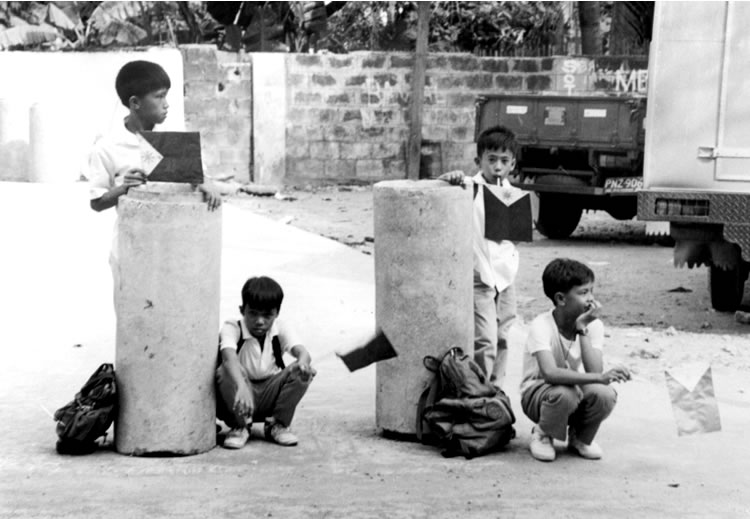
Pay attention to details; serendipity; photo by Atty. Galacio

[2] Learn from paintings, music videos, comic books
, poetry, etc.


Look at paintings; watch good music videos. Look at comic books on superheroes; they have brilliant colors, subtle shadings, clean and dynamic lines. By the way, which superhero works as a photojournalist? Peter Parker, a.k.a. Spiderman!

Read poetry, short stories and other creative fiction, and then visualize in your mind the ideas, emotions expressed in them. One time, after reading Tennyson’s poem “Flower in a Crannied Wall,” I took my camera and for nearly a week, shot a lot of walls. I couldn’t find a single flower in a crannied wall but I did find a lot of small plants, a lot of moss between cracks in the walls, and our neighbors had a jolly good time watching me inspecting and shooting close-ups of walls in our compound!

[3] Practice visualizing things

In the novel “The Heart is a Lonely Hunter” written by Carson McCullers, Mickey, the main character, wanted desperately to learn how to play the violin. She drew a violin on a piece of cardboard, cut it out and then listened for weeks to the classical music being played by a neighbor. Wow, talk about visualization! What happened? Did Mickey become a world-class violinist? Of course not! What do you think this is, real life? Get real! This is fiction! Mickey became a waitress at the end of the novel.


[4] Look for symbolism and relationships

I took this picture way back in 1986 during the original EDSA Revolution. What are the symbolisms here? The soldier is the defender of freedom and democracy (symbolized by the Philippine flag in the background) and the child he’s carrying is the beneficiary of that freedom and democracy.

EDSA Revolution 1986; symbolisms and relationships; photo by Atty. Galacio

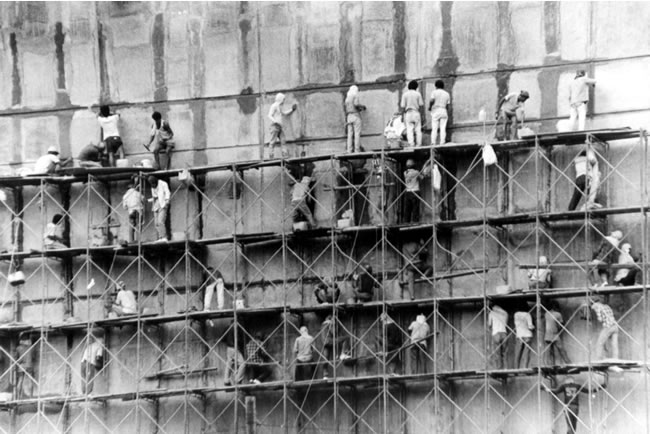
Look for symbolism and relationships. I tried to say in the picture above that students (represented by the bags) were waiting for the building to be finished. I know, I know, it’s really corny!

Symbolisms and relationships; photo by Atty. Galacio

[5] Practice doing still life

These milk cans in the picture below were rusting away near a santol tree. I’ve seen them several times before but I felt that they needed something else to perk up the image. I looked around, saw an old rubber doll my cute nephew (who looks like me) had outgrown, and placed it inside one of the milk cans.

form; still life; 1992; photo by Atty. Galacio

Visualize Better Photos
Wednesday, July 18, 2007

Photojournalism (8): Color or black and white?

Update as of September 18, 2023:

If you’re a high school or grade school student in the Philippines who’s joining the photojournalism contest in the division, regional, or national press conference, I’m offering two free resources to you :

A. 900-plus interactive exercises on English grammar, vocabulary, reading comprehension, verbal analogy, etc (with around 200 megabytes total file size). The exercises have time limit and automatic scoring, with an average of 10 items per exercise.

Examples of these interactive exercises are: Common English grammar errors: Exercise 01 (nouns - confusions of number); Phrasal Verbs: Expressions with Go; English Placement Test (45 items).

B. 200-plus resources (JPG, PDF, MP4, etc.) on photography and photojournalism, with 600-plus megabytes total file size. For some examples of these resources, surf to the “Free photography e-books, cheat sheets” page.

For the download links and more information about how to use the interactive exercises, please surf to my “Better English resources and exercises” blog. Please inform your journalism teacher/schoolpaper adviser or your parents about these resources before downloading them.

If you have any question about downloading or using these free resources, please email me (after informing your journalism teacher/schoolpaper adviser or your parents). I’ll be able to reply to you within two to three days; if you don’t see my reply in your Inbox, check your Spam folder. Or, you can text me.

Also, if you win in the photojournalism contest at whatever level (district, division, regional, or national), you can send me your prizewinning pictures, and I will feature them in a blog post.

Atty. Gerry T. Galacio
gtgalacio@yahoo.com
0927-798-3138


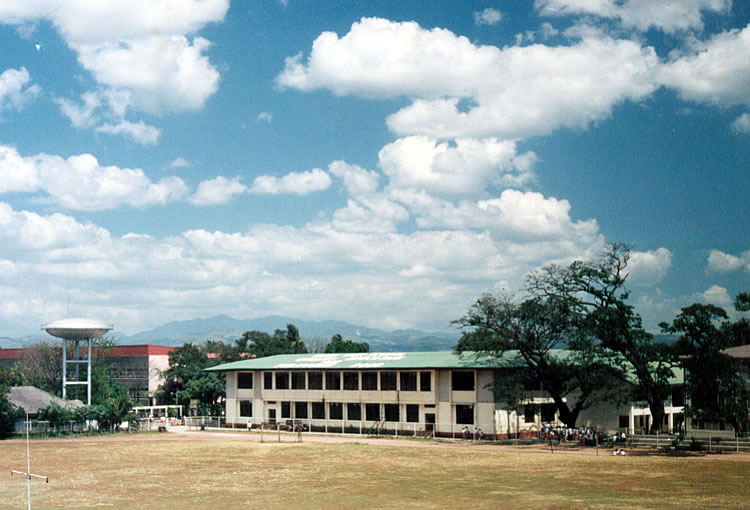
Look at the two pictures below of the athletic oval and Main Building in Rizal High School (Pasig City). One is in black and white, the other in full color. Which picture do you like better?

Rizal High School, Pasig 1995; photo by Atty GalacioRizal High School, Pasig, 1996; photo by Atty. GalacioAs I explained in the Introduction, this series on photojournalism is specifically meant for those of you who are schoolpaper staffers and participants to the press conferences, whether in grade school or high school, in whatever level (division, regional, or national). But if you’re none of these and just someone who likes photography, hey, you’re still welcome!

Relevant materials:

Color temperature scale (see also the graphic near the bottom of this page)

Learn the Basics of Color Theory to Know What Looks Good

Create Visual Depth in Your Photographs with Color (The Color Wheel)

Color in photography: The color wheel explained


Color Theory in Photography (Using complimentary, analogous, and monochromatic in photographs)

You will notice that all of the pictures I have posted so far are black and white pictures; to be more technical about, they are monochromes. When I was still a journalism teacher, I always told my students that a good photographer is someone who can create good black and white pictures. I don’t know if this is accurate or not, but I’ve known a lot of photographers who can produce excellent color pictures but who cannot come up with satisfactory black and white images. Of course, “good”, “excellent”, and “satisfactory” are all relative terms, but shooting black and white pictures seems to be difficult for a lot of photographers. This is primarily because color is such a dominating element.

Shooting black and white photos: think in various shades of gray

When you’re shooting black and white photographs, you’ve got to deliberately think of the various colors as being black, white, or shades of gray in the final picture.
You’re forced to think of the image in terms of the basic elements - line, shape, form, tone, pattern, etc. (This is why shooting black and white photographs is an excellent way to learn photography.) As one Kodak advertisement puts it, “The absence of color ... the presence of imagination!”

“Colour my world ...” This is the title of a hit song by the group Chicago in the 1970’s back when Peter Cetera was still its lead singer and bell bottom pants were still in vogue. Peter Cetera has been going solo, and bell bottom pants now belong to museums for today’s generation to look at and say, Yuck! How baduy!” The expression “colour my world” still best sums, however, the near-total dominance of color film and color pictures in the field of photography. Say “photography” and people will automatically think of color pictures.

With the advent of digital cameras, however, black and white photography has become and more marginalized, as it were. It’s very difficult now to find locally materials for black and white photography like film, photo paper, and darkroom chemicals. (If you are from Metro Manila, try looking for these materials in R. Hidalgo St. in Quiapo, Manila.)

Photojournalism used to be synonymous with black and white photographs

Shooting Black and White on your D-SLR
free e-book by photoanswers.co.uk
(7.15 MB, 22 pages)
Photojournalism was once synonymous with black and white photographs. Today, however, practically all national and international news publications use color news pictures (except for occasional photo essays in monochrome). But there are still people who believe that news pictures should always be shot in black and white. Sebastiao Salgado, considered as the world’s best photojournalist, for example believes that color tends to prettify things, even images of death, squalor or poverty. He believes that black and white has a more realistic, more “gritty” feel.

Most schoolpapers, elementary and high school levels, in the Philippines do not have the budget to produce publications in full color. (Some schools thus resort to the practice of producing two issues of a schoolpaper – a limited edition in full color for the group competitions, and another edition without color for distribution to the students.)

Speaking of budgets, Republic Act 7079 or the “Campus Journalism Act of 1990” gives the schools the right to collect schoolpaper fees, but for one reason or another, the Department of Education only allows voluntary contributions. Needless to say, schoolpapers have been having a difficult time financially, with the advisers oftentimes forced to shell out their own money.

Anyway, a good solution is for the schools to invest in digital cameras (the higher the megapixels, the better). Digital cameras have the capacity to shoot in both color, and in black and white. You don’t have to buy any film, unlike in traditional film-based cameras. After you’re through shooting, you just plug in your camera into the computer, and save or burn the pictures on your hard disk or a CD You can also transfer your pictures on a USB flash drive.

By whatever way you save your pictures from a digital camera, you can then bring them to the printing press. The press will then incorporate your pictures right into the electronically set pages, using Pagemaker, Coreldraw, Photoshop, etc. Also, if you had shot your pictures in color, it’s a whiz using these software programs to turn them into black and white pictures.


In the US, the movie “It’s a Wonderful Life” starring James Stewart is part of the Christmas Day tradition. The original movie dating back to the 1940’s was shot in black and white, but now, the movie has been turned into color, through a process known as “colorization.” What’s the better version - the original black and white, or the colorized version? Me, I like the black and white version.

What about that heartwarming and blockbuster movie “Big” directed by Penny Marshall? Remember that last scene, that bittersweet separation as lead actor Tom Hanks walks away from Elizabeth Perkins, with gold, yellow, and orange leaves falling from the trees and swirling about on the streets? Would the scene be just as effective, just as poignant if it had been shot in black and white? I don’t think so. What’s my point? Some images look good in black and white, some really look good in color.

When you’re shooting in color, you’ve got to be aware of the color or colors within the image. This may sound basic (or even nonsense to some of you), but you have to admit that we oftentimes take color for granted. In one National Secondary Schools Press Conference in the late 1980’s, for example, the topic for the feature writing contest was this: “How do you explain the color red to someone born blind?”

Go ahead, try explaining it ... you’ll realize how we take colors so much for granted!

http://www.techradar.com/how-to/photography-video-capture/cameras/what-is-color-temperature-free-photography-cheat-sheet-1320923
Color temperature scale
(free cheat sheet from Tech Radar/
Digital Camera World)
Color photography: classifying colors; psychological, emotional, and cultural reactions to colors; color me red

One way of classifying colors is to divide them into (1) warm and cool colors, and (2) harmonious and conflicting colors. (See the color wheel infographic from Digital Camera World below.)

Colors that tend to arouse warm feelings in people include yellow, orange, magenta, and red.

Cool colors that convey feelings of calmness or placidity are blue, mint, green, and cyan.

Conflicting colors are those found on opposite sides of the color wheel: red and cyan; blue and yellow; magenta and green.

Harmonious colors, which provide the viewer a relaxed, comfortable feeling, are those near each other in the color wheel: red and yellow; blue and magenta; green and cyan.

(Note: Click the image below to see a bigger-sized image of the color wheel infographic from Digital Camera World.)

https://blogger.googleusercontent.com/img/b/R29vZ2xl/AVvXsEg5g4mydNGrG7KneM76ZFP-guXOqDQEk0qC-oi3TvCQGpzW6tE3MJreBxXUz6mq9H4vP-ai31se_kfFRVrEFRS_8VISuVcsTC8XmjQ-yfs0SFOdZ39lZqfUgXeRFa2paB2yJ7AhIA/s1600/Digital+Camera+World+cheet+sheat+What_is_the_color_wheel_cheat_sheet+1000+px.jpg

Relevant article and charts:

Color Psychology: The Emotional Effects of Colors

Color Meanings and Symbolism of Colors (charts)
Psychological, emotional, and cultural reactions to colors:

White - purity, classic, clean, airy, cool, pristine (but if overused with no contrasting colors , it can appear cold and sterile)

Gray - neutral, classic, cool, sober, practical, corporate , timeless, quality

Black - powerful, bold, strong, dramatic, expensive, magical, mysterious, sexy, sophisticated, prestigious

Blue - authoritative, dependable, professional, conservative, confident, serene

Green - fresh, springlike, outdoorsy, happy, lively

Red - exciting, hot, intense, passionate, dramatic, energetic, dynamic, daring, provocative

Two things you have to remember about the color red:

(1) Red is comparatively rare in nature.

(2) Red visually 'stands out' as compared to blue or green.


From Color to Black and White

Monday, July 16, 2007

Photojournalism (7): Element of perspective

Update as of September 18, 2023:

If you’re a high school or grade school student in the Philippines who’s joining the photojournalism contest in the division, regional, or national press conference, I’m offering two free resources to you :

A. 900-plus interactive exercises on English grammar, vocabulary, reading comprehension, verbal analogy, etc (with around 200 megabytes total file size). The exercises have time limit and automatic scoring, with an average of 10 items per exercise.

Examples of these interactive exercises are: Common English grammar errors: Exercise 01 (nouns - confusions of number); Phrasal Verbs: Expressions with Go; English Placement Test (45 items).

B. 200-plus resources (JPG, PDF, MP4, etc.) on photography and photojournalism, with 600-plus megabytes total file size.

To avail of these free resources, email me with the following information: your name and school; the name and email address of your journalism teacher or schoolpaper adviser (or that of your parents); the division, regional, or national press conference that you’re joining.

(I’ll be able to reply to you within two to three days; if you don’t see my reply in your Inbox, check your Spam folder. Or, you can text me.)

Atty. Gerry T. Galacio
gtgalacio@yahoo.com
0927-798-3138


Photographs are two dimensional objects; they’re flat with height and width but no depth (the third dimension). Remember our previous discussion of the x-, y-, and z-axis? We have already learned that the elements of forms and texture through lighting, highlights, and shadows can convey the illusion of depth. The best element, however, which enables a two-dimensional image to achieve the impression of being three-dimensional is “perspective.” The term refers to the relationships in space and the relative sizes of objects in a scene. It may either be linear or aerial.


linear perspective; photo by Atty. GalacioLinear perspective

Objects of the same size diminish in their apparent size the farther away they are from the photographer. On the other hand, a smaller object located closer to the camera will appear almost the same size as a larger object located at a farther distance.
Examples are

(1) the students at the top of the picture seem smaller than the hollow blocks at the bottom portion;
 
linear perspective; photo by Atty. Galaciolinear perspective; photo by Atty. Galacio


(2)
the guy in front, who’s hogging all the chairs for himself, appear much bigger than the other students who are located farther away from the camera; and


(3)
the jeepney located nearer to the camera appears to be almost as wide as the building behind it.

With the picture of the students and the hollow blocks, what I really wanted to shoot was the graffiti on the hollow blocks. I held the camera to shoot in the horizontal format (more on formats later on) but I felt something was missing. Boy, I’ve always wanted to say something like this! Then I saw these students whose portraits I had just taken, walking off to return to their classes. I focused on the foreground, turned the camera vertically and included the students in the background. Just when I pressed the shutter release button, the girl in the middle wearing a dark T-shirt looked back at me. Serendipity!

Because of linear perspective, the hollow blocks in the foreground look much bigger than those in the background. Also, they seem to recede into the vanishing point. But that girl really makes the picture!

perspective; vanishing point; photo by Atty. Galacio Linear perspective, parallel lines, and vanishing points

You have probably learned from your geometry subject what Euclid, a Greek mathematician, the father of geometry, declared centuries ago. Euclid said, “Parallel lines do not meet.” Well excuse me, Mr. Euclid, Sir! In photography, parallel lines can be made to appear to converge as they recede into the so-called “vanishing point.” This is another aspect of linear perspective. Take a look, for example, at the posts of the waiting shed above which appear to become smaller and smaller as they recede into the background, and finally converging into the vanishing point.

Linear perspective and diagonal lines

A very easy, yet very effective way of creating depth is by using diagonal lines. Shoot your subject from the side, and you’ll get a diagonal line. To make a better photograph, anchor the corners with the diagonal lines. Example is this picture below of CAT cadets taking refuge from the downpour under the waiting shed, with the edge of the roof and the walkway as diagonal lines. (Depth is also created with the posts of the shed becoming increasingly smaller from left to right.)

perspective; diagonal lines; parallel lines; photo by Atty. Galacio


Aerial perspective


Objects located farther away from the camera will appear lighter in tone or less saturated in color than objects located closer to the camera. This is caused by smoke, mist, fog, or atmospheric haze. “Aerial perspective” is another way of achieving a sense of depth in your pictures.

Friday, July 13, 2007

Photojournalism (6): Element of pattern

Update as of September 18, 2023:

If you’re a high school or grade school student in the Philippines who’s joining the photojournalism contest in the division, regional, or national press conference, I’m offering two free resources to you :

A. 900-plus interactive exercises on English grammar, vocabulary, reading comprehension, verbal analogy, etc (with around 200 megabytes total file size). The exercises have time limit and automatic scoring, with an average of 10 items per exercise.

Examples of these interactive exercises are: Common English grammar errors: Exercise 01 (nouns - confusions of number); Phrasal Verbs: Expressions with Go; English Placement Test (45 items).

B. 200-plus resources (JPG, PDF, MP4, etc.) on photography and photojournalism, with 600-plus megabytes total file size. For some examples of these resources, surf to the “Free photography e-books, cheat sheets” page.

For the download links and more information about how to use the interactive exercises, please surf to my “Better English resources and exercises” blog. Please inform your journalism teacher/schoolpaper adviser or your parents about these resources before downloading them.

If you have any question about downloading or using these free resources, please email me (after informing your journalism teacher/schoolpaper adviser or your parents). I’ll be able to reply to you within two to three days; if you don’t see my reply in your Inbox, check your Spam folder. Or, you can text me.

Also, if you win in the photojournalism contest at whatever level (district, division, regional, or national), you can send me your prizewinning pictures, and I will feature them in a blog post.

Atty. Gerry T. Galacio
gtgalacio@yahoo.com
0927-798-3138


Pattern is the repetition of shapes, lines, colors, or forms. It can either be a random or orderly arrangement of objects in nature or of man-made objects. It may either be a repetition of a single, basic shape or a combination of shapes.

patterns - single shapes or combinations; photo by Atty. Galacio

pattern - squares and triangles; photo by Atty. Galacio

patterns may also be of people's actions, positions, etc; photo by Atty. Galacio

People by their gestures, actions, expressions, and movements, can also create patterns, as in the picture of the girls below, fervently praying, waiting for the announcement of winners in a drama contest.

patterns - gestures, movements of people; Rizal High School, 1995, praying for the results of the drama contest; photo by Atty. Galacio

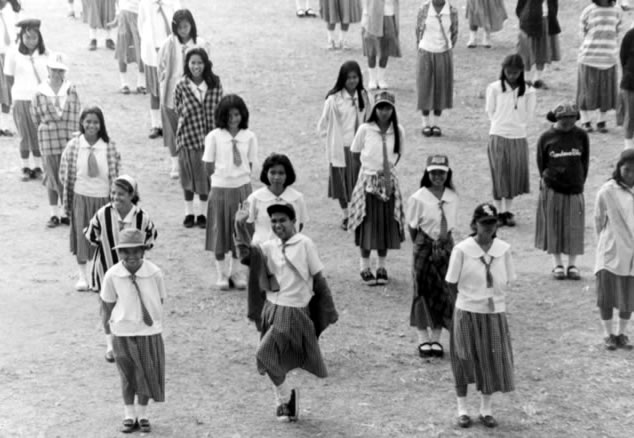
Sometimes however, a picture can become more effective or interesting if there is a disruption in the pattern of a subject, like in picture below where this girl on the left, front row, takes time out from the field demo practice to say “hello!”

disruption in patterns create interest; photo by Atty. Galacio

9 Photo Composition Tips (featuring Steve McCurry, 2002 Photographer of the Year, American Photo Magazine); Tip No. 8: Patterns and repetition

Wednesday, July 11, 2007

Photojournalism (5): Elements of tone and contrast

Element of tone

No, we definitely cannot be talking about music here; I am tone deaf, you see. Tone in photography refers to the transition of light to dark within the subject of your photograph. The variations in tones provide us with the visual information enabling us to distinguish one object from another, and to determine a photograph’s quality.

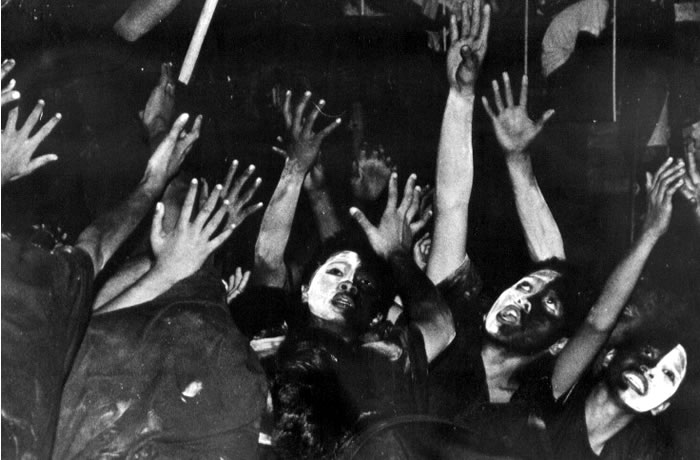
Rizal High School choral interpretation contest circa early '90s; tone; fill the frame; photoby Atty. Galacio
The distribution and variation of light and shadow within the image set the mood of a photograph. A picture with primarily dark tones will convey a somber, dramatic, mysterious mood (as in the picture above of students with hands reaching upwards, towards something or someone).

Rizal High School CAT fancy drill competition; 1989-1990; photo by Atty. Galacio 
Light tones, on the other hand, convey to the viewers a cheerful, open and optimistic mood as in this picture of cadets preparing for the fancy drill.


Bright and dark tones produce visually strong image; photo by Atty. Galacio 
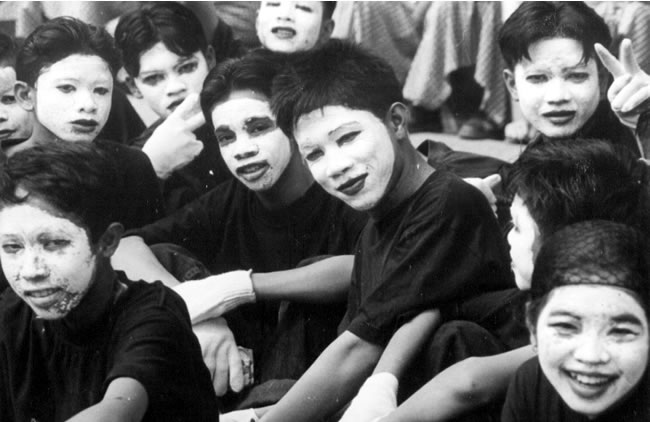
When bright and dark tones are both present, a bold, assertive image will be created like in this picture where the painted faces are pure white and the T-shirts are solid black.

By the way, in the climactic scene of the movie “City Hal,l” Al Pacino playing the role of New York City mayor Joe Pappas, says: “There’s black and there’s white. It’s the grays in between that give us the problems.” He was referring of course to ethics and moral standards (are there such things?) in politics. If he had been referring to black and white photography, he could not have been more wrong.

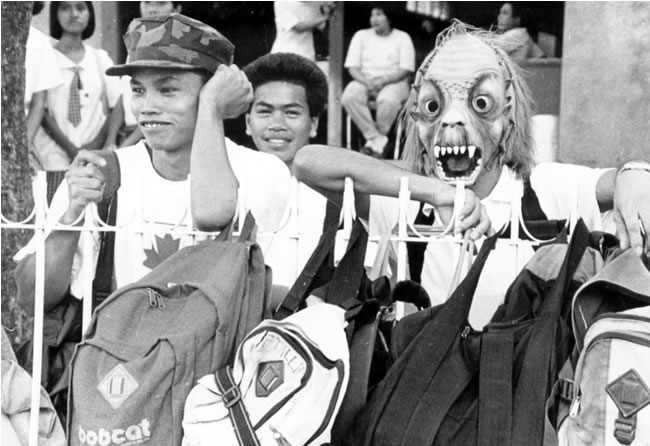
Buffy's boyfriend; 1992; full tonal range; photo by Atty. Galacio 
Good black and white photographs often display what photographers refer to as “full tonal range.” A good picture, in terms of tone, oftentimes exhibit solid blacks, pure whites and varying degrees of grays, like in this picture where the guy on the right obviously has a face only his mother (or Buffy the Vampire Slayer) could love. His fangs are pure white, the background on the upper left hand corner is pure black, while the bags on the foreground exhibit various shades of gray. A picture with only black and white tones would just show the subject’s shape or outline (known as a “silhouette”). The varying shades of gray (dark, light or medium) generally produce a more aesthetically pleasing image.

So you see, “there’s black and there’s white. It’s the grays in between that give us good pictures.”

Element of contrast

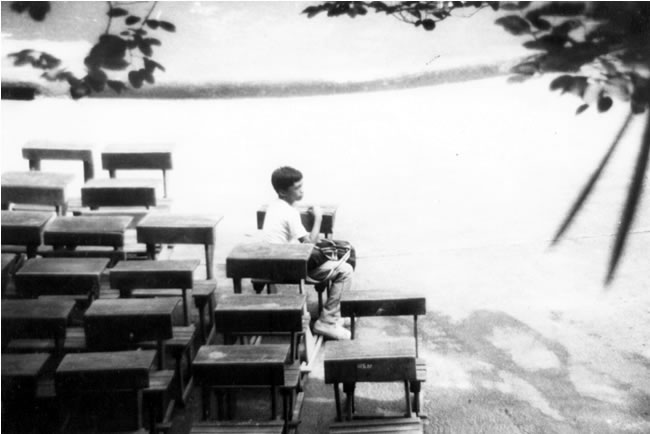
High contrast image; 1989; photo by Atty. Galacio 
Closely related to tone, contrast is the difference between the strongest highlight and the darkest shadow in a photograph. When a picture uses tones at the opposite ends of the tonal range, it is said to have “high contrast.” Photographs with extremely high contrast like in the picture above will lack detail in the burned out highlights (the ground) and in the almost solid black shadows (the desks and the overhanging foliage).

“Low contrast” images on the other hand, have a limited range of tones. When the range between the highlights and the shadows is very low, the resulting pictures will look muddy and dull. Nothing is black and white as the movie “White Man’s Burden” starring John Travolta and Sidney Poitier would say.

You have to keep in mind that the eye sees the world differently from the way film does. While our eyes can distinguish tones in a scene with a brightness range of 1:1000, film can only record a very limited range of brightness. The technique is to squint your eyes while looking at your subject - this will give you a fairly good idea of how the scene will record on film.

Sunday, July 08, 2007

Photojournalism (4): Elements of form and texture

Update as of September 18, 2023:

If you’re a high school or grade school student in the Philippines who’s joining the photojournalism contest in the division, regional, or national press conference, I’m offering two free resources to you :

A. 900-plus interactive exercises on English grammar, vocabulary, reading comprehension, verbal analogy, etc (with around 200 megabytes total file size). The exercises have time limit and automatic scoring, with an average of 10 items per exercise.

Examples of these interactive exercises are: Common English grammar errors: Exercise 01 (nouns - confusions of number); Phrasal Verbs: Expressions with Go; English Placement Test (45 items).

B. 200-plus resources (JPG, PDF, MP4, etc.) on photography and photojournalism, with 600-plus megabytes total file size. For some examples of these resources, surf to the “Free photography e-books, cheat sheets” page.

For the download links and more information about how to use the interactive exercises, please surf to my “Better English resources and exercises” blog. Please inform your journalism teacher/schoolpaper adviser or your parents about these resources before downloading them.

If you have any question about downloading or using these free resources, please email me (after informing your journalism teacher/schoolpaper adviser or your parents). I’ll be able to reply to you within two to three days; if you don’t see my reply in your Inbox, check your Spam folder. Or, you can text me.

Atty. Gerry T. Galacio
gtgalacio@yahoo.com
0927-798-3138


Element of form

In the early days of photography, tribesmen from jungles and mountains believed that cameras had the power to steal their soul and imprison them in a piece of paper. But photographs really are just reproductions of what is actually there in reality. The problem oftentimes, however, is that a lot of pictures do not have depth, which makes them look unreal. Here we need the element of form. While shapes are two-dimensional, form provides a third dimension – depth. If you are mathematically oriented, think of it this way; shapes only have the x- and y-axis, while form has the x-, y-, and z-axis.

form; still life; 1992; photo by Atty. Galacio
Rizal High School musical theater 1993; photo by Atty. GalacioThe word photography actually comes from two words – “photon” meaning light and “graphein” meaning “to write.” As someone once said, without light, photography is not possible. And so it is with form and depth. When light strikes an object, it creates highlights and shadows. If I remember correctly my Humanities I subject in UP Diliman way back in 1973, the interplay of light and shadow is called “chiaroscuro.” The combination of highlights and shadows convey a sense of depth, of volume or of the subject’s solidity like the pictures above of the rubber doll nestling in the rusted milk cans, and the folds in the nuns’s uniforms.

Note: We will later on discuss the quality and direction of light; enough to say for now that in terms of the direction of light, sidelighting best emphasizes form.

Element of texture

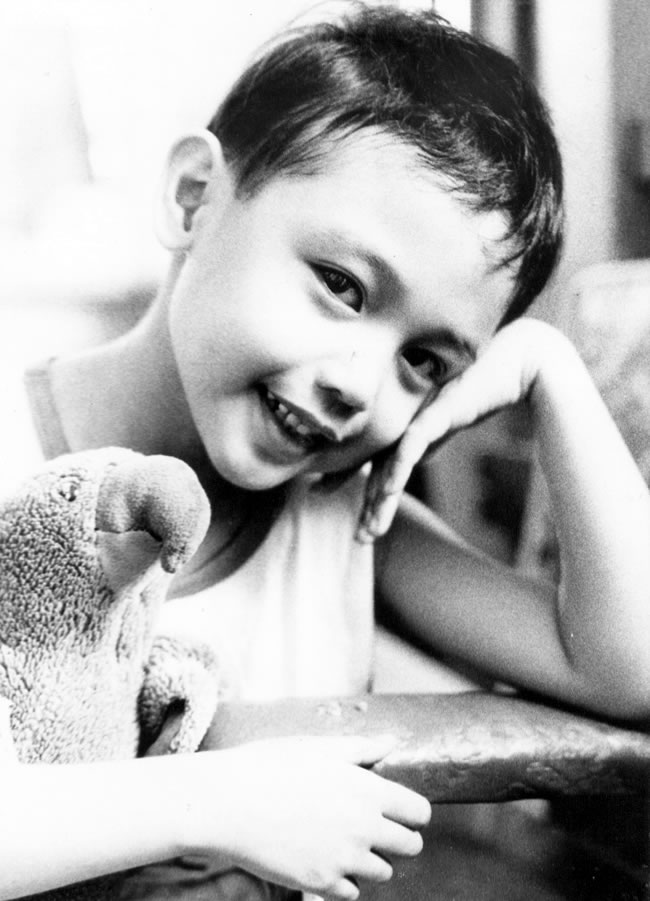
My cute nephew JR 1993; texture; picture diagonal; photo by Atty. GalacioA child’s soft skin, a stuffed toy’s rough, furry exterior ... While form gives us an idea of what it would be like to hold the object in our photograph, texture gives us an idea how that object’s surface would be like to touch, whether it would be rough or smooth.

In picture above, my nephew JR poses together with his stuffed toy. He’s cute because he looks like me. Hold it! Let me get that straight. I don’t look like the stuffed toy; I look like JR, okay? okay? You can almost feel the softness of his skin and cheeks, and the furry exterior of that stuffed parrot.

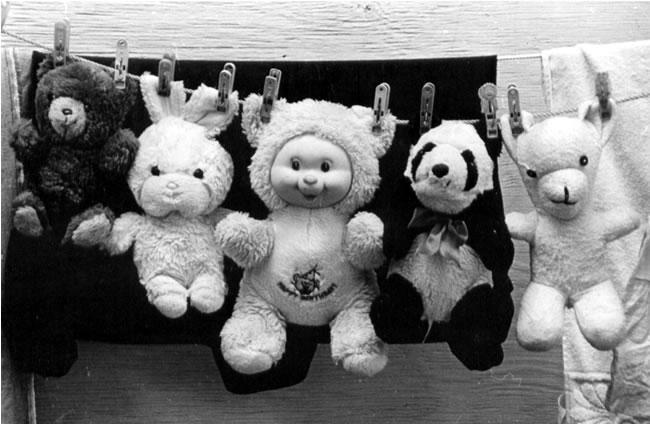
texture;1992; cutest picture in history of photography, taken by Atty. GalacioThe stuffed toys in the picture above are obviously just enjoying themselves, hanging out together and, although, they’re in the shade, you can also sense their furry texture. I’m sure the girls among you will agree with me that this picture is probably the cutest picture in the history of photography!

Photographs (with fast lenses and slow film; more on this later) can very accurately and realistically portray textures but this may not always be desirable. In portraits, for example, subjects often want to look years younger than they really are (men!) or more beautiful than they really are (women!).

Oftentimes, photographers have to use soft focus lenses or diffusion filters (and now, Adobe Photoshop and other software) to “alter the textural quality of the image” which is really a euphemism for removing or hiding the subject’s lines, wrinkles, blemishes, warts, etc. Why can’t people be like Oliver Cromwell, England’s protector who beheaded King Charles I? When he was asked by a portrait painter to turn his face sideways, he ordered, “Paint me, warts and all!”

In landscapes or nature photography, however, scenes sometimes look best when the texture of rock formations, trees, etc. stand out. (By the way, Galen Rowell is known as America’s best scenic photographer. Did you know that before he became a photographer, he worked as an auto mechanic? Great career change!)


Be a better writer or editor through StyleWriter 4: this software checks 10,000 words in 12 seconds for hundreds of style and English usage issues like wordy and complex sentences, passive voice, nominalization, jargon, clichés, readability, spelling, etc.

StyleWriter 4 graphs your style and sentence variety, and identifies your writing habits to give an instant view of your writing. You can learn to adjust your writing style to suit your audience and task. You can learn, for example, the writing style of Newsweek, Time, The Economist, and Scientific American.

StyleWriter 4 is widely used in the US federal government (for example, the Environmental Protection Agency). It can be used by educators, students, and professionals in various fields - business, law, social or physical science, medicine, nursing, engineering, public relations, human resources, journalism, accounting, etc. Download your free 14-day trial copy now.

Tuesday, July 03, 2007

Pictures from Miriam College HS Department photojournalism seminar

Last Saturday, June 30, I gave a one-and-half hour seminar in photojournalism for the staffers of Miriam's Magnificat yearbook. Pictures below were taken by Tsina218. Thanks, girls, for putting up with my corny jokes!

P.S. I recommend to all of you Dannah Gresh's website Purefreedom, plus Silver Ring Thing, Every Student and True Love Waits. The links are in the sidebar of this blog. Hope to see you in the press conferences!

Hi, girls! Please don't forget to browse Dannah Gresh's website Purefreedom, plus Silver Ring Thing, Every Student and True Love Waits. These sites are great for teenagers like you.

Wednesday, June 27, 2007

Photojournalism (3): Elements of lines and shapes

Update as of September 18, 2023:

If you’re a high school or grade school student in the Philippines who’s joining the photojournalism contest in the division, regional, or national press conference, I’m offering two free resources to you :

A. 900-plus interactive exercises on English grammar, vocabulary, reading comprehension, verbal analogy, etc (with around 200 megabytes total file size). The exercises have time limit and automatic scoring, with an average of 10 items per exercise.

Examples of these interactive exercises are: Common English grammar errors: Exercise 01 (nouns - confusions of number); Phrasal Verbs: Expressions with Go; English Placement Test (45 items).

B. 200-plus resources (JPG, PDF, MP4, etc.) on photography and photojournalism, with 600-plus megabytes total file size. For some examples of these resources, surf to the “Free photography e-books, cheat sheets” page.

For the download links and more information about how to use the interactive exercises, please surf to my “Better English resources and exercises” blog. Please inform your journalism teacher/schoolpaper adviser or your parents about these resources before downloading them.

If you have any question about downloading or using these free resources, please email me (after informing your journalism teacher/schoolpaper adviser or your parents). I’ll be able to reply to you within two to three days; if you don’t see my reply in your Inbox, check your Spam folder. Or, you can text me.

Also, if you win in the photojournalism contest at whatever level (district, division, regional, or national), you can send me your prizewinning pictures, and I will feature them in a blog post.

Atty. Gerry T. Galacio
gtgalacio@yahoo.com
0927-798-3138


Lines are the most basic component of a photographic image, and can be classified into two ways - physical lines, and imaginary lines of force and direction.

Physical lines

These lines are those that exist in the empirical world like painted lines on the streets or on the basketball court, the lines on a piece of paper and the bare branches of a tree suffering under summer’s merciless sun ... I know, I know, it’s such a corny line!

Imaginary lines of force and direction

This kind of lines exists only in our minds
like the rows of CAT cadets in a fancy drill competition below, the direction in which persons look, like these guys and girls all looking at the little girl with the pig tails at the extreme left, the dancers looking towards to the right; the direction in which moving objects travel, the imaginary lines created when we divide something up like a very real, very delicious pizza..

Rizal High School fancy drill competition 1995; vertical lines express movement and dynamism; photo by Atty. Galacio
Rizal High School Musical Theater 1993; imaginary lines of direction; photo by Atty. Galacio
Rizal High School 1995; imaginary lines of direction; photo by Atty. Galacio(Please take note that the pictures I will be posting to illustrate this series on photojournalism are more than a decade old, and thus leave a lot to be desired in terms of quality. I shot all these pictures using my Canon AE-1 Program camera and mostly Kodak Tri-X film. This film is reportedly the favorite of Sebastiao Salgado, considered as the world’s best photojournalist.)

Psychological effects of lines

Lines have profound psychological effects on the viewers;
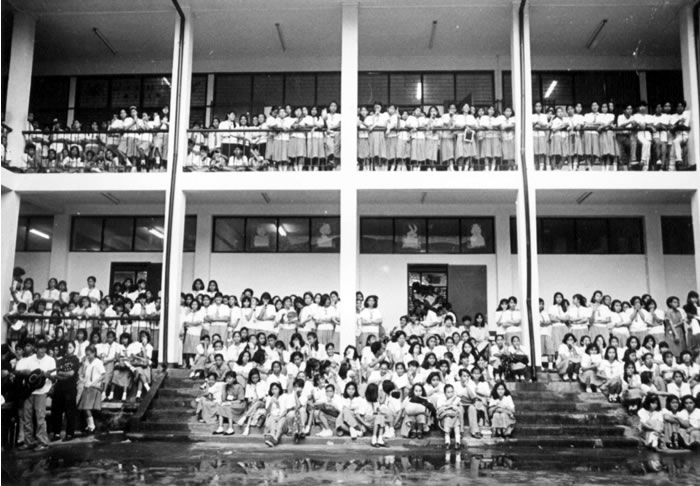
for example, pictures containing horizontal lines evoke feelings of serenity, stability, while vertical lines have a sense of energy, grandeur. Diagonal lines, like those in the picture of the marching cadets above (the crossbands on their uniforms, their rifles, their left legs thrusting forward in cadence) express movement and dynamism.

Rizal High School Main Bldg 1995; psychological effects of lines; photo by Atty. Galacio Element of shape

Lines when joined together create two-dimensional shapes like circles, squares, triangles, rectangles, polygons, etc.
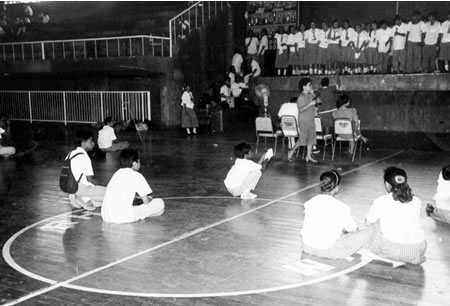
Shapes attract our attention first and foremost whenever we look at photographs. Everyday objects are rich sources of shapes; some shapes will be obvious like the painted circle in the middle of the gymnasium below, and the water hose (very first picture above).

Lines and shapes; photo by Atty. GalacioPhotography and pizza

Tim Burton is the world famous director of such movies as “Edward Scissorhands”, “Beetlejuice,” and “Batman” parts 1 and 2. One time, while he was doing post-production work on the Batman 2 movie, he got hungry so he ordered out for some pizza. He got a mild surprise when upon opening the box, he found several pictures on top of the pizza.

The pizza delivery guy, named John Pezzota if I remember right, was a struggling photographer working part time at a pizza joint to support himself. When he found out that it was Tim Burton who was ordering the pizza, he took a chance by placing some of his black and white pictures in the pizza box.

Well, Tim Burton did like the pizza, and the photographer’s dark somber style which suited Batman 2’s moody atmosphere. The result? The photographer got the job of shooting the movie posters of Batman played by Michael Keaton and Catwoman played by Michelle Pffeifer. Cowabunga!

Sunday, June 24, 2007

Photojournalism (2): Elements of photojournalism, with videos

Update as of September 18, 2023:

If you’re a high school or grade school student in the Philippines who’s joining the photojournalism contest in the division, regional, or national press conference, I’m offering two free resources to you :

A. 900-plus interactive exercises on English grammar, vocabulary, reading comprehension, verbal analogy, etc (with around 200 megabytes total file size). The exercises have time limit and automatic scoring, with an average of 10 items per exercise.

Examples of these interactive exercises are: Common English grammar errors: Exercise 01 (nouns - confusions of number); Phrasal Verbs: Expressions with Go; English Placement Test (45 items).

B. 200-plus resources (JPG, PDF, MP4, etc.) on photography and photojournalism, with 600-plus megabytes total file size. For some examples of these resources, surf to the “Free photography e-books, cheat sheets” page.

For the download links and more information about how to use the interactive exercises, please surf to my “Better English resources and exercises” blog. Please inform your journalism teacher/schoolpaper adviser or your parents about these resources before downloading them.

If you have any question about downloading or using these free resources, please email me (after informing your journalism teacher/schoolpaper adviser or your parents). I’ll be able to reply to you within two to three days; if you don’t see my reply in your Inbox, check your Spam folder. Or, you can text me.

Also, if you win in the photojournalism contest at whatever level (district, division, regional, or national), you can send me your prizewinning pictures, and I will feature them in a blog post.

Atty. Gerry T. Galacio
gtgalacio@yahoo.com
0927-798-3138


Elements of photojournalism (from Wikipedia)


1. Timeliness — the images have meaning in the context of a recently published record of events.

2. Objectivity — the situation implied by the images is a fair and accurate representation of the events they depict in both content and tone.

3. Narrative — the images combine with other news elements to make facts relatable to the viewer or reader on a cultural level.

Elements of Photojournalism


The best photographs in photojournalism, 1943 to the present, from Pictures of the Year International (POYi)


Best of POYi from Pictures of the Year on Vimeo.

Relevant articles and downloads on photojournalism


Stacy Pearsall, combat photographer for the US Air Force:

“By the time I was considered to be combat ready, I was aerial qualified and had attended ground survival and evasion courses, prisoner of war training, water survival school and close quarters combat training.”

“From the age of 21 to the age of 27, I captured over 500,000 images from over 41 different countries. I was considered the best photographer in the military and was the first woman to have won the Military Photographer of the Year twice.” (Read the complete article or download sample pages from her book.)


Articles

The Definition of Photojournalism: Looking at Ethics in Photojournalism; Basic Principles of Photojournalism; Photojournalism Careers: Looking at Photojournalism Degree Requirements; Photojournalism Photography: Capturing Events (Pre-Shooting); Preparing for Your First Shoot as a Photojournalist

Downloads

A Photojournalist’s Field Guide: In the Trenches with Stacy Pearsall (58 sample pages; 6.97 MB); Photojournalism Curriculum Guide – Texas Association of Journalism Educators (16 pages; 119.84 KB); Photojournalism history (42 slides; 36.33 MB); History of Photojournalism - Legacy Student Media (34 slides; 2.91 MB); Photojournalism in the U.S. and Germany: A Comparative View (44 slides; 2.92 MB)

Photojournalism videos


The Power of Photojournalism


7 Photojournalism Tips by Reuters Photographer Damir Sagolj (Thomson Reuters Foundation)


Photography Techniques: Photojournalism Tips From Ed Kashi (Advancing Your Photography)


Documentary Photography: Tips & Advice by Daniel Milnor (Advancing Your Photography)


The Best Of Photography Awards Pulitzer, World Press

Saturday, June 23, 2007

Photojournalism (1): "I Am A Camera"

Update as of September 18, 2023:

If you’re a high school or grade school student in the Philippines who’s joining the photojournalism contest in the division, regional, or national press conference, I’m offering two free resources to you :

A. 900-plus interactive exercises on English grammar, vocabulary, reading comprehension, verbal analogy, etc (with around 200 megabytes total file size). The exercises have time limit and automatic scoring, with an average of 10 items per exercise.

Examples of these interactive exercises are: Common English grammar errors: Exercise 01 (nouns - confusions of number); Phrasal Verbs: Expressions with Go; English Placement Test (45 items).

B. 200-plus resources (JPG, PDF, MP4, etc.) on photography and photojournalism, with 600-plus megabytes total file size.

To avail of these free resources, email me with the following information: your name and school; the name and email address of your journalism teacher or schoolpaper adviser (or that of your parents); the division, regional, or national press conference that you’re joining.

(I’ll be able to reply to you within two to three days; if you don’t see my reply in your Inbox, check your Spam folder. Or, you can text me.)

Atty. Gerry T. Galacio
gtgalacio@yahoo.com
0927-798-3138


Topics discussed in this blog post: Tragic story of photojournalist Sean Flynn; Creativity is in your heart and mind, not in your camera; 35 mm: film format and viewing system; What you see is what you get; Features of modern SLR cameras; Practical tip: always release the shutter button gently; Computers, digital cameras, and the future of photography; Decision-free photography; A camera for your schoolpaper; Types of digital cameras (infographic); How to hold a camera (infographic)

Using your Digital SLR (free e-book
from Photo Answers; 22 pages)

Types of digital cameras (see also the
graphic at bottom portion of this post)

Camera buying guide (Most important
things to know when shopping for a
camera)

How to hold a camera: getting started
with your new DSLR
(see also the
graphic at bottom portion of this post)

6 camera settings new photographer
find confusing (and we can see why)


“What camera should I buy?” - The 4
types of camera
(video)

Best Types of Cameras for Learning
Photography
(video)

TOP 5: Best Entry Level DSLR
Camera For Beginners 2018
(video)

DSLR Camera Basics Tutorial:
Shutter Speed / Aperture / ISO

(video)

How to Use a DSLR Camera: Learn
DSLR Camera Basics Shutter
Aperture ISO
(video)

How to take better photos with
your Android phone


iPhone Photography School (tutorials:
tips and techniques; weekly contest)

10 Tips To Help Improve Your
Smartphone Photography


7 smartphone photography tips for
taking better pictures


How to Take Better Pictures with
Your Smartphone's Camera


10 Tips for Good Smartphone
Photography - TechSpot
Sean Flynn, son of the legendary 1940’s Hollywood actor Errol Flynn, was a photojournalist who covered the Vietnam War in the 1960’s. Bitterly disillusioned by all the killings he witnessed and the horrors of the war, he set aside his camera but still continued going with the US Special Forces in their operations.

Sean was confronted by his best friend and fellow photojournalist Tim Page about this contradiction. With a lost look in his eyes, Sean pointed to his head and said, “The images are all in here!”

Sean disappeared after the Vietnam War; it is believed that he was murdered by the Khmer Rouge guerrillas in Cambodia.

(Tim Page is the author of the book “Page after Page” that was turned into the 1990s TV miniseries “Frankie’s House”; the book and the miniseries narrate Page’s odyssey in Vietnam and his friendship with Sean.)

The human brain is certainly an incredibly marvelous thing (more on this later), but we do need a camera to take pictures. Say “photojournalism” and the camera that comes immediately into people’s minds is the 35 mm SLR (single lens reflex) camera.

The SLR camera is used in all kinds of photographic work like sports, fashion, portraits, etc. It has an extensive system of interchangeable lenses ranging from ultra-wide fisheye lenses up to the super telephotos, which can shoot close up pictures of subjects more than a mile away, and numerous accessories such as motor drives, power winders, dedicated flash units, remote controlled operation, etc.

Creativity is in your heart and mind, not in your camera

Richard Avedon, known as the world’s number one photographer according to a 1996 survey, once said, “It’s not the camera that makes a good picture but the eye and the mind of the photographer.”
(Avedon’s most famous photograph is that of Hollywood actress Nastassia Kinski with a snake wrapped around her body.)

Don’t be discouraged if you don’t have the kind of cameras that you see professionals carry around. Use whatever camera that you may have, however cheap or old it may be.

As painter Pablo Picasso said, “There are painters who transform the sun into a yellow spot, but there are others who, thanks to their art and intelligence, transform a yellow spot into a sun.” An avid photographer, Picasso meant to say is that creativity is in your heart and mind, not in your camera.

For example, the 1947 Pulitzer Prize for photojournalism was awarded to a photograph of a woman jumping out from the window of a burning hotel. The picture was taken by Arnold Hardy, an amateur photographer, who bought his camera a month before the fire which claimed the lives of a hundred people. He took the picture with his very last flashbulb.

As someone has put it, photography really is both art and science. The term “EOS” in Canon autofocus cameras really stands for “electronic optical system” but the Canon company wants to be more poetic about it. So, it says that the term stands for “Eos”, the Greek goddess of dawn. Autofocus being the dawn of a new age for cameras, get it?

35 mm: film format and viewing system

We can break down the term “35 mm single lens reflex” camera into two components: one, the film format, and two, the viewing system. The “35 mm” portion of the term “35 mm camera” does not refer to the focal length of the lens but to the film format. The SLR camera uses the so-called 135 size film that measures 24 by 36 mm, loaded in cassettes holding 12, 24 or 36 frames (an accessory allows the use of film magazines with a total capacity of 250 frames).

Relevant article: “Film vs. Digital: A Comparison of the Advantages and Disadvantages” (PetaPixel)

What you see is what you get

The single most important characteristic of the SLR system is that there is absolutely no parallax problem. The image you see on the viewfinder is exactly the image you’ll get on the film. The SLR system of viewing allows you to see the image exactly as the film will record it. This system of viewing may be summed up by the term computer users are familiar with, WYSIWYG or “what you see is what you get.”

For you math nerds out there, it might interest you to know that parallax is also used for estimating the distances of the stars and other astronomical bodies. How? Well, if you know the distance between the real position of the star and its apparent location, and the angle between them from where you are, you will be able to measure the distance between you and the star. That is trigonometry, right? Right!

Free e-book:
Get More From Your Digital SLR
Photo Answers

(5.09 MB, 22 pages)
Features of modern SLR cameras

Everything (well, almost everything) is automatic like film loading and rewinding, film speed setting through DX decoders, and shutter speed and aperture combinations through sophisticated metering systems. The built-in flash fires automatically when needed, reduces red eye, and automatically balances ambient light with just the right amount of fill flash. Autofocusing (meaning the camera lens focuses itself without any help from you) is so sophisticated that cameras can focus on wispy clouds or on a zigzagging football player.

If you’d like to take a break but still be able to take pictures, you can use what is variously known as trap focus, snap-in focus or catch-in focus. You can leave your camera unattended, take your time doing something else, and when your subject hits the pre-focused spot, the camera will automatically fire.

All these have been made possible by microchips built into cameras. If you read the specifications for some late model cameras, you’ll notice that they use “fuzzy logic” or a system by which computers think like human beings!

Practical tip: always release the shutter button gently

Whether you’re using a manual camera or an autofocus camera with all the bells and whistles, so to speak, always gently press the shutter release with your right index finger when you are shooting your subject. Simply apply a little pressure to the release button; you’ll feel just a little tension on your right forearm when you do so. If you “jab” or “push” the shutter release heavily downward, you’ll have blurred images caused by camera shake.

How DSLR Cameras Work


Understanding DSLR vs. Mirrorless Cameras

Computers, digital cameras, and the future of photography

“From today, painting is dead!” This was the cry of doom and despair by French painter Laroche way back in 1839 when photography was introduced to the world.
History has proven him wrong, however; painting is still very much a flourishing art form. With the advent of personal computers and their revolutionary impact on almost all aspects of life, it seems it’s now the turn of photographers to exclaim, “From today, photography is dead!”

Photography is a technology-based art form. Since 1839, it has always been a silver halide-based art form, meaning we’ve got to have film in order to have pictures, until today that is. Now, computers and cameras have been fused together to produce film-less digital cameras.

Primarily, digital cameras use a charge coupled device (CCD) to record the images. Since the images are “digitized” as they’re shot, you can use them at once in your computer. Some digital cameras have LCD preview and playback monitor, video output for viewing images on television, sound recording, etc.

Decision-free photography

A lot of professional photographers, however, look down on “auto-photography” or “decision free” photography. These terms refer to the heavy, oftentimes complete reliance on the automatic features of today’s cameras brought by computers, microchips, and electronics.


These photographers think that relying on automation and electronics is a hindrance to a person’s creativity. These photographers want the best of two worlds, actually. They value the information, the assistance given by the automatic features of today’s cameras, but they also want what is known as “manual override” that is, they want to be able to turn off the camera’s automatic features and to rely on their brains, their experiences, their feelings, their sensibilities. In other words, they don’t want their cameras to take the pictures for them; they want to take the pictures themselves.

For example, Apa Ongpin, a popular tri-media personality, stated in a magazine interview many years ago, that he would sometimes go on photo assignments using 30 year old manual cameras.

A camera for your schoolpaper

In the regional press conferences (high school level), participants are often required to use SLR cameras, so schools have no choice but to purchase one or two cameras. If your school cannot afford to buy a brand new SLR camera, you can choose to buy a second hand camera, either from someone you know or in R. Hidalgo in Quiapo, Manila. Shoot one roll of film with the camera to see if it still produces good pictures. Me, I started learning about photography by borrowing the camera of my staff photographer, Luis (we called him “Tatay”), from QC Science High School way back in 1983. Oftentimes, he’d rather play football all day long than cover school events, so I ended up being the staff photographer myself!

For your schoolpaper or your annual, however, I would advise that you invest your money in a digital camera. It will make your publication work easier and eventually save you a lot of money.

My beloved Canon AE-I Program
camera with Vivitar 28-210 mm zoom
lens; I used it for 19 years to shoot
more than 10,000 pictures, including
all the black and white pictures in
this photojournalism series.
For 19 years, from 1985 up to early 2004, I used a Canon AE-1 Program SLR camera. This camera model (and its non-program brother) is the most popular ever in the history of photography, having sold more than five million units worldwide since its release in 1982. What else can I tell you? Canon SLR cameras, they’re beautiful, they’re okay.

By the way, if you saw the movie “Emong Salvacion” starring Eddie Garcia, you probably saw that scene where lead actress Beth Tamayo used a camera to record the activities of a criminal syndicate. That camera is a Canon A Series camera, although I could not quite make out the exact model (I only saw the movie trailer). What did I tell you? Beth Tamayo’s beautiful! I mean, I mean, I mean, the Canon SLR camera is beautiful, not Beth Tamayo! I mean, I mean, I mean, they’re both beautiful, okay?okay?okay?

A “program” camera is ideal for beginners since there’s no need to bother with shutter speeds and apertures. If you want your skills to improve, however, you’ve got to learn how to set your shutter speeds and apertures manually. Why? So that you’ll have greater artistic control over your photographs. You won’t simply be doing what is known as straight photography or turning out what some professional photographers derisively refer to as record shots. When I first started learning about photography, I was totally dependent on the “program” mode. Now I use my camera only on manual exposure or shutter priority mode. Okay!

I love my AE-1 Program camera, but the flash synchronization broke down after 19 years of use and after some 10,000 shots. I can still use it in outdoor shots, but I do a lot of shooting indoors at this point in time. I reluctantly had to switch over to a digital camera. For the last two years, I have been borrowing and using my sister’s Sony digital camera, and I have to admit, the picture quality is good. I have saved a lot of money which could have gone to purchasing film and batteries and paying for film processing.

By the way, the SLR probably isn’t singer/songwriter Alanis Morissette’s favorite camera. It’s probably a focus-free 35 mm compact camera. Why? Listen to her words in the song Hand in My Pocket.” The song say, “I’m free but I’m focused!”

A final note (or is it, a final shot?)

Medium format cameras are those which use the “120 roll film” that can produce very high quality pictures measuring up to several feet in dimension. Studios specializing in portraiture usually use medium format cameras (whether film-based or digital in format). This kind of camera, however, is not suited for photojournalism because they’re bulky and heavy. They are pretty expensive, too!

Do you remember those historic moon landing shots taken by the Apollo 11 astronauts Neil Armstrong and Buzz Aldrin on July 20, l969? (Incidentally, the astronauts were apprehensive about stepping on the moon’s surface. If the theory of evolution was right and that the moon was several millions of years in age, the dust covering the lunar surface would have been several feet deep, and the astronauts could drown in all that dust. Well, the dust on the moon was only an inch or so in depth.)

Anyway, these memorable lunar pictures were taken with a medium format camera, specifically, the Hasselblad Data Camera which was a modified version of the Hasselblad 500 EL model. It had a 60 mm f/5.6 Zeiss Biogon lens, and had a 170-frame magazine capacity. What happened to this historic camera, you might ask?

Well, the Apollo 11 astronauts simply left it there on the moon. I have always wanted to have a medium format camera but couldn’t afford to buy one. Now I know where I can get one, free. Yes! Yes! Yes!

Types of digital cameras

http://www.gcflearnfree.org/digitalphotography/1.2

How to hold a camera (article from Digital Photography School with free cheat sheet originally from Digital Camera World; click the image to see the full-sized graphic in a new tab and then right-click to download/save the image)

http://media.digitalcameraworld.com/wp-content/uploads/sites/123/2014/06/How_to_hold_a_camera.jpg